
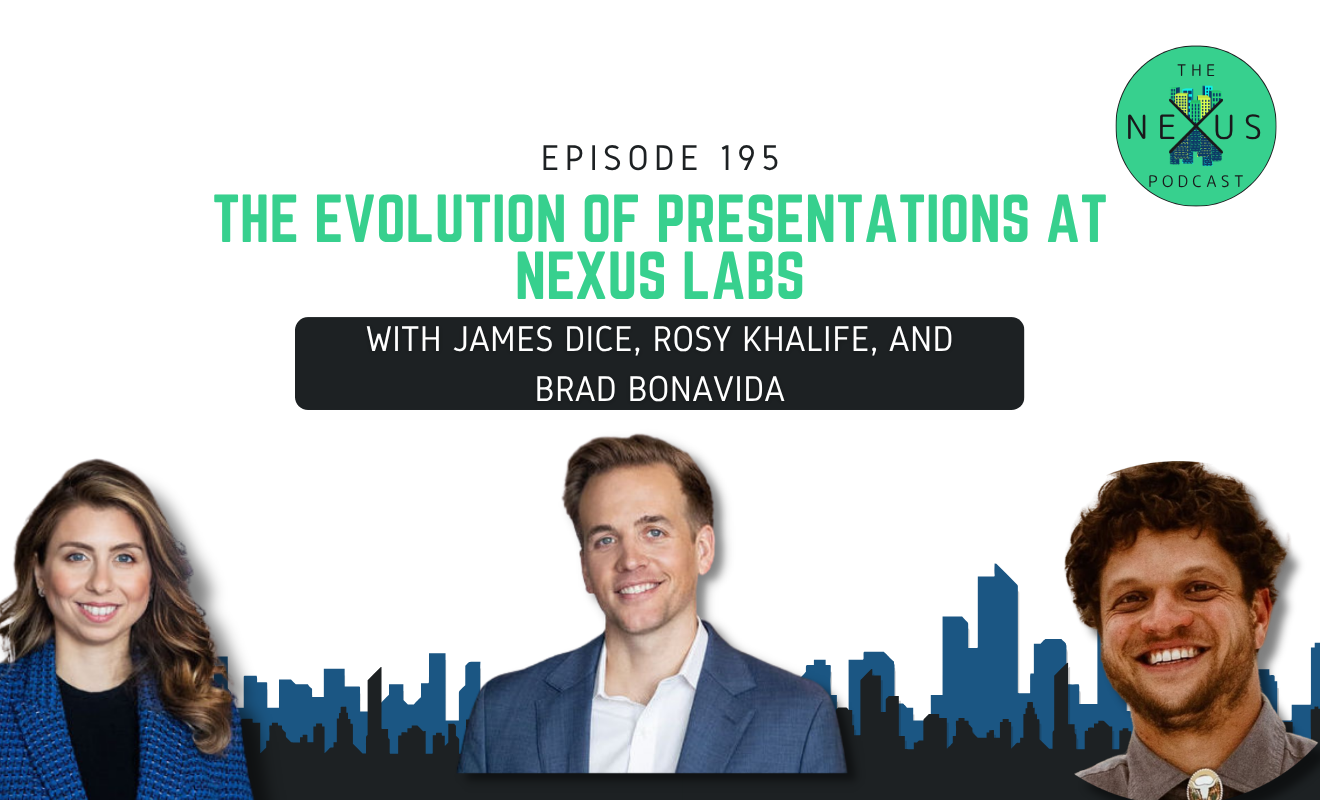
🎧 #195: The Evolution of Presentations at Nexus Labs
Welcome to Nexus Labs, the home for the Connected Buildings Ecosystem—hosted by James Dice. If you’re new to Nexus Labs, sign up for our Connected Buildings Briefing, a 5-minute briefing on the people, tools, and playbooks changing how buildings run. Delivered every two weeks to 8,000+ building professionals.
The Nexus podcast (Apple | Spotify | YouTube | Other apps) is our chance to explore and learn with the brightest minds in the industry.
Nexus Labs runs an annual conference, NexusCon, and a quarterly virtual conference series, NexusCast.
Episode 195 is a conversation with James Dice, Rosy Khalife, and Brad Bonavida from Nexus Labs.
Summary
This episode breaks down how Nexus Labs transformed its events from story-driven case studies into highly actionable learning experiences. After realizing that even great owner stories often lacked “how-to” value, the team shifted toward structured playbooks and “playbook accelerators” that focus on solving real, repeatable challenges. The result is a better balance between building owners and vendors—where owners bring context and vendors contribute scalable expertise. With strict no-sales guardrails, every session is designed to teach practical, product-agnostic insights attendees can actually use. It’s a behind-the-scenes look at how Nexus Labs is redefining what a truly valuable conference experience should be.
Mentions and Links
- Want to watch the NexusCon 2025 recordings? Become a Nexus Pro Member
- NexusCon 2026 Abstract Application (Due May 1)
- Nexuscast Event Page
Highlights
Introduction (0:00)
Phase 1: The Early Days (2:15)
Phase 2: Owners-first at NexusCon 2025 (4:45)
The Playbook & “Playbook Accelerators” (9:57)
Guardrails: No Sales Pitches, Ever (17:35)
Where We’re Going Next (26:12)
Sign Off (26:45)
Music credits: There Is A Reality by Common Tiger—licensed under an Music Vine Limited Pro Standard License ID: S791938-16073.
Full transcript
Note: transcript was created using an imperfect machine learning tool and lightly edited by a human (so you can get the gist). Please forgive errors!
Brad Bonavida: [00:00:00] All right. Hello friends. Welcome back to the Nexus podcast. This is where we talked about what, talk about connected buildings and the playbooks that are behind them. Um, this is kind of a special episode. This is not targeted at a single, um, you know, type of building owner. This is targeted at our whole entire community.
Anyone who has attended our events or plans to attend our events in the future. Today we're gonna dig into the evolution of how we at Nexus Labs, choose presentations at our events, how we curate that process. And this matters for all of you because if you've listened to anything that we've produced, we really strive hard to have the most educational presentations possible, and we wanna keep things merit based and we wanna keep things not pay to play.
That's kind of our philosophy. So we're gonna dig into that. Um, a quick note, if you're trying to stay on top of the space and not wade through all the vendor noise. We write a newsletter every week, every, every other week called the Connected Buildings Briefing. If you haven't signed up, please do sign up.
It's right on the front of our [00:01:00] homepage. Uh, it's a five minute breakdown of what's worth paying attention to. We have over 8,000 subscribers who read it. Um, we'll also tag it in the show notes so you can find it there as well. My name is Brad Bonavita. I'm the head of product at Nexus Labs, and I am here with my two coworkers favorite coworkers, James Deis and Rosie, who is back from maternity leave.
Welcome back, Rosie. The audience missed you.
Rosy Khalife: Yes, I bet they did. Hi everyone. Good to be back. I missed my two favorite people as well, and everyone that's listening.
James Dice: All of our, all of our other employees are gonna be so pissed that Yeah,
Rosy Khalife: they're pissed.
James Dice: They weren't named in the favorites.
Brad Bonavida: I know, I know. So we're gonna dive into like just kind of this timeline of how we've always thought about presentations at Nexus Labs, the arc, and where we're at today.
Um, so the call to action, you know, definitely check out Nexus Cast and Nexus Con. Those are our two types of events. We've got these virtual events, a series that happens throughout the year [00:02:00] called Nexus Cast. Those go on different subjects. We have our Condition-based Maintenance Nexus cast coming up on April 15th, so you can register for that.
And then of course, nexus Con is our big in-person event that's happening October 5th through seventh in Detroit this year. So with that, let's get into it. Uh, you guys, you know, I always, I always like preface you guys kind of started this journey before I got involved 'cause you guys knew each other before you started Nexus before I came here.
So I'll leave it to I, James, maybe you start or Rosie jump in if you want. Tell me about like, this arc of, you know, going to events and figuring out what those were like and you know, kind of brainstorming how you wanted our events to be different.
James Dice: Well, I think, I think all good companies get started by complaining, right?
You start, you complain about something that happens in your life and you start a company to fix it. I think from the standpoint of our events, I mean, that's what it was. Rosie and I met at a Smart buildings [00:03:00] conference and either first conversation was complaining about it. I'm pretty sure Rosie.
Brad Bonavida: Yeah.
James Dice: And I, I think in terms of this conversation, we were most likely complaining about how the educational side of the conference was a joke. Like it was an afterthought. And when I say it's a joke, I mean like everyone is there and they've just decided that like half the people don't even go into the session rooms because they're there to network with their, you know.
They're there to chat with their network. They're there to maybe, you know, walk the expo floor sometimes. But it's almost like the, the educational side of the conference at a lot of the conferences in our industry is a little bit of like a charade situation. Like, it's not, they don't really take it seriously.
Like, and, and I think these conferences have sort of taught the attendees that they're not gonna learn anything that they can actually apply. And so they've just over years just. I think people are happy to speak [00:04:00] 'cause it's a fun thing to do and get up on stage and all of that. But it's not necessarily like they're gonna learn anything.
And the standard format right, is a five person panel. Usually about four sponsors that paid to have that speaking slot as part of their sponsor package. And then you throw up a building owner to give some sort of credibility to that panel and you never, like, they just spent 45 minutes like skimming along the surface and never getting into anything.
And so that's the sort of complaining about that is sort of where, why and why and where we started with. Creating our own events.
Brad Bonavida: Yeah, so we've done two Nexus Con. Now Nex Con 2024 was the first, and we did 2025, and I came in and started helping plan at the beginning of that first one. And the message from both of you was like very strong around.
Getting those building owners [00:05:00] onto the stage because there's such a validating factor to the stories that have been told. So anyone who who has applied or talked to us about our events knows how building owner first, we are intentionally because of the validation that that brings to the presentation.
It's not just somebody who's incentive is to, you know, sell something by EXPLO getting on stage, but it's someone who's using this. This processor technology or playbook to, to get something done. So we, we, um, we emphasize heavily on the building owners. We actually had over 80% of our presentations at Nexus Con 2025 were building owner led, which was pretty cool.
James Dice: And we wanted to feel when we set out to design our sessions. We've done a lot of work designing our sessions. Right. Um, we talk a lot about like, what is the perfect session? For creating change in our industry and we, we really wanted at the beginning with Nexus Con and our, all of our events to [00:06:00] feel like the educational side is a peer-to-peer sharing session, like a working session.
Like they all are grouped by their jobs in the different tracks, so they're sitting there with their actual peers. These people are in other organizations, but in the same department as you. Share what you've learned with them and they can share what they've learned with you. And it's, it's like real time feedback from what everyone did in the last year, basically, is the idea.
Brad Bonavida: Yeah. I, I wanna bring up two examples anonymously that came from Nexus Con 2025. So. We have these recordings. If you're a pro member, you can watch all of Nexus Con 2025. But, but we watch 'em too. Like we use this to try to get better and to learn from them. And the two examples that I have is, number one is a case study that was building owner led that, you know, I was really [00:07:00] excited for when the event came, but when I watched that case study, I just realized that.
It was very not applicable to the audience. Like it was kind of cool, but like if you watched that and you were there to learn, you don't really have any takeaways. It was more of like a history lesson and like, oh, that's interesting, but I'm not gonna change the way I operate my buildings on it. And the second one.
Is one, one of the ones that wasn't the 80% building owner led. It was one that was part of the minority, 20%. That was, uh, actually a technology vendor and a service provider up on stage. And I, I as helping build the agenda, I was a little bit concerned, like, hopefully this isn't just a sales pitch. And it was such a beautiful like.
Explanation of how to get over something that everybody faces in their buildings and like everybody in the entire audience has had their hands raised for like follow-ups and stuff. Awesome. So it's a little bit of a head scratcher 'cause it was like, those [00:08:00] are two counter examples to what we um, anticipated.
Rosy Khalife: I feel like if you're listening and you wanna know, 'cause I wanna know what presentation you're talking about as well. I'm not sure which one it is. If you're listening and you wanna know, maybe if you email Brad, he'll, he'll tell you. What do you think, Brad?
Brad Bonavida: Yeah.
James Dice: Yeah. Maybe
Brad Bonavida: I'll, I'll tell him about the positive
Rosy Khalife: one.
Yeah. Pause. Of course. Tell one day course. Definitely.
Brad Bonavida: Yeah.
Rosy Khalife: That's awesome.
James Dice: I, I also had a presentation like, I, I, I first wanna say this is really hard, like, like the three of us worked and do work and we're about to start the work that goes into building the agenda for 2026. It's really, really hard. And Brad, you could talk about all the reasons why it's hard to do the, do this the way we do.
Um. I remember being, you know, sitting in a presentation last year and I was like, I'm, I'm looking around for things I could throw at the speakers because it just didn't match our vibe. I was like, do I throw my chair? Do I go unplug the AV equipment right [00:09:00] now? I was like literally squirming in my chair and I think.
If we started out from just like hating all the presentations at other conferences and then we start, it's really hard to do it a new way and like teach our community how we want it. Right. Brad? And I think if we look at where we were last year, like we're really proud of the overall agenda, but I think.
You know, you and I are the ones that are watching these. We're still like, there's still like a 30% where we like
Brad Bonavida: Yeah.
James Dice: Want to get it to where we're proud of all of the sessions at the con Of course. Or the
Brad Bonavida: presentation
James Dice: conference.
Brad Bonavida: Perfectly set. Yeah. Like very proud. But there's some humility, like we wanna continue to do better and we're acknowledging the ways that we can, which I, I think is a good transition into like, how we're thinking about it this year.
Mm-hmm. Um, and that change, so James. Can I put you on the spot? And we, we kind of invented this term. I think you actually, you invented this [00:10:00]term playbook, accelerators. Like could you just kind of,
Rosy Khalife: we're a
Brad Bonavida: team Brad. We all invented it. Playbook accelerators. His
Rosy Khalife: brain is our brain. It's okay.
James Dice: Yeah. I mean this, you know, we've had so many conversations.
It starts by like. Being there in person and saying like, well, what's off about this? Like, it's a little bit off and, and then you watch a, a perfect presentation like you said, and you're like, well, how, what, what are the differences between these two things? And I think it really goes back to sort of removing the stuff that is nice as a story, but it's not necessarily actionable.
Like we don't like. I think Brad, you, you like to talk about this, like there's, there's a lot of presentations that happen where they're like, here's our 15 year journey from, you know, 2012 to today. And it's like, okay, that's interesting, but like, how is someone supposed to take that and do something with it?
And so, cutting that, like [00:11:00] a lot of case studies, people think that they need to tell this really long story and that's not necessarily true. Um. So, so that's it. And then the, the next stage I would say is like zeroing in on the operational transformation that a building owner needs to go through in order to run their buildings differently.
That's actually the, the concept of this playbook. I'm running this playbook so I can take our buildings from the way that we used to run them to this new way of running them. That uses the technology, but it's not necessarily focused on the technology at all. It's an operational change, and so that's what we call this playbook.
Then when you go on that operational change journey, you are going to run up against the same obstacles as everyone else is running up against. And that's where the obstacle comes in. And in order to accelerate that playbook, we're asking people to teach how to overcome that obstacle, which [00:12:00] is the playbook Acceler.
So our vision would be you come to Nexus Con or you come to Nexus Cast and you're getting a quick overview of the transformation, the playbook that everyone's working on, right? But you're really hit with detailed presentations around these accelerators so that when you hit those obstacles. In your buildings, you then have this, um, very detailed explanation from somebody who's done that in the past, and you don't need to make the mistakes they made, you just follow this, this teaching and like, that's how we believe the industry will accelerate faster.
And I, I really, my vision would be that we stop sort of. We hold our educational sessions at our conferences and in way more higher regard, we have higher expectations of them to actually be used in the buildings when people go back home.
Brad Bonavida: Yeah. So one, I will give a real [00:13:00] concrete example of that from Nexus Con 2025.
So, uh, throughout reviewing these, we were, we were looking at one of the presentations from the LinkedIn team, and they were talking about their FDD rollout there. So in the case of their FDD rollout, we, you know, that FDD is a tool in condition-based maintenance, which we talked about for two and a half hours in our last podcast.
So the playbook was condition-based maintenance and how LinkedIn was, um, you know, incorporating that playbook into their buildings. But one portion of that presentation. The LinkedIn team really dove into how this, there was this obstacle that all of their contractors didn't do contracting that was based on condition-based maintenance.
So they had to rewrite all their contracts and renegotiate them with all their external service providers so that they had KPIs, like proactive work order completion, and comfort scores. So I'm just bringing that out as an example of a playbook accelerator. You've got a playbook, condition-based maintenance.
You've [00:14:00] got this obstacle. That your, uh, external service contractors don't wanna operate with your condition based maintenance. It doesn't work with the contract you have with them. So here's how LinkedIn got around that obstacle in a way that, you know, you also could as a building owner. So we're really trying to hone in on like very specific teachings like that, getting people to those within our, uh, within our presentations.
James Dice: And the idea here would be like, I think everyone's experienced this thing where they go to a conference and the same stuff is said over and over again. We hear that a lot. Like, um, we don't need to get into examples 'cause I don't wanna call anyone out, but we don't need to rehash what the playbook is or what a specific technology is or why we need to converge network.
So our idea is all these events start building on themselves. And so these playbooks and all the playbook accelerators. Formal library on our website that people can go back and find basically the roadmap to smarter, more connected buildings. And then our events become the way [00:15:00] that we start te stacking on top of that existing library.
Um,
Brad Bonavida: yep. So logistically how that's gonna work in our events, nexus Cast and Nexus Con is that. We are focused on a specific playbook. In terms of Nexus cast, it's usually about one playbook. At Nexus Con, it's gonna be about like 16 plus playbooks, and the session will start with that context building of like everything you need to know and understand about the playbook, the technologies involved.
What, what are the definitions, what are the key words? Why do people run the playbook? Like all of that upfront context. Then it's followed by these accelerators where people are teaching you about those obstacles that they got over. So you get the context upfront and then you get, call it two to five lessons about like, hi, I ran into this exact problem and here's how I operationalize to work around to make it happen.
And you can do the same
James Dice: E. All of these playbooks require technology to enable them, right? And so when you're at our events, you know that there will be [00:16:00]technology vendors that enable these playbooks on the demo stage. Throughout the whole event, and then you can go talk to 'em and put at their booths. So we have operational playbooks that are enabled by technology, technology vendors on the demo stage.
Show how they enable those playbooks. And then if you want to go talk further to them, your, their booth is there for you to go get a detailed demo nerd out with them at their booth.
Rosy Khalife: So in terms of folks that are listening to us, I want us to summarize it for them. Like what does this mean for them? Like if I am a technology vendor, what does this now, what is now unlocked for me?
Question mark. And then what does it look like for building owners and service providers?
Brad Bonavida: Yeah, well, I mean we were talking about this a little bit before we started recording, but it's a hierarchy and I think the elephant in the room is like you can get on stage without a building on. That's not an absolute requirement.
Rosy Khalife: Wow. It's a big deal guys. This is a change for us.
Brad Bonavida: The, the fir, the first [00:17:00] piece in the hierarchy is that teaching that we're talking about, that accelerator like an obstacle that you are teaching someone to get around you. You, you've operationalized and you've seen it operationalized. This is how you do it Now, right next to that is.
Building owner led or building owner supported because that validation of like a customer or an end user talking about that obstacle is extremely powerful and still stands, but it's really about that teaching being at the core. And, and sometimes, you know, technology vendors and service providers have seen this enough and they can teach, but we're not gonna let it be a sales pitch.
No way. Still, still gonna avoid that. Um. I think if you're like trying to figure out how to give a playbook accelerator, uh, as a technology vendor service provider, ask yourself is what you're teaching agnostic to your product. Like, it has to be able to apply even if someone isn't using your product, if they have to use your product, [00:18:00] it's, this is becoming a sales pitch.
Um, or you're, you know, maybe it's good, good, uh, content for the demo stage. 'cause you're describing this new feature that you have that no one else has. If you're teaching somebody, it, it can't just apply to your product and service. It has to be applicable to anybody who is running into these, you know, same problems, running a playbook.
Agree.
Rosy Khalife: Totally.
Brad Bonavida: The, the, the silence. No, I mean, that was really well said, Brad. Okay, good. Um, what else? Uh, no,
James Dice: Brad, tell everyone what you're looking for from them because they, by the time this comes out, they have a few weeks to submit their abstracts. Yeah.
Brad Bonavida: And where can
Rosy Khalife: they go to submit it? Like what? What do I do?
Brad Bonavida: Right, right. So there's, there's, we have all the, you know, we talked about virtual events and in-person events there's always nexus cast applications out there where you can submit to our virtual events. You can find those under our events on our, uh, homepage and got to any of the Nexus cast events. But you guys are talking about Nexus Khan, our in-person, uh, event, you know, the big [00:19:00] annual conference.
Uh, we have the, the deadline for submitting to speak at Nexus Con is Friday, May 1st. So you have like exactly a month from when we're recording this to submit. And within that application, you can, you know, you can tell us about the playbook that you're trying to teach on, but you'll see within the application that it's like, what is the very specific obstacle within a playbook that you're addressing?
What are you teaching people about how to get around that obstacle? So it's not like, here's the case study of this giant portfolio of buildings and this story and you know, everything that's happened. No, no, no. Zoom weigh in and imagine that your audience is going to have all the context they need to understand what condition-based maintenance or advanced supervisory control or device, uh, inventory management is.
They're gonna know that and you're gonna say, okay, everyone in the room's caught up. Now you can run into this [00:20:00] problem I have, or my customer has, or you know, I've seen this happen a bunch of times and this is exactly how you can get around that. And, and the more specific you are about what you're gonna teach by far, the more likely it is that you're gonna find yourself on stage.
Rosy Khalife: Amazing.
James Dice: Can you give one example from our next Nexus cast of what, what people are teaching?
Brad Bonavida: Yeah. Um, there's lots of examples. One that I will bring up is. So it's condition-based maintenance. I feel like I've said that last months. You have like, like if this was a drinking
Rosy Khalife: game podcast, we would've had a couple shots by now.
Brad Bonavida: Um, mapped. Mapped is gonna be on stage Jose De Castro, who is the chief Technology Officer at Mapped, and he's going to be very specifically teaching how you could have. Smart restrooms. So iot sensors in your restrooms that are sensing all sorts of things that can happen in a restroom and how you can integrate that smart restroom data into your CMMS [00:21:00]so that you get actionable workflows out of it.
So we're very, very zoomed in. We're not talking about like. And IDL overall and how you incorporate that. We're not talking about how you implement IOT sensors across your building. We're talking about if you're trying to get, uh, sensors in your bathroom and utilize that data in your workflow, this is exactly the ways that you can connect that effectively and what to watch out for.
So very much zoomed in.
James Dice: And the obstacle is you have data over here and then you have your, your, all of your work orders over here. How do you take that data and, and do something that creates work orders?
Brad Bonavida: I feel like there's, oh, I, I have, so I have one question. I'm gonna put you guys on the spot really quick.
Okay. To maybe wrap this up. So I was just talking actually with a, um, technology vendor yesterday who is going to be doing, you know, a presentation and I was telling 'em this idea of the playbook, accelerators, and really honing in like, you can't do a sales pitch or we're gonna, you know, kick you off stage.
And they were asking, [00:22:00] you know. About slides versus, uh, screen share of a platform, which I actually think is interesting given this new concept that we're bringing because they know that at Nexus Labs events, we like real demos. We wanna see the real thing live in person. That's happening. But if you're a technology vendor service provider on the stage and you're sharing a live platform, how do you make that technology or service agnostic when you're showing your own platform, but you're trying to teach a playbook accelerator, right?
Like you're trying to show how someone can operationalize this, but you have to be very thoughtful in how you pull that apart from demonstrating your products. Any, any thoughts on that?
Rosy Khalife: I think it's definitely possible. We definitely wanna lean in the, the vibe of leaning towards action. Like showing a platform is the ultimate action, right?
Like this is how you actually do it. And so I think that those vendors. Can definitely show their platform and just have to think of the way that they're speaking. This [00:23:00] isn't when they're showing their platform to do a sales demo. They're showing their platform to just show the breadth of the, the technology and how it's being utilized.
So yeah, they gotta be thoughtful 'cause we are gonna kick them off stage. That's a real thing, guys. Not, I don't know how we're gonna do it in person 'cause that seems a little intense, but through Nexus cast, it's really easy. It's like, poof.
James Dice: Tomatoes,
Rosy Khalife: that's easy.
James Dice: We're gonna throw tomatoes.
Rosy Khalife: I love the audience's input on this.
So let me just tell, this is like a sidebar, but basically what we're saying is if you are up on stage and you get really salesy, everyone's annoyed in the audience, right? Like no one wants, that's not, that's not the right forum.
James Dice: Everyone's supposed to like fidget.
Rosy Khalife: Yeah.
James Dice: And they look at us, look
Rosy Khalife: at us to give us dirty looks,
James Dice: do this
Rosy Khalife: and that.
Nothing is wrong with that in that. If you were at your booth doing that, that's awesome. And if you were on the demo stage showing us your new features, also not being salesy, but like showing us your new features and your platforms and whatever. That's really cool. Not in a session, like there's a place for everything anyways, so you're in a session that's happening, what [00:24:00] do we do?
That's been our, a big question for us because we have, uh, moderators and we try to empower them.
James Dice: We need clear rules and we need to like onboard everyone into the events. I
Rosy Khalife: think all the attendees will have the power.
James Dice: Yeah. All the
Rosy Khalife: attendees. Yeah. Whatever this thing is. Yeah. So we're,
James Dice: well, we haven't gotten to the point where it's like, I think every, like people that have been with us for five years know when someone's off the vibes.
Yeah, yeah, right.
Rosy Khalife: Totally.
James Dice: But we haven't, the community has grown and changed and it's like, how do we make it so that. Everybody knows the vibes.
Rosy Khalife: Mm-hmm.
James Dice: They don't just come in, be salesy, you know, and
Rosy Khalife: think it'll just
James Dice: pass. So I, the clear rules and the first, I think the first time we, we kick someone off stage that will start to change things.
Rosy Khalife: Totally. You know, who does this really well and maybe I put this on him to figure out how to teach others. Um, Andrew Rogers from Ace IOT, he was part of our last Nexus cast, and when he was doing his demo, I just felt [00:25:00] like it was so collaborative and, you know. Nothing about it was salesy. It was like, I actually learned something even through his demo and it was just awesome.
So shout out to him. Uh, and maybe we can put this on him.
James Dice: Well, I think as far as the, like, pulling up a live platform in your session, I think makes sense as long as it's in context of the workflow transformation that needs to happen, right? Like if, if showing the platform helps people understand and make it more real.
Um, that you did this thing that then enables the work orders to, like, if that helps show the workflow transformation and show the acceleration, then yeah. But is it a full demo? I remember in the Nexus Con 2024, someone like turned their case study. I'm using air quotes here into a full demo, and we're sitting there like, I'm gonna murder you.
You know what
Rosy Khalife: I mean? I just sighed without even noticing because i's still there. Like I can, I, I'm like [00:26:00] brought back to that moment.
Brad Bonavida: You can feel it.
Rosy Khalife: Yeah.
Brad Bonavida: You can feel
Rosy Khalife: it. And then we were like, Brad,
Brad Bonavida: so
Rosy Khalife: did you approve this? And Brad was like, no,
Brad Bonavida: that's the worst, right? Because like I, things sneak through where I, you know, we really think we know what's gonna happen on stage and then something else happens on stage.
But anytime anyway, step one, if you wanna speak at Nexus, gone is you have to submit an application, which we'll put in the show notes as well, or else you're never gonna have an opportunity. Step two is you better be teaching something that if we haven't made that clear in the last 20 minutes, I don't know how we could.
Step three, building owners are still like the, the, the top of the hierarchy. If you're there and you're the end user, you're the customer. It's just such validation that's still real, but we're just leaning even further into the teaching aspect of that over, um, you know, case studies and other, other nonsense.
Love it.
Rosy Khalife: Okay. Carve out,
Brad Bonavida: uh, car You're it. Haha. Okay. It's fine. I, I have one already thought of. Um. I, I am my, my friends always make fun of me 'cause I'm kind of into like ex [00:27:00] obscure sports and competitions. 'cause I'm not good at like normal sports and competitions. So the last two weeks I have been, I have.
Last week I did the gun barrel challenge, which is at, uh, my local ski resort, monarch and gun barrel's, like the steepest run. And it was closing day and you have to run up the run. And then skier snowboard down and I got fifth place out of like seven. Wow,
Rosy Khalife: that's good. Uh,
Brad Bonavida: people. So I was feeling good. And this coming weekend is the Imperial Challenge, which is kind of the same thing, but at Breckenridge, which is like way bigger.
So you start in town and you have to bike. Six miles up to the base of the ski resort. And then you have to skin from the base of the ski resort to the top, which is 13,000 feet. It's like 4,000 tiade. And then
Rosy Khalife: what shoes
Brad Bonavida: do you wear? You know, ski, snowboard back down, like
Rosy Khalife: snow boots,
Brad Bonavida: snowboard boots, snow boots.
So I've got my, my snowboard splits into skis, and then I walk up the mountain on my snowboard of skis, and then I get to the top and put the snowboard back together and snowboard down. And it's
Rosy Khalife: hard,
Brad Bonavida: like
Rosy Khalife: you could slip. [00:28:00]
Brad Bonavida: Well, you're slipping the whole time. I mean, it's snow, it's continuous slip.
Rosy Khalife: It's so intense.
Rod.
James Dice: It's funny because snowboard boots are easier to go up uphill on than ski Correct. Ski boots. But then ski boots are easier to get in your skis and then go back down. So it's like a
Brad Bonavida: That's exactly right. Yeah. I think that was key for the gun barrel is like a lot of snowboarders did. Well 'cause if you're like, it's that one you're just running in your boots, like it's a lot easier to run in snowboard boots than skis.
But anyway, that's my obscure sports. That's so cool. Brad. Competitions I'm doing,
Rosy Khalife: I love that.
Brad Bonavida: Cool. But Rosie, now it's your turn.
Rosy Khalife: Oh motherfucker. Alright. My turn. Um, so I have so much exciting things happening for me. Um, what is my, I don't know guys, it's hard. Okay, let me tell you what I've been into lately.
I bought, um, I bought clay Air, air dry clay. I know it sounds hilarious, like modeling clay. And it is so cool to make things that then get, like, become a real figurine. And so I've been making [00:29:00] these little, um, olives that I'm gonna put on like a, like a, like a dish. I'm making artwork basically. I've, I've been tapping into my creative side.
Um, and it's really easy and it's super. You could take it anywhere and do it. It's almost the, a version of coloring books kind of for adults. Uh, so that's what I've been into these days.
Brad Bonavida: So that like goes on like a serving dish
Rosy Khalife: or something, like that's what I'm doing. But you can make anything that it's just clay that then air dries basically.
So it's really easy. It's like Play-Doh for adults, basically.
Brad Bonavida: Cool.
Rosy Khalife: Random.
James Dice: Um, I'm reading a book called If Anyone Builds It, everyone Dies. Oh, it's about AI and it's. It's a basically a prediction that if we build superhuman AI or super intelligent ai, then it will kill us as a species. Very dark,
Brad Bonavida: especially considering how much we're incorporating AI into our business on a daily basis.
James Dice: It's an interesting read, like to spend all [00:30:00] day, like we're, we're very heavily integrating AI into everything we do and at then, then to read that before bed at like, it's not easy to sleep after you read that. 'cause we're being pulled in almost like we have to be pulled in. But then it's like, well, I don't want it.
I don't wanna be pulled in so much that it goes all the way to what this book is describing, so,
Rosy Khalife: wow.
James Dice: It's a weird, weird time we're in.
Rosy Khalife: Do you read that before bed? I hope not
James Dice: Sometimes. Yeah.
Rosy Khalife: Okay. Okay. Got it.
Brad Bonavida: There you have it.
James Dice: There you have it.
Brad Bonavida: Running uphill Clay, olives and horror AI books. Those are your, those are your three carve outs.
Okay. Thank you everyone for listening, and we'll see you next time. Yes.
James Dice: Bye everyone. Thank you.
Rosy Khalife: Okay, friends. Thank you for listening to this episode. As we continue to grow our global community of change makers, we need your help. For the next couple of months, we're challenging our listeners to share a link to their favorite Nexus episode on [00:31:00] LinkedIn with a short post about why you listen. It would really, really help us out.
Make sure to tag us in the post so we can see it. Have a good one.
Welcome to Nexus Labs, the home for the Connected Buildings Ecosystem—hosted by James Dice. If you’re new to Nexus Labs, sign up for our Connected Buildings Briefing, a 5-minute briefing on the people, tools, and playbooks changing how buildings run. Delivered every two weeks to 8,000+ building professionals.
The Nexus podcast (Apple | Spotify | YouTube | Other apps) is our chance to explore and learn with the brightest minds in the industry.
Nexus Labs runs an annual conference, NexusCon, and a quarterly virtual conference series, NexusCast.
Episode 195 is a conversation with James Dice, Rosy Khalife, and Brad Bonavida from Nexus Labs.
Summary
This episode breaks down how Nexus Labs transformed its events from story-driven case studies into highly actionable learning experiences. After realizing that even great owner stories often lacked “how-to” value, the team shifted toward structured playbooks and “playbook accelerators” that focus on solving real, repeatable challenges. The result is a better balance between building owners and vendors—where owners bring context and vendors contribute scalable expertise. With strict no-sales guardrails, every session is designed to teach practical, product-agnostic insights attendees can actually use. It’s a behind-the-scenes look at how Nexus Labs is redefining what a truly valuable conference experience should be.
Mentions and Links
- Want to watch the NexusCon 2025 recordings? Become a Nexus Pro Member
- NexusCon 2026 Abstract Application (Due May 1)
- Nexuscast Event Page
Highlights
Introduction (0:00)
Phase 1: The Early Days (2:15)
Phase 2: Owners-first at NexusCon 2025 (4:45)
The Playbook & “Playbook Accelerators” (9:57)
Guardrails: No Sales Pitches, Ever (17:35)
Where We’re Going Next (26:12)
Sign Off (26:45)
Music credits: There Is A Reality by Common Tiger—licensed under an Music Vine Limited Pro Standard License ID: S791938-16073.
Full transcript
Note: transcript was created using an imperfect machine learning tool and lightly edited by a human (so you can get the gist). Please forgive errors!
Brad Bonavida: [00:00:00] All right. Hello friends. Welcome back to the Nexus podcast. This is where we talked about what, talk about connected buildings and the playbooks that are behind them. Um, this is kind of a special episode. This is not targeted at a single, um, you know, type of building owner. This is targeted at our whole entire community.
Anyone who has attended our events or plans to attend our events in the future. Today we're gonna dig into the evolution of how we at Nexus Labs, choose presentations at our events, how we curate that process. And this matters for all of you because if you've listened to anything that we've produced, we really strive hard to have the most educational presentations possible, and we wanna keep things merit based and we wanna keep things not pay to play.
That's kind of our philosophy. So we're gonna dig into that. Um, a quick note, if you're trying to stay on top of the space and not wade through all the vendor noise. We write a newsletter every week, every, every other week called the Connected Buildings Briefing. If you haven't signed up, please do sign up.
It's right on the front of our [00:01:00] homepage. Uh, it's a five minute breakdown of what's worth paying attention to. We have over 8,000 subscribers who read it. Um, we'll also tag it in the show notes so you can find it there as well. My name is Brad Bonavita. I'm the head of product at Nexus Labs, and I am here with my two coworkers favorite coworkers, James Deis and Rosie, who is back from maternity leave.
Welcome back, Rosie. The audience missed you.
Rosy Khalife: Yes, I bet they did. Hi everyone. Good to be back. I missed my two favorite people as well, and everyone that's listening.
James Dice: All of our, all of our other employees are gonna be so pissed that Yeah,
Rosy Khalife: they're pissed.
James Dice: They weren't named in the favorites.
Brad Bonavida: I know, I know. So we're gonna dive into like just kind of this timeline of how we've always thought about presentations at Nexus Labs, the arc, and where we're at today.
Um, so the call to action, you know, definitely check out Nexus Cast and Nexus Con. Those are our two types of events. We've got these virtual events, a series that happens throughout the year [00:02:00] called Nexus Cast. Those go on different subjects. We have our Condition-based Maintenance Nexus cast coming up on April 15th, so you can register for that.
And then of course, nexus Con is our big in-person event that's happening October 5th through seventh in Detroit this year. So with that, let's get into it. Uh, you guys, you know, I always, I always like preface you guys kind of started this journey before I got involved 'cause you guys knew each other before you started Nexus before I came here.
So I'll leave it to I, James, maybe you start or Rosie jump in if you want. Tell me about like, this arc of, you know, going to events and figuring out what those were like and you know, kind of brainstorming how you wanted our events to be different.
James Dice: Well, I think, I think all good companies get started by complaining, right?
You start, you complain about something that happens in your life and you start a company to fix it. I think from the standpoint of our events, I mean, that's what it was. Rosie and I met at a Smart buildings [00:03:00] conference and either first conversation was complaining about it. I'm pretty sure Rosie.
Brad Bonavida: Yeah.
James Dice: And I, I think in terms of this conversation, we were most likely complaining about how the educational side of the conference was a joke. Like it was an afterthought. And when I say it's a joke, I mean like everyone is there and they've just decided that like half the people don't even go into the session rooms because they're there to network with their, you know.
They're there to chat with their network. They're there to maybe, you know, walk the expo floor sometimes. But it's almost like the, the educational side of the conference at a lot of the conferences in our industry is a little bit of like a charade situation. Like, it's not, they don't really take it seriously.
Like, and, and I think these conferences have sort of taught the attendees that they're not gonna learn anything that they can actually apply. And so they've just over years just. I think people are happy to speak [00:04:00] 'cause it's a fun thing to do and get up on stage and all of that. But it's not necessarily like they're gonna learn anything.
And the standard format right, is a five person panel. Usually about four sponsors that paid to have that speaking slot as part of their sponsor package. And then you throw up a building owner to give some sort of credibility to that panel and you never, like, they just spent 45 minutes like skimming along the surface and never getting into anything.
And so that's the sort of complaining about that is sort of where, why and why and where we started with. Creating our own events.
Brad Bonavida: Yeah, so we've done two Nexus Con. Now Nex Con 2024 was the first, and we did 2025, and I came in and started helping plan at the beginning of that first one. And the message from both of you was like very strong around.
Getting those building owners [00:05:00] onto the stage because there's such a validating factor to the stories that have been told. So anyone who who has applied or talked to us about our events knows how building owner first, we are intentionally because of the validation that that brings to the presentation.
It's not just somebody who's incentive is to, you know, sell something by EXPLO getting on stage, but it's someone who's using this. This processor technology or playbook to, to get something done. So we, we, um, we emphasize heavily on the building owners. We actually had over 80% of our presentations at Nexus Con 2025 were building owner led, which was pretty cool.
James Dice: And we wanted to feel when we set out to design our sessions. We've done a lot of work designing our sessions. Right. Um, we talk a lot about like, what is the perfect session? For creating change in our industry and we, we really wanted at the beginning with Nexus Con and our, all of our events to [00:06:00] feel like the educational side is a peer-to-peer sharing session, like a working session.
Like they all are grouped by their jobs in the different tracks, so they're sitting there with their actual peers. These people are in other organizations, but in the same department as you. Share what you've learned with them and they can share what they've learned with you. And it's, it's like real time feedback from what everyone did in the last year, basically, is the idea.
Brad Bonavida: Yeah. I, I wanna bring up two examples anonymously that came from Nexus Con 2025. So. We have these recordings. If you're a pro member, you can watch all of Nexus Con 2025. But, but we watch 'em too. Like we use this to try to get better and to learn from them. And the two examples that I have is, number one is a case study that was building owner led that, you know, I was really [00:07:00] excited for when the event came, but when I watched that case study, I just realized that.
It was very not applicable to the audience. Like it was kind of cool, but like if you watched that and you were there to learn, you don't really have any takeaways. It was more of like a history lesson and like, oh, that's interesting, but I'm not gonna change the way I operate my buildings on it. And the second one.
Is one, one of the ones that wasn't the 80% building owner led. It was one that was part of the minority, 20%. That was, uh, actually a technology vendor and a service provider up on stage. And I, I as helping build the agenda, I was a little bit concerned, like, hopefully this isn't just a sales pitch. And it was such a beautiful like.
Explanation of how to get over something that everybody faces in their buildings and like everybody in the entire audience has had their hands raised for like follow-ups and stuff. Awesome. So it's a little bit of a head scratcher 'cause it was like, those [00:08:00] are two counter examples to what we um, anticipated.
Rosy Khalife: I feel like if you're listening and you wanna know, 'cause I wanna know what presentation you're talking about as well. I'm not sure which one it is. If you're listening and you wanna know, maybe if you email Brad, he'll, he'll tell you. What do you think, Brad?
Brad Bonavida: Yeah.
James Dice: Yeah. Maybe
Brad Bonavida: I'll, I'll tell him about the positive
Rosy Khalife: one.
Yeah. Pause. Of course. Tell one day course. Definitely.
Brad Bonavida: Yeah.
Rosy Khalife: That's awesome.
James Dice: I, I also had a presentation like, I, I, I first wanna say this is really hard, like, like the three of us worked and do work and we're about to start the work that goes into building the agenda for 2026. It's really, really hard. And Brad, you could talk about all the reasons why it's hard to do the, do this the way we do.
Um. I remember being, you know, sitting in a presentation last year and I was like, I'm, I'm looking around for things I could throw at the speakers because it just didn't match our vibe. I was like, do I throw my chair? Do I go unplug the AV equipment right [00:09:00] now? I was like literally squirming in my chair and I think.
If we started out from just like hating all the presentations at other conferences and then we start, it's really hard to do it a new way and like teach our community how we want it. Right. Brad? And I think if we look at where we were last year, like we're really proud of the overall agenda, but I think.
You know, you and I are the ones that are watching these. We're still like, there's still like a 30% where we like
Brad Bonavida: Yeah.
James Dice: Want to get it to where we're proud of all of the sessions at the con Of course. Or the
Brad Bonavida: presentation
James Dice: conference.
Brad Bonavida: Perfectly set. Yeah. Like very proud. But there's some humility, like we wanna continue to do better and we're acknowledging the ways that we can, which I, I think is a good transition into like, how we're thinking about it this year.
Mm-hmm. Um, and that change, so James. Can I put you on the spot? And we, we kind of invented this term. I think you actually, you invented this [00:10:00]term playbook, accelerators. Like could you just kind of,
Rosy Khalife: we're a
Brad Bonavida: team Brad. We all invented it. Playbook accelerators. His
Rosy Khalife: brain is our brain. It's okay.
James Dice: Yeah. I mean this, you know, we've had so many conversations.
It starts by like. Being there in person and saying like, well, what's off about this? Like, it's a little bit off and, and then you watch a, a perfect presentation like you said, and you're like, well, how, what, what are the differences between these two things? And I think it really goes back to sort of removing the stuff that is nice as a story, but it's not necessarily actionable.
Like we don't like. I think Brad, you, you like to talk about this, like there's, there's a lot of presentations that happen where they're like, here's our 15 year journey from, you know, 2012 to today. And it's like, okay, that's interesting, but like, how is someone supposed to take that and do something with it?
And so, cutting that, like [00:11:00] a lot of case studies, people think that they need to tell this really long story and that's not necessarily true. Um. So, so that's it. And then the, the next stage I would say is like zeroing in on the operational transformation that a building owner needs to go through in order to run their buildings differently.
That's actually the, the concept of this playbook. I'm running this playbook so I can take our buildings from the way that we used to run them to this new way of running them. That uses the technology, but it's not necessarily focused on the technology at all. It's an operational change, and so that's what we call this playbook.
Then when you go on that operational change journey, you are going to run up against the same obstacles as everyone else is running up against. And that's where the obstacle comes in. And in order to accelerate that playbook, we're asking people to teach how to overcome that obstacle, which [00:12:00] is the playbook Acceler.
So our vision would be you come to Nexus Con or you come to Nexus Cast and you're getting a quick overview of the transformation, the playbook that everyone's working on, right? But you're really hit with detailed presentations around these accelerators so that when you hit those obstacles. In your buildings, you then have this, um, very detailed explanation from somebody who's done that in the past, and you don't need to make the mistakes they made, you just follow this, this teaching and like, that's how we believe the industry will accelerate faster.
And I, I really, my vision would be that we stop sort of. We hold our educational sessions at our conferences and in way more higher regard, we have higher expectations of them to actually be used in the buildings when people go back home.
Brad Bonavida: Yeah. So one, I will give a real [00:13:00] concrete example of that from Nexus Con 2025.
So, uh, throughout reviewing these, we were, we were looking at one of the presentations from the LinkedIn team, and they were talking about their FDD rollout there. So in the case of their FDD rollout, we, you know, that FDD is a tool in condition-based maintenance, which we talked about for two and a half hours in our last podcast.
So the playbook was condition-based maintenance and how LinkedIn was, um, you know, incorporating that playbook into their buildings. But one portion of that presentation. The LinkedIn team really dove into how this, there was this obstacle that all of their contractors didn't do contracting that was based on condition-based maintenance.
So they had to rewrite all their contracts and renegotiate them with all their external service providers so that they had KPIs, like proactive work order completion, and comfort scores. So I'm just bringing that out as an example of a playbook accelerator. You've got a playbook, condition-based maintenance.
You've [00:14:00] got this obstacle. That your, uh, external service contractors don't wanna operate with your condition based maintenance. It doesn't work with the contract you have with them. So here's how LinkedIn got around that obstacle in a way that, you know, you also could as a building owner. So we're really trying to hone in on like very specific teachings like that, getting people to those within our, uh, within our presentations.
James Dice: And the idea here would be like, I think everyone's experienced this thing where they go to a conference and the same stuff is said over and over again. We hear that a lot. Like, um, we don't need to get into examples 'cause I don't wanna call anyone out, but we don't need to rehash what the playbook is or what a specific technology is or why we need to converge network.
So our idea is all these events start building on themselves. And so these playbooks and all the playbook accelerators. Formal library on our website that people can go back and find basically the roadmap to smarter, more connected buildings. And then our events become the way [00:15:00] that we start te stacking on top of that existing library.
Um,
Brad Bonavida: yep. So logistically how that's gonna work in our events, nexus Cast and Nexus Con is that. We are focused on a specific playbook. In terms of Nexus cast, it's usually about one playbook. At Nexus Con, it's gonna be about like 16 plus playbooks, and the session will start with that context building of like everything you need to know and understand about the playbook, the technologies involved.
What, what are the definitions, what are the key words? Why do people run the playbook? Like all of that upfront context. Then it's followed by these accelerators where people are teaching you about those obstacles that they got over. So you get the context upfront and then you get, call it two to five lessons about like, hi, I ran into this exact problem and here's how I operationalize to work around to make it happen.
And you can do the same
James Dice: E. All of these playbooks require technology to enable them, right? And so when you're at our events, you know that there will be [00:16:00]technology vendors that enable these playbooks on the demo stage. Throughout the whole event, and then you can go talk to 'em and put at their booths. So we have operational playbooks that are enabled by technology, technology vendors on the demo stage.
Show how they enable those playbooks. And then if you want to go talk further to them, your, their booth is there for you to go get a detailed demo nerd out with them at their booth.
Rosy Khalife: So in terms of folks that are listening to us, I want us to summarize it for them. Like what does this mean for them? Like if I am a technology vendor, what does this now, what is now unlocked for me?
Question mark. And then what does it look like for building owners and service providers?
Brad Bonavida: Yeah, well, I mean we were talking about this a little bit before we started recording, but it's a hierarchy and I think the elephant in the room is like you can get on stage without a building on. That's not an absolute requirement.
Rosy Khalife: Wow. It's a big deal guys. This is a change for us.
Brad Bonavida: The, the fir, the first [00:17:00] piece in the hierarchy is that teaching that we're talking about, that accelerator like an obstacle that you are teaching someone to get around you. You, you've operationalized and you've seen it operationalized. This is how you do it Now, right next to that is.
Building owner led or building owner supported because that validation of like a customer or an end user talking about that obstacle is extremely powerful and still stands, but it's really about that teaching being at the core. And, and sometimes, you know, technology vendors and service providers have seen this enough and they can teach, but we're not gonna let it be a sales pitch.
No way. Still, still gonna avoid that. Um. I think if you're like trying to figure out how to give a playbook accelerator, uh, as a technology vendor service provider, ask yourself is what you're teaching agnostic to your product. Like, it has to be able to apply even if someone isn't using your product, if they have to use your product, [00:18:00] it's, this is becoming a sales pitch.
Um, or you're, you know, maybe it's good, good, uh, content for the demo stage. 'cause you're describing this new feature that you have that no one else has. If you're teaching somebody, it, it can't just apply to your product and service. It has to be applicable to anybody who is running into these, you know, same problems, running a playbook.
Agree.
Rosy Khalife: Totally.
Brad Bonavida: The, the, the silence. No, I mean, that was really well said, Brad. Okay, good. Um, what else? Uh, no,
James Dice: Brad, tell everyone what you're looking for from them because they, by the time this comes out, they have a few weeks to submit their abstracts. Yeah.
Brad Bonavida: And where can
Rosy Khalife: they go to submit it? Like what? What do I do?
Brad Bonavida: Right, right. So there's, there's, we have all the, you know, we talked about virtual events and in-person events there's always nexus cast applications out there where you can submit to our virtual events. You can find those under our events on our, uh, homepage and got to any of the Nexus cast events. But you guys are talking about Nexus Khan, our in-person, uh, event, you know, the big [00:19:00] annual conference.
Uh, we have the, the deadline for submitting to speak at Nexus Con is Friday, May 1st. So you have like exactly a month from when we're recording this to submit. And within that application, you can, you know, you can tell us about the playbook that you're trying to teach on, but you'll see within the application that it's like, what is the very specific obstacle within a playbook that you're addressing?
What are you teaching people about how to get around that obstacle? So it's not like, here's the case study of this giant portfolio of buildings and this story and you know, everything that's happened. No, no, no. Zoom weigh in and imagine that your audience is going to have all the context they need to understand what condition-based maintenance or advanced supervisory control or device, uh, inventory management is.
They're gonna know that and you're gonna say, okay, everyone in the room's caught up. Now you can run into this [00:20:00] problem I have, or my customer has, or you know, I've seen this happen a bunch of times and this is exactly how you can get around that. And, and the more specific you are about what you're gonna teach by far, the more likely it is that you're gonna find yourself on stage.
Rosy Khalife: Amazing.
James Dice: Can you give one example from our next Nexus cast of what, what people are teaching?
Brad Bonavida: Yeah. Um, there's lots of examples. One that I will bring up is. So it's condition-based maintenance. I feel like I've said that last months. You have like, like if this was a drinking
Rosy Khalife: game podcast, we would've had a couple shots by now.
Brad Bonavida: Um, mapped. Mapped is gonna be on stage Jose De Castro, who is the chief Technology Officer at Mapped, and he's going to be very specifically teaching how you could have. Smart restrooms. So iot sensors in your restrooms that are sensing all sorts of things that can happen in a restroom and how you can integrate that smart restroom data into your CMMS [00:21:00]so that you get actionable workflows out of it.
So we're very, very zoomed in. We're not talking about like. And IDL overall and how you incorporate that. We're not talking about how you implement IOT sensors across your building. We're talking about if you're trying to get, uh, sensors in your bathroom and utilize that data in your workflow, this is exactly the ways that you can connect that effectively and what to watch out for.
So very much zoomed in.
James Dice: And the obstacle is you have data over here and then you have your, your, all of your work orders over here. How do you take that data and, and do something that creates work orders?
Brad Bonavida: I feel like there's, oh, I, I have, so I have one question. I'm gonna put you guys on the spot really quick.
Okay. To maybe wrap this up. So I was just talking actually with a, um, technology vendor yesterday who is going to be doing, you know, a presentation and I was telling 'em this idea of the playbook, accelerators, and really honing in like, you can't do a sales pitch or we're gonna, you know, kick you off stage.
And they were asking, [00:22:00] you know. About slides versus, uh, screen share of a platform, which I actually think is interesting given this new concept that we're bringing because they know that at Nexus Labs events, we like real demos. We wanna see the real thing live in person. That's happening. But if you're a technology vendor service provider on the stage and you're sharing a live platform, how do you make that technology or service agnostic when you're showing your own platform, but you're trying to teach a playbook accelerator, right?
Like you're trying to show how someone can operationalize this, but you have to be very thoughtful in how you pull that apart from demonstrating your products. Any, any thoughts on that?
Rosy Khalife: I think it's definitely possible. We definitely wanna lean in the, the vibe of leaning towards action. Like showing a platform is the ultimate action, right?
Like this is how you actually do it. And so I think that those vendors. Can definitely show their platform and just have to think of the way that they're speaking. This [00:23:00] isn't when they're showing their platform to do a sales demo. They're showing their platform to just show the breadth of the, the technology and how it's being utilized.
So yeah, they gotta be thoughtful 'cause we are gonna kick them off stage. That's a real thing, guys. Not, I don't know how we're gonna do it in person 'cause that seems a little intense, but through Nexus cast, it's really easy. It's like, poof.
James Dice: Tomatoes,
Rosy Khalife: that's easy.
James Dice: We're gonna throw tomatoes.
Rosy Khalife: I love the audience's input on this.
So let me just tell, this is like a sidebar, but basically what we're saying is if you are up on stage and you get really salesy, everyone's annoyed in the audience, right? Like no one wants, that's not, that's not the right forum.
James Dice: Everyone's supposed to like fidget.
Rosy Khalife: Yeah.
James Dice: And they look at us, look
Rosy Khalife: at us to give us dirty looks,
James Dice: do this
Rosy Khalife: and that.
Nothing is wrong with that in that. If you were at your booth doing that, that's awesome. And if you were on the demo stage showing us your new features, also not being salesy, but like showing us your new features and your platforms and whatever. That's really cool. Not in a session, like there's a place for everything anyways, so you're in a session that's happening, what [00:24:00] do we do?
That's been our, a big question for us because we have, uh, moderators and we try to empower them.
James Dice: We need clear rules and we need to like onboard everyone into the events. I
Rosy Khalife: think all the attendees will have the power.
James Dice: Yeah. All the
Rosy Khalife: attendees. Yeah. Whatever this thing is. Yeah. So we're,
James Dice: well, we haven't gotten to the point where it's like, I think every, like people that have been with us for five years know when someone's off the vibes.
Yeah, yeah, right.
Rosy Khalife: Totally.
James Dice: But we haven't, the community has grown and changed and it's like, how do we make it so that. Everybody knows the vibes.
Rosy Khalife: Mm-hmm.
James Dice: They don't just come in, be salesy, you know, and
Rosy Khalife: think it'll just
James Dice: pass. So I, the clear rules and the first, I think the first time we, we kick someone off stage that will start to change things.
Rosy Khalife: Totally. You know, who does this really well and maybe I put this on him to figure out how to teach others. Um, Andrew Rogers from Ace IOT, he was part of our last Nexus cast, and when he was doing his demo, I just felt [00:25:00] like it was so collaborative and, you know. Nothing about it was salesy. It was like, I actually learned something even through his demo and it was just awesome.
So shout out to him. Uh, and maybe we can put this on him.
James Dice: Well, I think as far as the, like, pulling up a live platform in your session, I think makes sense as long as it's in context of the workflow transformation that needs to happen, right? Like if, if showing the platform helps people understand and make it more real.
Um, that you did this thing that then enables the work orders to, like, if that helps show the workflow transformation and show the acceleration, then yeah. But is it a full demo? I remember in the Nexus Con 2024, someone like turned their case study. I'm using air quotes here into a full demo, and we're sitting there like, I'm gonna murder you.
You know what
Rosy Khalife: I mean? I just sighed without even noticing because i's still there. Like I can, I, I'm like [00:26:00] brought back to that moment.
Brad Bonavida: You can feel it.
Rosy Khalife: Yeah.
Brad Bonavida: You can feel
Rosy Khalife: it. And then we were like, Brad,
Brad Bonavida: so
Rosy Khalife: did you approve this? And Brad was like, no,
Brad Bonavida: that's the worst, right? Because like I, things sneak through where I, you know, we really think we know what's gonna happen on stage and then something else happens on stage.
But anytime anyway, step one, if you wanna speak at Nexus, gone is you have to submit an application, which we'll put in the show notes as well, or else you're never gonna have an opportunity. Step two is you better be teaching something that if we haven't made that clear in the last 20 minutes, I don't know how we could.
Step three, building owners are still like the, the, the top of the hierarchy. If you're there and you're the end user, you're the customer. It's just such validation that's still real, but we're just leaning even further into the teaching aspect of that over, um, you know, case studies and other, other nonsense.
Love it.
Rosy Khalife: Okay. Carve out,
Brad Bonavida: uh, car You're it. Haha. Okay. It's fine. I, I have one already thought of. Um. I, I am my, my friends always make fun of me 'cause I'm kind of into like ex [00:27:00] obscure sports and competitions. 'cause I'm not good at like normal sports and competitions. So the last two weeks I have been, I have.
Last week I did the gun barrel challenge, which is at, uh, my local ski resort, monarch and gun barrel's, like the steepest run. And it was closing day and you have to run up the run. And then skier snowboard down and I got fifth place out of like seven. Wow,
Rosy Khalife: that's good. Uh,
Brad Bonavida: people. So I was feeling good. And this coming weekend is the Imperial Challenge, which is kind of the same thing, but at Breckenridge, which is like way bigger.
So you start in town and you have to bike. Six miles up to the base of the ski resort. And then you have to skin from the base of the ski resort to the top, which is 13,000 feet. It's like 4,000 tiade. And then
Rosy Khalife: what shoes
Brad Bonavida: do you wear? You know, ski, snowboard back down, like
Rosy Khalife: snow boots,
Brad Bonavida: snowboard boots, snow boots.
So I've got my, my snowboard splits into skis, and then I walk up the mountain on my snowboard of skis, and then I get to the top and put the snowboard back together and snowboard down. And it's
Rosy Khalife: hard,
Brad Bonavida: like
Rosy Khalife: you could slip. [00:28:00]
Brad Bonavida: Well, you're slipping the whole time. I mean, it's snow, it's continuous slip.
Rosy Khalife: It's so intense.
Rod.
James Dice: It's funny because snowboard boots are easier to go up uphill on than ski Correct. Ski boots. But then ski boots are easier to get in your skis and then go back down. So it's like a
Brad Bonavida: That's exactly right. Yeah. I think that was key for the gun barrel is like a lot of snowboarders did. Well 'cause if you're like, it's that one you're just running in your boots, like it's a lot easier to run in snowboard boots than skis.
But anyway, that's my obscure sports. That's so cool. Brad. Competitions I'm doing,
Rosy Khalife: I love that.
Brad Bonavida: Cool. But Rosie, now it's your turn.
Rosy Khalife: Oh motherfucker. Alright. My turn. Um, so I have so much exciting things happening for me. Um, what is my, I don't know guys, it's hard. Okay, let me tell you what I've been into lately.
I bought, um, I bought clay Air, air dry clay. I know it sounds hilarious, like modeling clay. And it is so cool to make things that then get, like, become a real figurine. And so I've been making [00:29:00] these little, um, olives that I'm gonna put on like a, like a, like a dish. I'm making artwork basically. I've, I've been tapping into my creative side.
Um, and it's really easy and it's super. You could take it anywhere and do it. It's almost the, a version of coloring books kind of for adults. Uh, so that's what I've been into these days.
Brad Bonavida: So that like goes on like a serving dish
Rosy Khalife: or something, like that's what I'm doing. But you can make anything that it's just clay that then air dries basically.
So it's really easy. It's like Play-Doh for adults, basically.
Brad Bonavida: Cool.
Rosy Khalife: Random.
James Dice: Um, I'm reading a book called If Anyone Builds It, everyone Dies. Oh, it's about AI and it's. It's a basically a prediction that if we build superhuman AI or super intelligent ai, then it will kill us as a species. Very dark,
Brad Bonavida: especially considering how much we're incorporating AI into our business on a daily basis.
James Dice: It's an interesting read, like to spend all [00:30:00] day, like we're, we're very heavily integrating AI into everything we do and at then, then to read that before bed at like, it's not easy to sleep after you read that. 'cause we're being pulled in almost like we have to be pulled in. But then it's like, well, I don't want it.
I don't wanna be pulled in so much that it goes all the way to what this book is describing, so,
Rosy Khalife: wow.
James Dice: It's a weird, weird time we're in.
Rosy Khalife: Do you read that before bed? I hope not
James Dice: Sometimes. Yeah.
Rosy Khalife: Okay. Okay. Got it.
Brad Bonavida: There you have it.
James Dice: There you have it.
Brad Bonavida: Running uphill Clay, olives and horror AI books. Those are your, those are your three carve outs.
Okay. Thank you everyone for listening, and we'll see you next time. Yes.
James Dice: Bye everyone. Thank you.
Rosy Khalife: Okay, friends. Thank you for listening to this episode. As we continue to grow our global community of change makers, we need your help. For the next couple of months, we're challenging our listeners to share a link to their favorite Nexus episode on [00:31:00] LinkedIn with a short post about why you listen. It would really, really help us out.
Make sure to tag us in the post so we can see it. Have a good one.


This is a great piece!
I agree.