
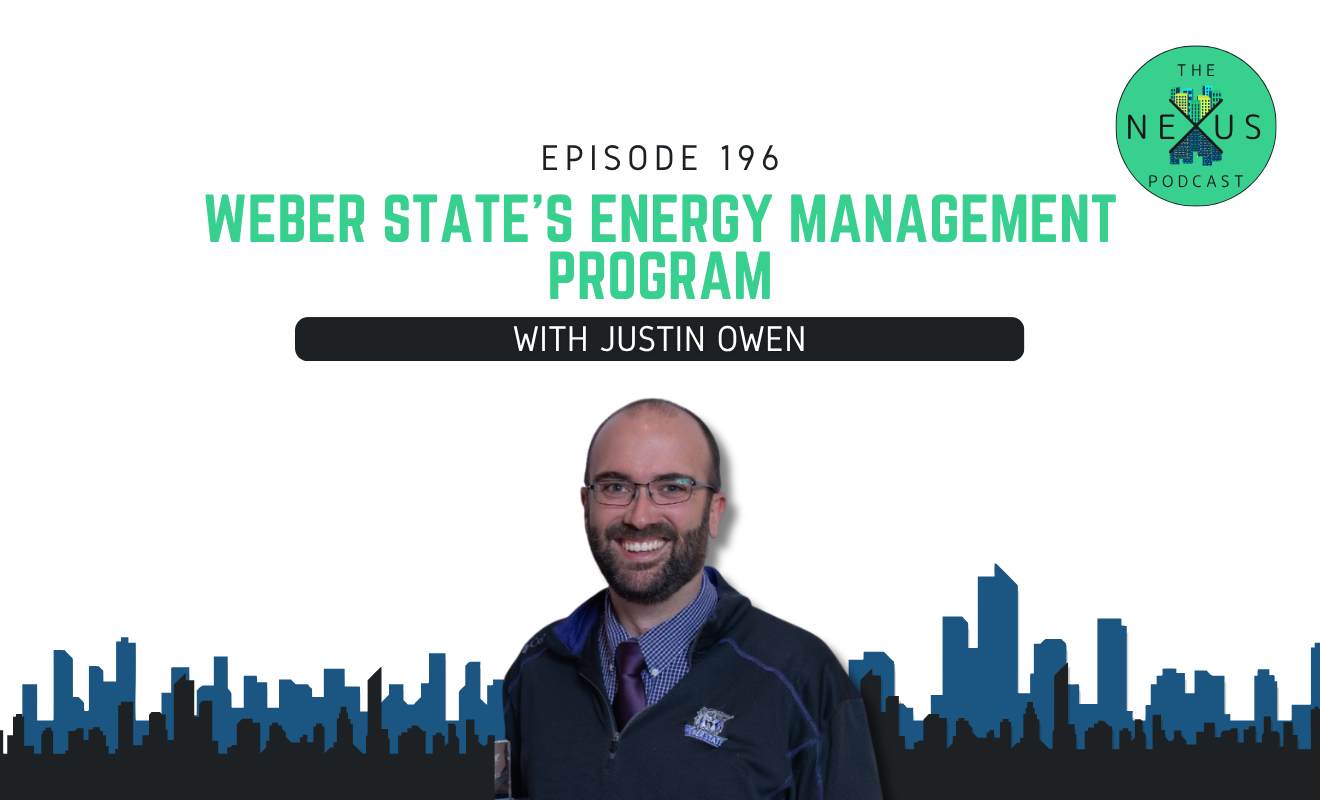
🎧 #196: Weber State's Energy Management Program
Welcome to Nexus Labs, the home for the Connected Buildings Ecosystem—hosted by James Dice. If you’re new to Nexus Labs, sign up for our Connected Buildings Briefing, a 5-minute briefing on the people, tools, and playbooks changing how buildings run. Delivered every two weeks to 8,000+ building professionals.
The Nexus podcast (Apple | Spotify | YouTube | Other apps) is our chance to explore and learn with the brightest minds in the industry.
Nexus Labs runs an annual conference, NexusCon, and a quarterly virtual conference series, NexusCast.
Episode 196 is a conversation with James Dice and Brad Bonavida from Nexus Labs, as well as Justin Owen from Weber State.
Summary
This episode dives into how Weber State University built a high-impact energy management program that’s already delivering millions in annual savings while pushing toward full electrification and carbon neutrality. Justin Owen breaks down how much of that progress comes not from new equipment, but from smarter HVAC sequences, optimization, and advanced supervisory control. The conversation unpacks real examples—from dramatic EUI reductions to campus-wide control strategies and battery integration. They also reveal how a self-funding model fuels continuous upgrades by reinvesting energy savings into new projects. It’s a practical blueprint for energy managers trying to hit aggressive sustainability goals without unlimited budgets.
Mentions and Links
- Sign up for the Connected Buildings Briefing Newsletter: https://www.nexuslabs.online/
- Sign up for NexusCast #3 for Energy Managers: https://www.nexuslabs.online/nexuscast-3
Highlights
Introduction (0:00)
Rapid fire contect-setting (2:52)
Sequence Optimization (6:20)
How the program is funded (33:58)
Sign Off (38:28)
Music credits: There Is A Reality by Common Tiger—licensed under an Music Vine Limited Pro Standard License ID: S795895-16073.
Full transcript
Note: transcript was created using an imperfect machine learning tool and lightly edited by a human (so you can get the gist). Please forgive errors!
Brad Bonavida: [00:00:00] All right. Hello friends. Welcome back to the Nexus Podcast where we talk about connected buildings and the playbooks behind them. In this episode, uh, we're, we're making this one specifically for energy managers who are focused on things like lowering your EUI generating savings through energy programs.
Uh, today we're actually digging into. Electrification, we're gonna dig into HVAC sequence optimization, maybe some advanced supervisory control and how you run an energy management program, um, and how that's all being implemented in real connecting buildings. Uh, this man matters for energy teams because you're pressured to meet energy and sustainability goals, but you're not always given the money or the resources or the budget to easily make that happen.
It doesn't stop there. This also shows up for facility managers that are trying to maintain the building and keep tenants happy while they're dealing with how that maintenance and that occupant experience is impacted by the energy savings that goes on. One quick note, if you're trying to stay on top of this space without wading [00:01:00] through the vendor noise.
We do write a short newsletter that comes out every other week. It's called the Connected, the Connected Buildings Briefing. It's about five minutes. It's a breakdown of what's worth paying attention to. It's read by over 8,000 people. I think we hit 9,000 and we're right on the cusp of that right now. Um, you can grab a link to that in the show notes.
My name is Brad Bonavita. I am the head of product at Nexus Labs. I'm joined by James Dice, our founder, and CEO. Hey James.
James Dice: Hey,
Brad Bonavida: and today our guest is Justin Owen, who is the Director of Utilities and Sustainability at Weber State. How you doing Justin?
Justin Owen: I'm doing great. Thanks for having me.
Brad Bonavida: Yeah. Uh, Weber State or Justin has helped Weaver State.
Uh, generate 3.1 million in annual energy savings, and you guys are targeting, I believe, a 2038 full electrification of the campus and potentially a 2040 carbon neutrality as well, which are pretty, that's the plan. Pretty awesome numbers. Um, so we're gonna get into. How you've built, uh, this Energy [00:02:00]Capital Projects program.
We're also gonna kind of get into the nerdiness of sequence optimization and supervisory control. And, um, you're a energy manager, you're extraordinaire. So we'll just see where this takes us throughout. Um, this is also kind of kicking off, uh, a, a series of things we're gonna do around. HVAC sequence optimization and advanced supervisory control.
Leading up to our third Nexus cast virtual event that's going to be happening on June 17th. That's specifically for energy managers. So if you like this podcast, if you're interested in this topic, generally. We will put in the show notes how to sign up for that event too. It's free for building owners to attend.
You're gonna hear a bunch of stories from people like Justin, um, who are doing these things in the real world. So with that, let's dive into it. Um, Justin, I always like to give a little bit of context setting to the audience without going too deep into the weeds. So rapid fire here. Uh, first of all, where is Weaver State and what is Weaver State?
So,
Justin Owen: uh, Weaver State is [00:03:00] a regional public university in northern Utah. We're about 40 miles north of Salt Lake City. Um, we've got about 3 million square feet of space, about 30,000 students. And we're primarily a commuter university. So we're very much about, you know, non-traditional students. Um, open enrollment and, and helping people better themselves through higher education.
Brad Bonavida: And how long have you been with the university?
Justin Owen: Oh man. I first came here as a student in 2007. Uh, graduated in 2012, went to grad school for a little bit while, and then I've been back working full time for over a decade now, which, ugh, time is flying.
Brad Bonavida: I love when people, uh, smart people find jobs at their university doing the stuff that they were inspired to do when they were there.
So I think that's cool. Um, what are some of the main goals that are driving your particular work at the university?
Justin Owen: Yeah, so at at Weber State, we, we consider ourselves physical environmentalists. So we, we do have a carbon neutral goal, but we're also very interested in, in, in getting [00:04:00] there in a way that generates return and reduced costs for the university.
Right? So initially our, our goal was carbon neutral by 2050. And as we've done a lot of analysis and planning and really kind of. Dug into a lot of these projects, we've realized that we can get there by 2040. And really the, the limiting factor there isn't so much funding as it is what do I do with the people that are in the building that I want to renovate?
Mm-hmm. I only have so much space I can play musical chairs with. So that's really, when we say 2040 and we have a plan, I mean, I, where's my binder? I don't have it handy, but I have a binder that shows the plan of, you know, what, what building we're doing when.
Brad Bonavida: Wow, that's awesome. Um, and you have already some pretty cool results.
Uh, you shared some at Nexus Con. What, what are some of the results that you have thus far that, um, I don't know, are inspirational or you're proud of?
Justin Owen: Yeah. So, uh, there's two big ones, right? One is the u utility cost reduction. We've reduced our utility cost by about 55%. Uh, that's that [00:05:00] 3.1 million you were talking about.
Um, and so one thing I'm proud of is all of those get those dollars, get routed into more energy projects. There's a reinvestment question here. Which I'm sure we'll touch on again later. Yeah. But the other one, I just ran our numbers for our fiscal year 25 emissions and, uh, scope one, scope two, and Scope three.
We are down 56%. Um, and that includes emissions from commuters, which is kind of an elephant in the wheel. Wow. I know this is a building centric Folk Focus podcast. Uh, but uh, 80% of our students, faculty and staff get here in a single occupancy gasoline vehicle. So it is not a small portion of our footprint.
Brad Bonavida: I, I am biting my tongue from asking you follow up questions about, um, how you're tracking what kind of cars people are driving to the university. This is the rapid
James Dice: fire round. Brad, let him
Brad Bonavida: wrap. I know, I know, I know. Okay, last one. What does your team look like? Who's working on these things?
Justin Owen: Yeah. So, uh, I'm the director in, in my division we have our preventive maintenance group, our heat, [00:06:00] our central plant, um, our building automation, our energy team, and our sustainability team.
So one of the things that I think is a good story at Weaver State is initially we started with literally just one person working on this stuff, and now we have about 25.
Brad Bonavida: Nice. That's awesome. Okay. Rapid fire over, uh, what I wanted to ask you to kick this off. You know, we wanted to, you know, start to get into this HVAC sequence optimization and the playbook that we're developing at Nexus Labs about how all the building owners in our community are doing that.
Um, at Nexus Con. Your talk was very much about the financial aspect of how you got here, but it was also about two really cool technologies that you've put in, which is ground source heat pumps and um, and hybrid VRF. But my question for you is those are like new, I don't know, flash is the right word, but they're capital, capital projects.
Mm-hmm. Modern technologies. How much of your energy journey has been. Came before all [00:07:00] that with like just getting the programs and sequences right. That are running whatever systems were already in the building.
Justin Owen: Yeah. So there, there, there's a long story there, right? Because we, we, we've been working on this kind of stuff for almost 20 years.
You know, when my predecessors predecessor started doing. You know, T 12 to T eight retrofits, we realized, hey, we can save some money on some utility bills. Right? But one of the really important things is connecting the people, and I think I talked about this, connecting the people that operate the equipment with the people that pay the bills.
Right. I am that connection. But, uh, you know, early on, you, you know, we, we had an ESCO come in. We looked at performance contracting. Uh, you know, they, they identified a, a bunch of potential savings on campus. And historically we're a very traditional campus, right? Steam boilers and chill, uh, chillers. Uh, so you know, the four pipe air handlers, we had some multi-zone.
Some dual deck systems, but for the most, for the most part, we're a, you know, an air handler with a chilled water [00:08:00] coil and a preheat coil, and then a terminal VAV unit. That was kind of our, our business as usual. So the, the energy program initially, and this, you know, this is almost 20 years ago, really started in lighting.
That's where a lot of the initial savings were generated right as we were looking at halogen and, and Hi, hi are pretty efficient. But you know, there's, there's lots of, uh, legacy lighting technologies where we realized we could get a lot of, gain, a lot of ground, and so. Initially we, we hired some electricians, we started doing lighting projects, right?
And if you, if you make a graph of, of our, our projected emissions over time, right? And I think most energy managers are familiar with a lot of the low hanging fruit, right? Building, scheduling, lighting, upgrades, all that kind of stuff. That takes care of the first part of the curve, right? And we know at the last part of the curve, there's gonna be some things I can't offset or elect, or I can't electrify.
So I'm probably gonna have to offset that. Right. But the, the, the heart of [00:09:00] the curve is what's really hard. Right. And, and, and as I've talked to a lot of my peers, there's this, what's the right word for it? I, I don't know if it's the status quo or if it's just momentum. As an industry, we're very locked in on central heating, and there's a reason for that, right?
And, and particularly in the sixties and seventies before we had condensing boilers, the bigger your boiler got, the more efficient it was. Right. Um, and so initially we started growing these, this the savings model and this idea that we're going to reinvest the money that we are saving on our energy bills, right?
Um, one of the early things that we did was we shut down our steam plant during the summer, right? If you think about what a VAV system does, you know, it's a hundred degrees outside here, here in Utah, and I'm cooling. The air that's coming into the building for the needs of the space that needs the most cooling, right?
Probably a computer lab or a, you know, a, a science lab. Something with a lot of equipment and a lot of people. And then I'm [00:10:00] reheating that same air using steam to create hot water, right? Natural gas boilers, whatever it is. And so there's, we, we realized there's kind of this, this redundancy to, to those systems.
And so we talked to some of our engineers and some of our HVAC consultants and designers and said, Hey, you know, what can we do here? Um, and so we decided we wanted to shut down our steam plant during summer. Um, but that required reprogramming of every VAV on campus to be in a cool only mode. And there's a ventilation question there too, as well, right?
You don't want the damper on the VAV to close. Uh, we did that in a pilot, um, in, in one building, uh, for one summer, and then the next summer we did that for everything. Right? And that generates 50, $60,000 a month in, in energy savings, right? Which to me was really eyeopening, right? Mm-hmm. The, the, the way we heat and cool our buildings.
Like I said, it's a hundred degrees outside. Why do I need heat? That, that was kind of the, [00:11:00] the thinking and, and I don't wanna paint a rosy picture here, right? Like something like that, you know, 3 million square feet has a lot of challenges, right? Yeah. If a VAV isn't connected to the, the VMS and it thinks it has heat, but it actually doesn't, it's gonna subcool your space.
So those are lots of the things that, that, that we've dealt with. But as we've gotten better at this over time, it's just become kind of business as usual. Like, oh yeah, we shut down our steam plan. And as I talk to, you know, our new technicians and, and, and people that we're training, they actually kind of come up if, if we're training them, they think this is normal, but it's very much not.
Right. And so, sorry
Brad Bonavida: Brandon, you have, how do you, yeah, well, how do you like tactically go about. Reprogramming every VV in the campus to not have heat mode for a couple months.
James Dice: I do wanna interject real quick in that. You know, Utah, being Utah, just in case people are listening to this and they don't know that there's no humidity in true.
This
Justin Owen: is
James Dice: true.
Justin Owen: This is true. [00:12:00] In fact, at some conferences I've been asked about, yeah, you know, what do you do about humidity? And I didn't even understand the question.
James Dice: Yeah, it's not even
Justin Owen: Right.
James Dice: Yeah. And it's the
Justin Owen: same. I have a humidity problem. My buildings are too dry.
James Dice: Yeah. Yeah. It's the same for me in Boulder.
Right. We don't need to worry about. Uh, cooling down to drop moisture out of the air to then reheat back up.
Brad Bonavida: Sure.
Justin Owen: So, you know, thinking more about our approach to hvac, right. We started looking at, you know, we were building to a lead silver standard. And building VAV reheat buildings. And we are trying to figure out that, again, that middle part of the curve, how do I make a steam plant carbon neutral?
Right? And, and one way is you just buy offsets. And, and we, we, because of the, our fiscal approach, we don't really like that idea, right? Um, offsets create additional costs and so. We went into the world of, um, you know, improving build, building envelope, right? Insulation. We had a, a, a deck, uh, no, it took us a good 15 years or so to do every roof on campus and get it to be a [00:13:00] high albea roof, right?
Um, but anyways, there was kind of this iterative process where we were trying to make VAVs. More efficient. So this is things like occupancy, occupancy sensors, you know, more advanced sequencing and that kind of stuff. And we realized it was, while it was more efficient, it also had a lot of management involved.
Right. Um, and that's when we started going into the world of, okay, what if we engineer the systems to be more energy efficient from the get go? Right. Particularly with a heat pump. Right. And the, so I'm condensing this. This is like an eight year process. Right where we're starting VAV buildings and we're like, Hey, let's try heat pumps.
And we actually did our facilities buildings first, um, and had our technicians do the work because along with this, we're transitioning our HVAC guys from really being kind of boiler and chiller technicians to just being refrigerant technicians. Right. [00:14:00] Um, and so we did some of our facilities buildings, and we did our first water cooled VRF building in 2014.
And it was actually our administration building, uh, it was a really tight timeline. It's about a 40,000 square foot building. Um, and we did that project in 90 days. It was a summer between fall and, and, and, uh, spring semesters during the summer. Um, and then, you know. The administration was happy with it.
And then we started kind of getting into this mode of, okay, what building's next? Um, and as we got better and better, and a lot of this has to do with our, our commissioning standards, our design standards, and all of those things, because one of the things I've definitely learned is if a VRF system isn't installed well, it's a real pain in the neck.
If it works, it's probably gonna work great and it's gonna work for a long time. If there's leaky refrigerant, it's a big problem, right? And so I have this lesson learned [00:15:00] document that's, you know, five pages of all the mistakes we've made over the years, and it's everything from, you know, fan coil orientation thermostats.
Um, filters, changes, commissioning, standard, all of these kind of things. But now we're at the point where we work with two or three different design firms and we kind of just rinse and repeat. Um, and so like, like I said, we, we've electrified, I just ran the numbers the other day. We're at 57% of campus is now on some sort of heat pump, and the majority of that is, is a water source, VRF.
Brad Bonavida: And are you, is, is there enough in Ashra guideline 36 to support you with that sort of a system? Or how are you actually coming up with the programs that are operating these devices? Do those come from the design teams who helped you put together the design?
Justin Owen: As far as the VRF sequencing.
Brad Bonavida: Yeah. I'm just imagining, like, my point is that I feel like when you think about HVAC sequence [00:16:00] optimization and the work that you can do, most people go to ash rate guideline 36 is like, well, have you gotten to that standard yet?
But I'm, you're, you're talking about new capital projects that might not even fully fit that guideline. I believe
Justin Owen: we're we're, we're a little outside of the box.
Brad Bonavida: Yeah.
Justin Owen: Right. And, and, and one thing I, I also want to mention. Is, you know, from an energy perspective, we are separating heating and cooling from ventilation.
Right? A traditional system is going to have an air handler that's sized to provide enough CFM to cool your building, right? Well, that fan size is a lot bigger. Than what you need for your, your fresh air requirements. Right. And so we use energy recovery ventilators, and the sequences on those are actually quite simple.
We just schedule them with the occupancy of the building. Um, and so they're running from nine to seven or, or whatever that is. And then on the HVAC side, the VRF, um, one of the other things that I'm a big proponent for this is more of a maintenance thing is standardization. Right. All but one of our systems are a particular [00:17:00] brand, and so our technicians know how to and how to maintain and operate them very well.
Right. But the, the V, one of the nice things from a building sequencing standpoint is the VRF systems in terms of energy recovery, they kind of just come ready out of the box, right? There's a lot of setup that's involved, but I don't have to really think about. Sequencing. Oh, what's this fan coil? What's this fan coil going to do?
Right. 16 zones are gonna be connected to a branch controller. The compressor's going to supply the net load of whatever that branch controller needs.
Rosy Khalife: Mm-hmm.
Justin Owen: The compressors are all connected to the same water line so they can share energy. Right now in some buildings, things do give a little more complicated.
Right. So, uh, our engineering building's a good example where in, in our engineering building, we have some spaces that need 24 7 ventilation. And so there's some dampers that close every night at the end of the occupancy schedule. One that's been really interesting is, uh, so we have a basketball arena.
It's about [00:18:00] 11,000. Uh, it holds about 11,000 people, right? So it's not huge, but it's big. Um, and we are wrapping up our electrification of that arena. And so. Talking about demand control ventilation based on an arena that sometimes has 200 people in it and sometimes has 11,000 people in. It was a really interesting, kind of very different from what we're used to doing.
'cause I, I, I suppose one of the advantages of working at a university is most of my buildings are just classrooms and offices. Right? Yeah. And so we have a very, for those kind of spaces, we have a very standardized approach.
Brad Bonavida: Gotcha. What, what is the, um, the, the control loop look like for that, uh, demand control ventilation?
Is it, is it all CO2 based or are you bringing in other aspects as well?
Justin Owen: Yeah, so the building's round, right? And there are two E RVs that supply fresh air, both for the, for the concourse as well as the minimum baseline ventilation for the arena. Right? Um, and so those [00:19:00] operate with the building schedule.
And then there's a CO2 component. There's two air handlers. As the, uh, CO2 levels rise outside, air dampers open and bring in fresh air. Uh, this is very much like kind of a hot off the press. In fact, I had a controls meeting on this building about four hours ago. Uh, we're not quite operational yet. We're in the final stages of, of commissioning and testing.
James Dice: So, Justin, when you think about like the campus as a whole, and when you think about all the things that need to go into optimizing HVAC sequences. That means something different for you guys, is what I'm hearing. You have different systems. You've decided to separate heating and cooling and ventilation.
Um, how do you think about, um, so number one, the question is like, controls, upgrades, the capital projects that go into getting controls everywhere. And then number two. Is there like a standardized sequence for every system type and then you're rolling that sequence [00:20:00] out across the campus. And then third part, how do you keep everything optimized?
Like you mentioned the technicians, technicians come in, they don't realize they override something that override stays. How do you keep the systems optimized in an ongoing way?
Justin Owen: Yes. Okay. Lot of questions there. Um, so the answer, you know, our standard approach, like I said is, is an E-R-V-W-W. We balance it with a, with a VFD during the, the, the tab and commissioning process, and then it operates with the building schedule, right.
Um, and then the VRF kind of just does its own heating and cooling. One of, one of the interesting things is we give every, every zone its own thermostat, right? And that's very much an occupant buy-in and comfort thing. Um, sorry. Remind me the other pieces of the question.
James Dice: Well, where does the, like, it, it sounds like that piece, when it gets installed comes with a control system.
What about the rest of campus that doesn't maybe have a control system, and how are you [00:21:00] managing those upgrades?
Justin Owen: Yes. And, and control the upgrades.
James Dice: And then part three was like, how do you keep all these things optimized? Getting, you know, the sequence, making sure the sequence is maintained at that sequence once you optimize
Justin Owen: it?
James Dice: Yes.
Justin Owen: Okay. So, um, one of the interesting things is at the building level. Our systems don't really have the ability to drift all that much. Right.
James Dice: With
Justin Owen: these
newer
James Dice: systems?
Justin Owen: Yeah, with these newer systems, with the older systems, uh, again, we, uh, we started building campus in the fifties, right? And so when I took over our building automation team, there was plenty of building controls that were, you know, we had pneumatics.
We had 1990s, 1980s era PLCs. And I was actually fortunate enough to get some, uh, some grant money to, to renovate a lot of that. But our general approach is when we, so we align our energy funding with our capital improvement funding, right? And so the capital improvement funding's there for stuff that needs to be replaced anyways, right?
Um, and [00:22:00] then the energy funding makes up the difference in initial cost between kind of a business as usual case and the stuff we want that has these higher efficiencies. And so as we do these big mechanical projects, we'll do a controls upgrade as well. But controls is a really tough one because, you know if, if I think about a building lifecycle, we typically build a 50 year building, right?
And we typically anticipate we'll do one major mechanical renovation during that timeframe. Right, and I'm sure your listeners know controls lifecycles are much more similar to a PC in some ways, right? As as you're rolling out firmware updates or you have old, uh, uh, you know, um, operating systems and that kind of thing.
So, so it's a challenge. Right now I do have a, a, a pretty sophisticated sub-metering system. On our campus, we've got about 300 utility submeters. And generally what I do, the thing I watch the most is our campus substation and see what's happening there. Right. Because one of the big questions as [00:23:00]an energy manager is, what's the best way to spend your time?
Right. And I'm all about, uh, frying the big fish. Right? So when I first, uh, got into the building automation world, our central plant had overrides everywhere. Overrides on the cooling towers, both on the fan speeds and the commands. Right? Overrides on every single one of the pumps, because our maintenance technicians didn't trust the automation, right?
And the last thing they want is to have people kind of chewing 'em out because it's too hot. And I don't blame 'em for that, right? They're gonna err on the side of making people happy and there's nothing wrong with that. And so one of the first things I did was I went to a bunch of controls trainings and learned how to write sequences.
And my first target was our chilled water plant. Because it, it was, you know, in terms of energy intensity, it's the most intense building on campus. It's a third of our campus demand, even now that I have much less demand for chilled water than I used to. And it was really kind of interesting 'cause we tried to get some contractors on [00:24:00] board and I, I don't wanna throw anybody under the bus, but I see a lot of value of, of in developing in-house staff that are capable of these kind of things.
'cause they're the ones that have to live with it, right?
Brad Bonavida: Yep.
Justin Owen: And so it was really interesting. I almost hesitate to share this, right? Because we, we, we paid a controls contractor. We gave 'em a laundry list and said, Hey, we wanna install these dps on campus. We want the, the, the pumps to control to this sequence.
We want the cooling towers to control to this sequence. And they kind of got to the maximum of their time of material and then kind of washed their hands and walked through away, right? And so that's, at that point I was like, okay, I need to figure something else out. 'cause I didn't get what I want. And.
I'm out the money that I spent there, and I'm not getting any gains in efficiency. And so I worked on developing an internal team that has the skills and kind of the passion for like, Hey, let's, let's get in and figure this thing out. I was a little shocked, um, as, as I dug into the sequencing, the only thing that was [00:25:00]wrong with the chilled water pump sequence was one connection in the logic was, was broken.
That's all it was. But I had to go through three different trainings to get the skill to, to actually figure that out. Right. And in, in terms of sequences, my general approach is to frying big fish first. Right. And also coming up with some sort of, some sort of balance between the very advanced and the very simple.
That gives me most of the savings I want.
Brad Bonavida: Mm-hmm.
Justin Owen: Right. So, um, you know, making sure, uh, taking advantage of the affinity laws, making sure your pumps are ramping up and down with some sort of, whether that's a flow set point or DP set point or whatever it's right. Um, making sure your towers fans are automating.
And making sure. So the way I like it, and this was from an a e training, is oh, as, as the fans stage up, we go low, low, low, low, medium, medium, medium, medium, high, high, high, high, high, right? Trying to take advantage of those affinity laws. Um, along with [00:26:00] that is kind of communicating with your maintenance group and saying, Hey, I know you guys don't trust the automation.
Here, let me try this one thing and let's see how it goes. How did that go? Okay.
Brad Bonavida: Yeah,
Justin Owen: let's not touch that now let's go to the next thing. Right. And over piece
Brad Bonavida: by piece
Justin Owen: overrides are a great example.
Brad Bonavida: Yeah.
Justin Owen: Right. Um, and in the early stages of, of recommissioning, our science lab, which is one of our most complex buildings, there's overrides all over the place.
I don't know who put 'em on there. You know, it so long ago. It's not in, it's not in the audit trail of the BMS anymore. Why is this an override? Did somebody just forget? Was there an actual reason What happens if I let it go? Right? These are the kind of questions you deal with.
Brad Bonavida: No, no one wants to touch an override that they didn't put in.
Justin Owen: Oh, right. Because the, uh, 'cause again, it comes back to if somebody did that because somebody was uncomfortable.
Brad Bonavida: Yeah.
Justin Owen: The last thing we want isano. Now the other thing I tell my technicians is, you know, if you're fixing things by putting on [00:27:00]overrides, particularly in a VAD system, right. You're creating more work for yourself in the future.
If they're too cold and I've overrode the reheat valve, that means they're going to be too hot later. And so kind of pivoting the culture in our maintenance group and saying, Hey, we have the expertise. We can actually dig into the sequencing. Why isn't that actuator opening and closing the valve like it should?
Is the linkage broken? Is it a physical problem or is it actually something in the programming?
Brad Bonavida: Right.
James Dice: Right. Justin, I'm curious. We, we do so much around fault detection diagnostics and hear so much about it that I think, I just assumed that everyone has it. But you haven't mentioned it at all here as part of this.
What, what's
Justin Owen: it's, it's, it's something I'm looking at. Um, and, and, and part of it is, uh, because we have a BMS that runs the fans scheduling and the pump sequences and all that stuff. Mitsubishi's kind of, oh, I, I wasn't gonna drop the name, but MITs we're a Mitsubishi [00:28:00] campus. Okay.
James Dice: Yeah. And,
Justin Owen: uh, they have their own control system.
Um, and for the most part, they don't interact. Right.
James Dice: I see.
Justin Owen: Makes sense. Um, and, and so I, I've been working on some proposals for fault detection, but my big question is, you know, is there product out there that can detect. Something that's going on with the VRF system, but also something that's on on the BMS.
Um, it's somewhere I would like to head there. There is, there is, right?
Rosy Khalife: Yeah. Yeah.
Justin Owen: But we're not quite there yet. And, and that's just the, in terms of prioritization and stuff, I was like, okay, let's get our basic sequences done first and then maybe I can get into this fall detection world. But for the most part, you know, our fault detection is our occupants.
James Dice: Oh, that's hilarious. I never heard that.
Justin Owen: Now that said, I do have some very simple, you know, um. Typical BMS alarming, right? If something is not behaving the way it should. Yeah. Um, [00:29:00] our, our controls team will see it. Our building or our heat plant, excuse me, our heat plant team might see it. If it's a big enough issue, I'll actually get a text message.
Right. Um, there's one configuration of valving in our central plant that can deadhead the pumps. If that happens, everybody's flow is blown up and say, what are you guys doing?
James Dice: Totally
Brad Bonavida: there. There's one other, uh, part of your energy plan that you talked about. Uh. You guys are installing a 10 megawatt hour battery, and I wanted to ask, so my question, the preface of it is that we did a battery energy storage, RFI, that we supported, you know, some building owners with last year and we asked all these battery providers.
What, what's controlling the battery in terms of if this is a, you know, microgrid interactive thing that's working with your utility and your PV and all these different sources. Who's deciding when we're charging and discharging and the answers that we got seemed [00:30:00] incredibly fragmented and confusing.
And like, do they know that there's a BMS on the the building already and that there's these metering programs on the building already? So how are you approaching the problem of. Who's responsible, what application is responsible for when that battery's charging, discharging, and supporting the rest of your grid that you're building out?
Justin Owen: Yes, so we're, we're in the final stages of that project. It's currently operational, but it's not intelligent yet. Right. And so right now how we're operating is based on a, a, a scheduled constant discharge based on time of use. So in, in on the rate schedule we're on as a campus during the winter, our on peak time is 6:00 AM to 9:00 AM and 6:00 PM to 10:00 PM And so we discharged at a constant rate, leading a certain amount in the, in the battery.
Um, it's funny you asked that. 'cause two hours ago I was actually working on a model to optimize the, the constant. [00:31:00] Approach. Um, and the reason we're doing that is we're still waiting on some metering to be installed. Right. The, the answer to your question is the batteries have come with their own s scada.
Brad Bonavida: Yeah.
Justin Owen: Um, and, and so it, we are learning a new product and in theory, and I was trying to think through, I. How this, how this really works, right? Because the economics of the battery, there's a little bit in, you know, we're getting rid of generators. That's nice. There's an incentive from the utility. You know, we have to leave a certain amount of our battery charged, you know, leave it in.
I think a 20 or 30% state of charge. So if they ever want us to go off grid, they can't, they can tell us to do so. Right. Um. But there's also this element of responding to the real time demand of campus, and it's something I'm currently trying to wrap my head around, right? And it, and it's kind of interesting as a campus, so we're in the foothills of the Wasatch Mountains, right?
Brad Bonavida: Mm-hmm.
Justin Owen: My campus peaks at about four and a half megawatts, and I have about a megawatt and a half of solar up campus. And so [00:32:00] historically. We, and, and I mentioned we're a commuter campus, right? So historically our, our demand would be kind of this, this broad peak, smooth curve between 10 and two, roughly in that frame timeframe, and then another smaller peak in the evening.
What's been really interesting is we've, we've installed more solar on campus. We kind of have this ramp up as the buildings all get going, and then as soon as the, as the sun comes over the mountains, we get the steep drop off. Right. And so there's going to have to be, and I'm, again, I'm currently working through this, there's going to have to be some kind of calculation on, okay, what is the campus demand, right?
Is it the time of day where I can, uh, is the where I can produce value by energy arbitrage, or whatever you wanna call it, right? Load, load shifting, and is there enough energy in the battery to actually supply all of that? Yeah. So for example, right now what we're [00:33:00] doing is we have a 40% minimum state of charge.
We never go below 40% and we discharge 850 kw during, on peak times. I know we can do better. Right? Um, and so that is something that I'm, like I said. Two hours ago, I was like, you know what? I need to build a model for this.
Brad Bonavida: Yeah.
Justin Owen: Um, and so it's something I'm, I'm actively working on
Brad Bonavida: it. It feels like there's going to be probably years of battery optimization in your future as you continue to grow with your programs and see what you
Justin Owen: gonna do.
Absolutely. And, and, and, you know, given the high capital cost of the project. Right. I wanna squeeze every dollar I can. Yeah. And, and, and again, this go kind of goes back to that question for an energy manager, where do I spend my time? Right. Well, you know, seven or eight years ago I was spending a lot of my time in the central plant.
The central plant's doing pretty good right now. So what's my next big target in terms of advanced sequencing? It's this battery.
Brad Bonavida: Mm-hmm. I think that's a good segue into just how your program is funded. You explained it as. [00:34:00] Basically self-funded with this internal loan. I think that's really cool. Do you want to just give like a very brief explanation of how did that get set up?
How does it work? How does it keep you guys moving forward?
James Dice: And let me add onto that, Justin, where did that come from? Like in the higher ups? Like who made that funding happen and accepted these like terms you're about to talk about?
Justin Owen: Yes. So, uh, timeframe, we're talking about 2007, 2008. I certainly remember the Great Recession.
Right? So those are the kind of interest rates we were dealing with at the time. Um, and, and like I mentioned, we, we, we had an esco, we had a performance, performance grade audit. We were looking at performance contracting. We were looking at low interest energy loans. Um, and, uh, my predecessor slash boss had this idea, you know, the university has a cash management pool that is, is typically, um.
Invested in quick turnaround, low risk investments, [00:35:00] right? Money market accounts, basically bonds, that kind of thing. And so my predecessor, the energy manager at the time, knew based on, you know, his own expertise and the the performance grade audit that there was potential for energy savings on campus.
Right. Um, one of the big questions is, is where do those dollars go when they're actually saved? Right. And he also knew that we had this cash management pool, and so he did a lot of due diligence in terms of understanding our utility bills, where that money was going, and how that was connected to the savings proposals.
Right. He's a pretty determined individual and he, he dug into a lot of the numbers and kind of just realized, you know, if we internalize a lot of this stuff, first of all, we can, we can use our in-house labor rates and people that are going to live with these systems for a long time. Right? Um, but second of all, um, we, we can [00:36:00] generate return for the university.
So we, we have a $5 million loan of credit. We borrow money from the cash management pool, um, and we pay. That in, or sorry, we pay that debt off. With our energy savings plus a 3% interest payment, so our investment managers are making 3%. I actually suggested, uh, threw out the idea of increasing that interest rate a couple years ago and was told it's not necessary, which made me happy.
Um, but the, it, it was all about doing some due diligence and building models and taking it to the, you know, the financial team and the, our, our equivalent of A CFO, our administrative. VP in terms they understand and in terms they value, right. Not making sure that there's a credibility thing and the, the, the two things, the, that the VP at the time said was, the savings have to be real and they have to be documented.
Right. So in terms of documentation, that is, is bill analysis, right? Understanding what the baseline scenario is [00:37:00] and understanding what our actual expenditure is. That's the documentation portion. The real element of that is my goal when I'm calculating energy savings is I want the number I calculate to match the surplus in the utility account.
Right. And to be honest, in the early days of the program, there was a lot of scrutiny. Right. And, and we actually had a, a, um, initially, this was years and years, 15, 20 years ago, the, uh, the utility payments were handled by our facilities management group. There was some mismanagement and that was taken out of facilities and given to financial services.
Right. And so maintaining that relationship and making sure the accountants understand how the calculations work, where the dollars come from and where the dollars go. Right? So the, the revolving fund. Pays for a lot of our kind of incremental efficiency upgrades. [00:38:00] And then, uh, we pair that with our capital improvement and our capital development dollars.
Right. So our, our sports, uh, event center's a good example where we, we, we were in, this is a 19 74, 78 era building, right? It's due for a mechanical upgrade. Let's throw some energy dollars in it so we can electrify it and put it in a ground source field.
James Dice: Totally. Um, we lost Brad. So let's, let's, let's end this thing now before he, uh, has any more wifi issues.
Um, let's end with something fun and personal, which is our carve outs. Uh, anything you, uh, are doing outside of work right now. It could be work related, but, uh, anything you wanna share with the audience outside of work? I'll go first. Um, I got this cool mug. It says FUCK on it, and it's a little heart. I got this at an art, uh, first Friday, um, local artist fair the other day.
And then, um, I watched two movies over the weekend that I recommend [00:39:00] for different reasons. One of them was a documentary that was just so cringe and awful. It's called Inside the Manosphere, and it's on Netflix and it's just, huh. I is just so bad. It's like you can't look away, but it's also like really upsetting.
And then the other one was, um, one battle after another. The le the new Leo that's on my list. Yeah. Uh, great movie. His character's hilarious. Actually, it's not a comedy, but I got halfway through it and I was like, I think he's actually really funny. And it's like a really dark movie. So I always like the dark mixed with.
The light at the same time. That makes
Justin Owen: me wanna see it more.
James Dice: Yeah. So, uh, what about you, Justin?
Justin Owen: Um, I mean, you can tell by, by the things I have in the background. I'm a pretty big nerd. Um, yeah, I actually headed to Vegas to play Magic, the Gathering for three days. I'm going to Magic on Vegas here in about three weeks.
James Dice: All right.
Justin Owen: And I'm pretty stoked. So [00:40:00]
James Dice: on your agenda is Nexus Con and Magic Con. All
Justin Owen: right? Yeah. Yeah.
James Dice: Great. That's great.
Justin Owen: Diversifying the Nerdery, right? Yeah.
James Dice: I played magic gathering when I was a kid, but it has, has been a long time.
Justin Owen: I've played since I was a kid and I never really stopped.
James Dice: That's awesome.
Well thanks for coming on the show. Um, we'll be looking forward to updates on the program as it progresses.
Justin Owen: Absolutely. Appreciate you having me.
Rosy Khalife: Okay, friends. Thank you for listening to this episode. As we continue to grow our global community of change makers, we need your help. For the next couple of months, we're challenging our listeners to share a link to their favorite Nexus episode on LinkedIn with a short post about why you listen. It would really, really help us out.
Make sure to tag us in the post so we can see it. Have a good one.
Welcome to Nexus Labs, the home for the Connected Buildings Ecosystem—hosted by James Dice. If you’re new to Nexus Labs, sign up for our Connected Buildings Briefing, a 5-minute briefing on the people, tools, and playbooks changing how buildings run. Delivered every two weeks to 8,000+ building professionals.
The Nexus podcast (Apple | Spotify | YouTube | Other apps) is our chance to explore and learn with the brightest minds in the industry.
Nexus Labs runs an annual conference, NexusCon, and a quarterly virtual conference series, NexusCast.
Episode 196 is a conversation with James Dice and Brad Bonavida from Nexus Labs, as well as Justin Owen from Weber State.
Summary
This episode dives into how Weber State University built a high-impact energy management program that’s already delivering millions in annual savings while pushing toward full electrification and carbon neutrality. Justin Owen breaks down how much of that progress comes not from new equipment, but from smarter HVAC sequences, optimization, and advanced supervisory control. The conversation unpacks real examples—from dramatic EUI reductions to campus-wide control strategies and battery integration. They also reveal how a self-funding model fuels continuous upgrades by reinvesting energy savings into new projects. It’s a practical blueprint for energy managers trying to hit aggressive sustainability goals without unlimited budgets.
Mentions and Links
- Sign up for the Connected Buildings Briefing Newsletter: https://www.nexuslabs.online/
- Sign up for NexusCast #3 for Energy Managers: https://www.nexuslabs.online/nexuscast-3
Highlights
Introduction (0:00)
Rapid fire contect-setting (2:52)
Sequence Optimization (6:20)
How the program is funded (33:58)
Sign Off (38:28)
Music credits: There Is A Reality by Common Tiger—licensed under an Music Vine Limited Pro Standard License ID: S795895-16073.
Full transcript
Note: transcript was created using an imperfect machine learning tool and lightly edited by a human (so you can get the gist). Please forgive errors!
Brad Bonavida: [00:00:00] All right. Hello friends. Welcome back to the Nexus Podcast where we talk about connected buildings and the playbooks behind them. In this episode, uh, we're, we're making this one specifically for energy managers who are focused on things like lowering your EUI generating savings through energy programs.
Uh, today we're actually digging into. Electrification, we're gonna dig into HVAC sequence optimization, maybe some advanced supervisory control and how you run an energy management program, um, and how that's all being implemented in real connecting buildings. Uh, this man matters for energy teams because you're pressured to meet energy and sustainability goals, but you're not always given the money or the resources or the budget to easily make that happen.
It doesn't stop there. This also shows up for facility managers that are trying to maintain the building and keep tenants happy while they're dealing with how that maintenance and that occupant experience is impacted by the energy savings that goes on. One quick note, if you're trying to stay on top of this space without wading [00:01:00] through the vendor noise.
We do write a short newsletter that comes out every other week. It's called the Connected, the Connected Buildings Briefing. It's about five minutes. It's a breakdown of what's worth paying attention to. It's read by over 8,000 people. I think we hit 9,000 and we're right on the cusp of that right now. Um, you can grab a link to that in the show notes.
My name is Brad Bonavita. I am the head of product at Nexus Labs. I'm joined by James Dice, our founder, and CEO. Hey James.
James Dice: Hey,
Brad Bonavida: and today our guest is Justin Owen, who is the Director of Utilities and Sustainability at Weber State. How you doing Justin?
Justin Owen: I'm doing great. Thanks for having me.
Brad Bonavida: Yeah. Uh, Weber State or Justin has helped Weaver State.
Uh, generate 3.1 million in annual energy savings, and you guys are targeting, I believe, a 2038 full electrification of the campus and potentially a 2040 carbon neutrality as well, which are pretty, that's the plan. Pretty awesome numbers. Um, so we're gonna get into. How you've built, uh, this Energy [00:02:00]Capital Projects program.
We're also gonna kind of get into the nerdiness of sequence optimization and supervisory control. And, um, you're a energy manager, you're extraordinaire. So we'll just see where this takes us throughout. Um, this is also kind of kicking off, uh, a, a series of things we're gonna do around. HVAC sequence optimization and advanced supervisory control.
Leading up to our third Nexus cast virtual event that's going to be happening on June 17th. That's specifically for energy managers. So if you like this podcast, if you're interested in this topic, generally. We will put in the show notes how to sign up for that event too. It's free for building owners to attend.
You're gonna hear a bunch of stories from people like Justin, um, who are doing these things in the real world. So with that, let's dive into it. Um, Justin, I always like to give a little bit of context setting to the audience without going too deep into the weeds. So rapid fire here. Uh, first of all, where is Weaver State and what is Weaver State?
So,
Justin Owen: uh, Weaver State is [00:03:00] a regional public university in northern Utah. We're about 40 miles north of Salt Lake City. Um, we've got about 3 million square feet of space, about 30,000 students. And we're primarily a commuter university. So we're very much about, you know, non-traditional students. Um, open enrollment and, and helping people better themselves through higher education.
Brad Bonavida: And how long have you been with the university?
Justin Owen: Oh man. I first came here as a student in 2007. Uh, graduated in 2012, went to grad school for a little bit while, and then I've been back working full time for over a decade now, which, ugh, time is flying.
Brad Bonavida: I love when people, uh, smart people find jobs at their university doing the stuff that they were inspired to do when they were there.
So I think that's cool. Um, what are some of the main goals that are driving your particular work at the university?
Justin Owen: Yeah, so at at Weber State, we, we consider ourselves physical environmentalists. So we, we do have a carbon neutral goal, but we're also very interested in, in, in getting [00:04:00] there in a way that generates return and reduced costs for the university.
Right? So initially our, our goal was carbon neutral by 2050. And as we've done a lot of analysis and planning and really kind of. Dug into a lot of these projects, we've realized that we can get there by 2040. And really the, the limiting factor there isn't so much funding as it is what do I do with the people that are in the building that I want to renovate?
Mm-hmm. I only have so much space I can play musical chairs with. So that's really, when we say 2040 and we have a plan, I mean, I, where's my binder? I don't have it handy, but I have a binder that shows the plan of, you know, what, what building we're doing when.
Brad Bonavida: Wow, that's awesome. Um, and you have already some pretty cool results.
Uh, you shared some at Nexus Con. What, what are some of the results that you have thus far that, um, I don't know, are inspirational or you're proud of?
Justin Owen: Yeah. So, uh, there's two big ones, right? One is the u utility cost reduction. We've reduced our utility cost by about 55%. Uh, that's that [00:05:00] 3.1 million you were talking about.
Um, and so one thing I'm proud of is all of those get those dollars, get routed into more energy projects. There's a reinvestment question here. Which I'm sure we'll touch on again later. Yeah. But the other one, I just ran our numbers for our fiscal year 25 emissions and, uh, scope one, scope two, and Scope three.
We are down 56%. Um, and that includes emissions from commuters, which is kind of an elephant in the wheel. Wow. I know this is a building centric Folk Focus podcast. Uh, but uh, 80% of our students, faculty and staff get here in a single occupancy gasoline vehicle. So it is not a small portion of our footprint.
Brad Bonavida: I, I am biting my tongue from asking you follow up questions about, um, how you're tracking what kind of cars people are driving to the university. This is the rapid
James Dice: fire round. Brad, let him
Brad Bonavida: wrap. I know, I know, I know. Okay, last one. What does your team look like? Who's working on these things?
Justin Owen: Yeah. So, uh, I'm the director in, in my division we have our preventive maintenance group, our heat, [00:06:00] our central plant, um, our building automation, our energy team, and our sustainability team.
So one of the things that I think is a good story at Weaver State is initially we started with literally just one person working on this stuff, and now we have about 25.
Brad Bonavida: Nice. That's awesome. Okay. Rapid fire over, uh, what I wanted to ask you to kick this off. You know, we wanted to, you know, start to get into this HVAC sequence optimization and the playbook that we're developing at Nexus Labs about how all the building owners in our community are doing that.
Um, at Nexus Con. Your talk was very much about the financial aspect of how you got here, but it was also about two really cool technologies that you've put in, which is ground source heat pumps and um, and hybrid VRF. But my question for you is those are like new, I don't know, flash is the right word, but they're capital, capital projects.
Mm-hmm. Modern technologies. How much of your energy journey has been. Came before all [00:07:00] that with like just getting the programs and sequences right. That are running whatever systems were already in the building.
Justin Owen: Yeah. So there, there, there's a long story there, right? Because we, we, we've been working on this kind of stuff for almost 20 years.
You know, when my predecessors predecessor started doing. You know, T 12 to T eight retrofits, we realized, hey, we can save some money on some utility bills. Right? But one of the really important things is connecting the people, and I think I talked about this, connecting the people that operate the equipment with the people that pay the bills.
Right. I am that connection. But, uh, you know, early on, you, you know, we, we had an ESCO come in. We looked at performance contracting. Uh, you know, they, they identified a, a bunch of potential savings on campus. And historically we're a very traditional campus, right? Steam boilers and chill, uh, chillers. Uh, so you know, the four pipe air handlers, we had some multi-zone.
Some dual deck systems, but for the most, for the most part, we're a, you know, an air handler with a chilled water [00:08:00] coil and a preheat coil, and then a terminal VAV unit. That was kind of our, our business as usual. So the, the energy program initially, and this, you know, this is almost 20 years ago, really started in lighting.
That's where a lot of the initial savings were generated right as we were looking at halogen and, and Hi, hi are pretty efficient. But you know, there's, there's lots of, uh, legacy lighting technologies where we realized we could get a lot of, gain, a lot of ground, and so. Initially we, we hired some electricians, we started doing lighting projects, right?
And if you, if you make a graph of, of our, our projected emissions over time, right? And I think most energy managers are familiar with a lot of the low hanging fruit, right? Building, scheduling, lighting, upgrades, all that kind of stuff. That takes care of the first part of the curve, right? And we know at the last part of the curve, there's gonna be some things I can't offset or elect, or I can't electrify.
So I'm probably gonna have to offset that. Right. But the, the, the heart of [00:09:00] the curve is what's really hard. Right. And, and, and as I've talked to a lot of my peers, there's this, what's the right word for it? I, I don't know if it's the status quo or if it's just momentum. As an industry, we're very locked in on central heating, and there's a reason for that, right?
And, and particularly in the sixties and seventies before we had condensing boilers, the bigger your boiler got, the more efficient it was. Right. Um, and so initially we started growing these, this the savings model and this idea that we're going to reinvest the money that we are saving on our energy bills, right?
Um, one of the early things that we did was we shut down our steam plant during the summer, right? If you think about what a VAV system does, you know, it's a hundred degrees outside here, here in Utah, and I'm cooling. The air that's coming into the building for the needs of the space that needs the most cooling, right?
Probably a computer lab or a, you know, a, a science lab. Something with a lot of equipment and a lot of people. And then I'm [00:10:00] reheating that same air using steam to create hot water, right? Natural gas boilers, whatever it is. And so there's, we, we realized there's kind of this, this redundancy to, to those systems.
And so we talked to some of our engineers and some of our HVAC consultants and designers and said, Hey, you know, what can we do here? Um, and so we decided we wanted to shut down our steam plant during summer. Um, but that required reprogramming of every VAV on campus to be in a cool only mode. And there's a ventilation question there too, as well, right?
You don't want the damper on the VAV to close. Uh, we did that in a pilot, um, in, in one building, uh, for one summer, and then the next summer we did that for everything. Right? And that generates 50, $60,000 a month in, in energy savings, right? Which to me was really eyeopening, right? Mm-hmm. The, the, the way we heat and cool our buildings.
Like I said, it's a hundred degrees outside. Why do I need heat? That, that was kind of the, [00:11:00] the thinking and, and I don't wanna paint a rosy picture here, right? Like something like that, you know, 3 million square feet has a lot of challenges, right? Yeah. If a VAV isn't connected to the, the VMS and it thinks it has heat, but it actually doesn't, it's gonna subcool your space.
So those are lots of the things that, that, that we've dealt with. But as we've gotten better at this over time, it's just become kind of business as usual. Like, oh yeah, we shut down our steam plan. And as I talk to, you know, our new technicians and, and, and people that we're training, they actually kind of come up if, if we're training them, they think this is normal, but it's very much not.
Right. And so, sorry
Brad Bonavida: Brandon, you have, how do you, yeah, well, how do you like tactically go about. Reprogramming every VV in the campus to not have heat mode for a couple months.
James Dice: I do wanna interject real quick in that. You know, Utah, being Utah, just in case people are listening to this and they don't know that there's no humidity in true.
This
Justin Owen: is
James Dice: true.
Justin Owen: This is true. [00:12:00] In fact, at some conferences I've been asked about, yeah, you know, what do you do about humidity? And I didn't even understand the question.
James Dice: Yeah, it's not even
Justin Owen: Right.
James Dice: Yeah. And it's the
Justin Owen: same. I have a humidity problem. My buildings are too dry.
James Dice: Yeah. Yeah. It's the same for me in Boulder.
Right. We don't need to worry about. Uh, cooling down to drop moisture out of the air to then reheat back up.
Brad Bonavida: Sure.
Justin Owen: So, you know, thinking more about our approach to hvac, right. We started looking at, you know, we were building to a lead silver standard. And building VAV reheat buildings. And we are trying to figure out that, again, that middle part of the curve, how do I make a steam plant carbon neutral?
Right? And, and one way is you just buy offsets. And, and we, we, because of the, our fiscal approach, we don't really like that idea, right? Um, offsets create additional costs and so. We went into the world of, um, you know, improving build, building envelope, right? Insulation. We had a, a, a deck, uh, no, it took us a good 15 years or so to do every roof on campus and get it to be a [00:13:00] high albea roof, right?
Um, but anyways, there was kind of this iterative process where we were trying to make VAVs. More efficient. So this is things like occupancy, occupancy sensors, you know, more advanced sequencing and that kind of stuff. And we realized it was, while it was more efficient, it also had a lot of management involved.
Right. Um, and that's when we started going into the world of, okay, what if we engineer the systems to be more energy efficient from the get go? Right. Particularly with a heat pump. Right. And the, so I'm condensing this. This is like an eight year process. Right where we're starting VAV buildings and we're like, Hey, let's try heat pumps.
And we actually did our facilities buildings first, um, and had our technicians do the work because along with this, we're transitioning our HVAC guys from really being kind of boiler and chiller technicians to just being refrigerant technicians. Right. [00:14:00] Um, and so we did some of our facilities buildings, and we did our first water cooled VRF building in 2014.
And it was actually our administration building, uh, it was a really tight timeline. It's about a 40,000 square foot building. Um, and we did that project in 90 days. It was a summer between fall and, and, and, uh, spring semesters during the summer. Um, and then, you know. The administration was happy with it.
And then we started kind of getting into this mode of, okay, what building's next? Um, and as we got better and better, and a lot of this has to do with our, our commissioning standards, our design standards, and all of those things, because one of the things I've definitely learned is if a VRF system isn't installed well, it's a real pain in the neck.
If it works, it's probably gonna work great and it's gonna work for a long time. If there's leaky refrigerant, it's a big problem, right? And so I have this lesson learned [00:15:00] document that's, you know, five pages of all the mistakes we've made over the years, and it's everything from, you know, fan coil orientation thermostats.
Um, filters, changes, commissioning, standard, all of these kind of things. But now we're at the point where we work with two or three different design firms and we kind of just rinse and repeat. Um, and so like, like I said, we, we've electrified, I just ran the numbers the other day. We're at 57% of campus is now on some sort of heat pump, and the majority of that is, is a water source, VRF.
Brad Bonavida: And are you, is, is there enough in Ashra guideline 36 to support you with that sort of a system? Or how are you actually coming up with the programs that are operating these devices? Do those come from the design teams who helped you put together the design?
Justin Owen: As far as the VRF sequencing.
Brad Bonavida: Yeah. I'm just imagining, like, my point is that I feel like when you think about HVAC sequence [00:16:00] optimization and the work that you can do, most people go to ash rate guideline 36 is like, well, have you gotten to that standard yet?
But I'm, you're, you're talking about new capital projects that might not even fully fit that guideline. I believe
Justin Owen: we're we're, we're a little outside of the box.
Brad Bonavida: Yeah.
Justin Owen: Right. And, and, and one thing I, I also want to mention. Is, you know, from an energy perspective, we are separating heating and cooling from ventilation.
Right? A traditional system is going to have an air handler that's sized to provide enough CFM to cool your building, right? Well, that fan size is a lot bigger. Than what you need for your, your fresh air requirements. Right. And so we use energy recovery ventilators, and the sequences on those are actually quite simple.
We just schedule them with the occupancy of the building. Um, and so they're running from nine to seven or, or whatever that is. And then on the HVAC side, the VRF, um, one of the other things that I'm a big proponent for this is more of a maintenance thing is standardization. Right. All but one of our systems are a particular [00:17:00] brand, and so our technicians know how to and how to maintain and operate them very well.
Right. But the, the V, one of the nice things from a building sequencing standpoint is the VRF systems in terms of energy recovery, they kind of just come ready out of the box, right? There's a lot of setup that's involved, but I don't have to really think about. Sequencing. Oh, what's this fan coil? What's this fan coil going to do?
Right. 16 zones are gonna be connected to a branch controller. The compressor's going to supply the net load of whatever that branch controller needs.
Rosy Khalife: Mm-hmm.
Justin Owen: The compressors are all connected to the same water line so they can share energy. Right now in some buildings, things do give a little more complicated.
Right. So, uh, our engineering building's a good example where in, in our engineering building, we have some spaces that need 24 7 ventilation. And so there's some dampers that close every night at the end of the occupancy schedule. One that's been really interesting is, uh, so we have a basketball arena.
It's about [00:18:00] 11,000. Uh, it holds about 11,000 people, right? So it's not huge, but it's big. Um, and we are wrapping up our electrification of that arena. And so. Talking about demand control ventilation based on an arena that sometimes has 200 people in it and sometimes has 11,000 people in. It was a really interesting, kind of very different from what we're used to doing.
'cause I, I, I suppose one of the advantages of working at a university is most of my buildings are just classrooms and offices. Right? Yeah. And so we have a very, for those kind of spaces, we have a very standardized approach.
Brad Bonavida: Gotcha. What, what is the, um, the, the control loop look like for that, uh, demand control ventilation?
Is it, is it all CO2 based or are you bringing in other aspects as well?
Justin Owen: Yeah, so the building's round, right? And there are two E RVs that supply fresh air, both for the, for the concourse as well as the minimum baseline ventilation for the arena. Right? Um, and so those [00:19:00] operate with the building schedule.
And then there's a CO2 component. There's two air handlers. As the, uh, CO2 levels rise outside, air dampers open and bring in fresh air. Uh, this is very much like kind of a hot off the press. In fact, I had a controls meeting on this building about four hours ago. Uh, we're not quite operational yet. We're in the final stages of, of commissioning and testing.
James Dice: So, Justin, when you think about like the campus as a whole, and when you think about all the things that need to go into optimizing HVAC sequences. That means something different for you guys, is what I'm hearing. You have different systems. You've decided to separate heating and cooling and ventilation.
Um, how do you think about, um, so number one, the question is like, controls, upgrades, the capital projects that go into getting controls everywhere. And then number two. Is there like a standardized sequence for every system type and then you're rolling that sequence [00:20:00] out across the campus. And then third part, how do you keep everything optimized?
Like you mentioned the technicians, technicians come in, they don't realize they override something that override stays. How do you keep the systems optimized in an ongoing way?
Justin Owen: Yes. Okay. Lot of questions there. Um, so the answer, you know, our standard approach, like I said is, is an E-R-V-W-W. We balance it with a, with a VFD during the, the, the tab and commissioning process, and then it operates with the building schedule, right.
Um, and then the VRF kind of just does its own heating and cooling. One of, one of the interesting things is we give every, every zone its own thermostat, right? And that's very much an occupant buy-in and comfort thing. Um, sorry. Remind me the other pieces of the question.
James Dice: Well, where does the, like, it, it sounds like that piece, when it gets installed comes with a control system.
What about the rest of campus that doesn't maybe have a control system, and how are you [00:21:00] managing those upgrades?
Justin Owen: Yes. And, and control the upgrades.
James Dice: And then part three was like, how do you keep all these things optimized? Getting, you know, the sequence, making sure the sequence is maintained at that sequence once you optimize
Justin Owen: it?
James Dice: Yes.
Justin Owen: Okay. So, um, one of the interesting things is at the building level. Our systems don't really have the ability to drift all that much. Right.
James Dice: With
Justin Owen: these
newer
James Dice: systems?
Justin Owen: Yeah, with these newer systems, with the older systems, uh, again, we, uh, we started building campus in the fifties, right? And so when I took over our building automation team, there was plenty of building controls that were, you know, we had pneumatics.
We had 1990s, 1980s era PLCs. And I was actually fortunate enough to get some, uh, some grant money to, to renovate a lot of that. But our general approach is when we, so we align our energy funding with our capital improvement funding, right? And so the capital improvement funding's there for stuff that needs to be replaced anyways, right?
Um, and [00:22:00] then the energy funding makes up the difference in initial cost between kind of a business as usual case and the stuff we want that has these higher efficiencies. And so as we do these big mechanical projects, we'll do a controls upgrade as well. But controls is a really tough one because, you know if, if I think about a building lifecycle, we typically build a 50 year building, right?
And we typically anticipate we'll do one major mechanical renovation during that timeframe. Right, and I'm sure your listeners know controls lifecycles are much more similar to a PC in some ways, right? As as you're rolling out firmware updates or you have old, uh, uh, you know, um, operating systems and that kind of thing.
So, so it's a challenge. Right now I do have a, a, a pretty sophisticated sub-metering system. On our campus, we've got about 300 utility submeters. And generally what I do, the thing I watch the most is our campus substation and see what's happening there. Right. Because one of the big questions as [00:23:00]an energy manager is, what's the best way to spend your time?
Right. And I'm all about, uh, frying the big fish. Right? So when I first, uh, got into the building automation world, our central plant had overrides everywhere. Overrides on the cooling towers, both on the fan speeds and the commands. Right? Overrides on every single one of the pumps, because our maintenance technicians didn't trust the automation, right?
And the last thing they want is to have people kind of chewing 'em out because it's too hot. And I don't blame 'em for that, right? They're gonna err on the side of making people happy and there's nothing wrong with that. And so one of the first things I did was I went to a bunch of controls trainings and learned how to write sequences.
And my first target was our chilled water plant. Because it, it was, you know, in terms of energy intensity, it's the most intense building on campus. It's a third of our campus demand, even now that I have much less demand for chilled water than I used to. And it was really kind of interesting 'cause we tried to get some contractors on [00:24:00] board and I, I don't wanna throw anybody under the bus, but I see a lot of value of, of in developing in-house staff that are capable of these kind of things.
'cause they're the ones that have to live with it, right?
Brad Bonavida: Yep.
Justin Owen: And so it was really interesting. I almost hesitate to share this, right? Because we, we, we paid a controls contractor. We gave 'em a laundry list and said, Hey, we wanna install these dps on campus. We want the, the, the pumps to control to this sequence.
We want the cooling towers to control to this sequence. And they kind of got to the maximum of their time of material and then kind of washed their hands and walked through away, right? And so that's, at that point I was like, okay, I need to figure something else out. 'cause I didn't get what I want. And.
I'm out the money that I spent there, and I'm not getting any gains in efficiency. And so I worked on developing an internal team that has the skills and kind of the passion for like, Hey, let's, let's get in and figure this thing out. I was a little shocked, um, as, as I dug into the sequencing, the only thing that was [00:25:00]wrong with the chilled water pump sequence was one connection in the logic was, was broken.
That's all it was. But I had to go through three different trainings to get the skill to, to actually figure that out. Right. And in, in terms of sequences, my general approach is to frying big fish first. Right. And also coming up with some sort of, some sort of balance between the very advanced and the very simple.
That gives me most of the savings I want.
Brad Bonavida: Mm-hmm.
Justin Owen: Right. So, um, you know, making sure, uh, taking advantage of the affinity laws, making sure your pumps are ramping up and down with some sort of, whether that's a flow set point or DP set point or whatever it's right. Um, making sure your towers fans are automating.
And making sure. So the way I like it, and this was from an a e training, is oh, as, as the fans stage up, we go low, low, low, low, medium, medium, medium, medium, high, high, high, high, high, right? Trying to take advantage of those affinity laws. Um, along with [00:26:00] that is kind of communicating with your maintenance group and saying, Hey, I know you guys don't trust the automation.
Here, let me try this one thing and let's see how it goes. How did that go? Okay.
Brad Bonavida: Yeah,
Justin Owen: let's not touch that now let's go to the next thing. Right. And over piece
Brad Bonavida: by piece
Justin Owen: overrides are a great example.
Brad Bonavida: Yeah.
Justin Owen: Right. Um, and in the early stages of, of recommissioning, our science lab, which is one of our most complex buildings, there's overrides all over the place.
I don't know who put 'em on there. You know, it so long ago. It's not in, it's not in the audit trail of the BMS anymore. Why is this an override? Did somebody just forget? Was there an actual reason What happens if I let it go? Right? These are the kind of questions you deal with.
Brad Bonavida: No, no one wants to touch an override that they didn't put in.
Justin Owen: Oh, right. Because the, uh, 'cause again, it comes back to if somebody did that because somebody was uncomfortable.
Brad Bonavida: Yeah.
Justin Owen: The last thing we want isano. Now the other thing I tell my technicians is, you know, if you're fixing things by putting on [00:27:00]overrides, particularly in a VAD system, right. You're creating more work for yourself in the future.
If they're too cold and I've overrode the reheat valve, that means they're going to be too hot later. And so kind of pivoting the culture in our maintenance group and saying, Hey, we have the expertise. We can actually dig into the sequencing. Why isn't that actuator opening and closing the valve like it should?
Is the linkage broken? Is it a physical problem or is it actually something in the programming?
Brad Bonavida: Right.
James Dice: Right. Justin, I'm curious. We, we do so much around fault detection diagnostics and hear so much about it that I think, I just assumed that everyone has it. But you haven't mentioned it at all here as part of this.
What, what's
Justin Owen: it's, it's, it's something I'm looking at. Um, and, and, and part of it is, uh, because we have a BMS that runs the fans scheduling and the pump sequences and all that stuff. Mitsubishi's kind of, oh, I, I wasn't gonna drop the name, but MITs we're a Mitsubishi [00:28:00] campus. Okay.
James Dice: Yeah. And,
Justin Owen: uh, they have their own control system.
Um, and for the most part, they don't interact. Right.
James Dice: I see.
Justin Owen: Makes sense. Um, and, and so I, I've been working on some proposals for fault detection, but my big question is, you know, is there product out there that can detect. Something that's going on with the VRF system, but also something that's on on the BMS.
Um, it's somewhere I would like to head there. There is, there is, right?
Rosy Khalife: Yeah. Yeah.
Justin Owen: But we're not quite there yet. And, and that's just the, in terms of prioritization and stuff, I was like, okay, let's get our basic sequences done first and then maybe I can get into this fall detection world. But for the most part, you know, our fault detection is our occupants.
James Dice: Oh, that's hilarious. I never heard that.
Justin Owen: Now that said, I do have some very simple, you know, um. Typical BMS alarming, right? If something is not behaving the way it should. Yeah. Um, [00:29:00] our, our controls team will see it. Our building or our heat plant, excuse me, our heat plant team might see it. If it's a big enough issue, I'll actually get a text message.
Right. Um, there's one configuration of valving in our central plant that can deadhead the pumps. If that happens, everybody's flow is blown up and say, what are you guys doing?
James Dice: Totally
Brad Bonavida: there. There's one other, uh, part of your energy plan that you talked about. Uh. You guys are installing a 10 megawatt hour battery, and I wanted to ask, so my question, the preface of it is that we did a battery energy storage, RFI, that we supported, you know, some building owners with last year and we asked all these battery providers.
What, what's controlling the battery in terms of if this is a, you know, microgrid interactive thing that's working with your utility and your PV and all these different sources. Who's deciding when we're charging and discharging and the answers that we got seemed [00:30:00] incredibly fragmented and confusing.
And like, do they know that there's a BMS on the the building already and that there's these metering programs on the building already? So how are you approaching the problem of. Who's responsible, what application is responsible for when that battery's charging, discharging, and supporting the rest of your grid that you're building out?
Justin Owen: Yes, so we're, we're in the final stages of that project. It's currently operational, but it's not intelligent yet. Right. And so right now how we're operating is based on a, a, a scheduled constant discharge based on time of use. So in, in on the rate schedule we're on as a campus during the winter, our on peak time is 6:00 AM to 9:00 AM and 6:00 PM to 10:00 PM And so we discharged at a constant rate, leading a certain amount in the, in the battery.
Um, it's funny you asked that. 'cause two hours ago I was actually working on a model to optimize the, the constant. [00:31:00] Approach. Um, and the reason we're doing that is we're still waiting on some metering to be installed. Right. The, the answer to your question is the batteries have come with their own s scada.
Brad Bonavida: Yeah.
Justin Owen: Um, and, and so it, we are learning a new product and in theory, and I was trying to think through, I. How this, how this really works, right? Because the economics of the battery, there's a little bit in, you know, we're getting rid of generators. That's nice. There's an incentive from the utility. You know, we have to leave a certain amount of our battery charged, you know, leave it in.
I think a 20 or 30% state of charge. So if they ever want us to go off grid, they can't, they can tell us to do so. Right. Um. But there's also this element of responding to the real time demand of campus, and it's something I'm currently trying to wrap my head around, right? And it, and it's kind of interesting as a campus, so we're in the foothills of the Wasatch Mountains, right?
Brad Bonavida: Mm-hmm.
Justin Owen: My campus peaks at about four and a half megawatts, and I have about a megawatt and a half of solar up campus. And so [00:32:00] historically. We, and, and I mentioned we're a commuter campus, right? So historically our, our demand would be kind of this, this broad peak, smooth curve between 10 and two, roughly in that frame timeframe, and then another smaller peak in the evening.
What's been really interesting is we've, we've installed more solar on campus. We kind of have this ramp up as the buildings all get going, and then as soon as the, as the sun comes over the mountains, we get the steep drop off. Right. And so there's going to have to be, and I'm, again, I'm currently working through this, there's going to have to be some kind of calculation on, okay, what is the campus demand, right?
Is it the time of day where I can, uh, is the where I can produce value by energy arbitrage, or whatever you wanna call it, right? Load, load shifting, and is there enough energy in the battery to actually supply all of that? Yeah. So for example, right now what we're [00:33:00] doing is we have a 40% minimum state of charge.
We never go below 40% and we discharge 850 kw during, on peak times. I know we can do better. Right? Um, and so that is something that I'm, like I said. Two hours ago, I was like, you know what? I need to build a model for this.
Brad Bonavida: Yeah.
Justin Owen: Um, and so it's something I'm, I'm actively working on
Brad Bonavida: it. It feels like there's going to be probably years of battery optimization in your future as you continue to grow with your programs and see what you
Justin Owen: gonna do.
Absolutely. And, and, and, you know, given the high capital cost of the project. Right. I wanna squeeze every dollar I can. Yeah. And, and, and again, this go kind of goes back to that question for an energy manager, where do I spend my time? Right. Well, you know, seven or eight years ago I was spending a lot of my time in the central plant.
The central plant's doing pretty good right now. So what's my next big target in terms of advanced sequencing? It's this battery.
Brad Bonavida: Mm-hmm. I think that's a good segue into just how your program is funded. You explained it as. [00:34:00] Basically self-funded with this internal loan. I think that's really cool. Do you want to just give like a very brief explanation of how did that get set up?
How does it work? How does it keep you guys moving forward?
James Dice: And let me add onto that, Justin, where did that come from? Like in the higher ups? Like who made that funding happen and accepted these like terms you're about to talk about?
Justin Owen: Yes. So, uh, timeframe, we're talking about 2007, 2008. I certainly remember the Great Recession.
Right? So those are the kind of interest rates we were dealing with at the time. Um, and, and like I mentioned, we, we, we had an esco, we had a performance, performance grade audit. We were looking at performance contracting. We were looking at low interest energy loans. Um, and, uh, my predecessor slash boss had this idea, you know, the university has a cash management pool that is, is typically, um.
Invested in quick turnaround, low risk investments, [00:35:00] right? Money market accounts, basically bonds, that kind of thing. And so my predecessor, the energy manager at the time, knew based on, you know, his own expertise and the the performance grade audit that there was potential for energy savings on campus.
Right. Um, one of the big questions is, is where do those dollars go when they're actually saved? Right. And he also knew that we had this cash management pool, and so he did a lot of due diligence in terms of understanding our utility bills, where that money was going, and how that was connected to the savings proposals.
Right. He's a pretty determined individual and he, he dug into a lot of the numbers and kind of just realized, you know, if we internalize a lot of this stuff, first of all, we can, we can use our in-house labor rates and people that are going to live with these systems for a long time. Right? Um, but second of all, um, we, we can [00:36:00] generate return for the university.
So we, we have a $5 million loan of credit. We borrow money from the cash management pool, um, and we pay. That in, or sorry, we pay that debt off. With our energy savings plus a 3% interest payment, so our investment managers are making 3%. I actually suggested, uh, threw out the idea of increasing that interest rate a couple years ago and was told it's not necessary, which made me happy.
Um, but the, it, it was all about doing some due diligence and building models and taking it to the, you know, the financial team and the, our, our equivalent of A CFO, our administrative. VP in terms they understand and in terms they value, right. Not making sure that there's a credibility thing and the, the, the two things, the, that the VP at the time said was, the savings have to be real and they have to be documented.
Right. So in terms of documentation, that is, is bill analysis, right? Understanding what the baseline scenario is [00:37:00] and understanding what our actual expenditure is. That's the documentation portion. The real element of that is my goal when I'm calculating energy savings is I want the number I calculate to match the surplus in the utility account.
Right. And to be honest, in the early days of the program, there was a lot of scrutiny. Right. And, and we actually had a, a, um, initially, this was years and years, 15, 20 years ago, the, uh, the utility payments were handled by our facilities management group. There was some mismanagement and that was taken out of facilities and given to financial services.
Right. And so maintaining that relationship and making sure the accountants understand how the calculations work, where the dollars come from and where the dollars go. Right? So the, the revolving fund. Pays for a lot of our kind of incremental efficiency upgrades. [00:38:00] And then, uh, we pair that with our capital improvement and our capital development dollars.
Right. So our, our sports, uh, event center's a good example where we, we, we were in, this is a 19 74, 78 era building, right? It's due for a mechanical upgrade. Let's throw some energy dollars in it so we can electrify it and put it in a ground source field.
James Dice: Totally. Um, we lost Brad. So let's, let's, let's end this thing now before he, uh, has any more wifi issues.
Um, let's end with something fun and personal, which is our carve outs. Uh, anything you, uh, are doing outside of work right now. It could be work related, but, uh, anything you wanna share with the audience outside of work? I'll go first. Um, I got this cool mug. It says FUCK on it, and it's a little heart. I got this at an art, uh, first Friday, um, local artist fair the other day.
And then, um, I watched two movies over the weekend that I recommend [00:39:00] for different reasons. One of them was a documentary that was just so cringe and awful. It's called Inside the Manosphere, and it's on Netflix and it's just, huh. I is just so bad. It's like you can't look away, but it's also like really upsetting.
And then the other one was, um, one battle after another. The le the new Leo that's on my list. Yeah. Uh, great movie. His character's hilarious. Actually, it's not a comedy, but I got halfway through it and I was like, I think he's actually really funny. And it's like a really dark movie. So I always like the dark mixed with.
The light at the same time. That makes
Justin Owen: me wanna see it more.
James Dice: Yeah. So, uh, what about you, Justin?
Justin Owen: Um, I mean, you can tell by, by the things I have in the background. I'm a pretty big nerd. Um, yeah, I actually headed to Vegas to play Magic, the Gathering for three days. I'm going to Magic on Vegas here in about three weeks.
James Dice: All right.
Justin Owen: And I'm pretty stoked. So [00:40:00]
James Dice: on your agenda is Nexus Con and Magic Con. All
Justin Owen: right? Yeah. Yeah.
James Dice: Great. That's great.
Justin Owen: Diversifying the Nerdery, right? Yeah.
James Dice: I played magic gathering when I was a kid, but it has, has been a long time.
Justin Owen: I've played since I was a kid and I never really stopped.
James Dice: That's awesome.
Well thanks for coming on the show. Um, we'll be looking forward to updates on the program as it progresses.
Justin Owen: Absolutely. Appreciate you having me.
Rosy Khalife: Okay, friends. Thank you for listening to this episode. As we continue to grow our global community of change makers, we need your help. For the next couple of months, we're challenging our listeners to share a link to their favorite Nexus episode on LinkedIn with a short post about why you listen. It would really, really help us out.
Make sure to tag us in the post so we can see it. Have a good one.


This is a great piece!
I agree.