
🎧 #198: Pressure Testing the HVAC Sequence Optimization Playbook with University of California Energy Experts
Welcome to Nexus Labs, the home for the Connected Buildings Ecosystem—hosted by James Dice. If you’re new to Nexus Labs, sign up for our Connected Buildings Briefing, a 5-minute briefing on the people, tools, and playbooks changing how buildings run. Delivered every two weeks to 8,000+ building professionals.
The Nexus podcast (Apple | Spotify | YouTube | Other apps) is our chance to explore and learn with the brightest minds in the industry.
Nexus Labs runs an annual conference, NexusCon, and a quarterly virtual conference series, NexusCast.
Episode 198 is a conversation with Brad Bonavida from Nexus Labs, Gabe Sandoval from UCSF Health, and Patrick Testoni from the University of California, Santa Cruz.
Summary
This episode puts the Nexus Labs HVAC Sequence Optimization Playbook to the test with energy leaders from University of California, San Francisco Health and University of California, Santa Cruz. Together, they explore what it really takes to reduce HVAC energy consumption, combat operational drift, and maintain occupant comfort across complex building portfolios. The discussion walks through the playbook’s phases—from setup and pilot projects to scaling and sustaining optimization programs over time. Along the way, they share practical lessons on controls infrastructure, measurement and verification, team structure, and continuous improvement. It’s a candid look at how real-world energy managers are turning HVAC optimization into a repeatable, long-term operational strategy.
Mentions and Links
- Download the Condition-Based Maintenance Playbook
- NexusCast #3: The HVAC Sequence Optimization Playbook
- Patrick’s Book Recommendation
Highlights
Introduction (0:00)
At the Nexus (1:58)
Rapid fire context-setting (5:03)
What is HVAC Sequence Optimization (10:40)
Why building owners run HVAC optimization (19:11)
Phase 1: The Setup Phase (21:26)
Phase 2: The Pilot Phase (35:51)
Phase 3: The Rollout Phase (51:56)
Maturity Framework (1:02:31)
Carve Outs (1:03:25)
Music credits: There Is A Reality by Common Tiger—licensed under an Music Vine Limited Pro Standard License ID: S800157-16073.
Full transcript
Note: transcript was created using an imperfect machine learning tool and lightly edited by a human (so you can get the gist). Please forgive errors!
Brad Bonavida: [00:00:00] All right. Hello, friends. Welcome back to the Nexus Podcast. Uh, I am your host today, Brad Bonavita, Head of Product at Nexus Labs. This is where we talk about connected buildings and the playbooks behind them. This episode is for energy managers who are focused on lowering energy consumption across their building portfolio, but are working with a limited budget and limited resources.
Today is kind of a special episode. We're gonna dig into the HVAC sequence optimization playbook, and we're gonna h- see how it holds up against some real programs that real energy managers are running. This matters for energy teams because you're pressured to meet sustainability goals and energy goals, but you're constantly fighting buildings that are drifting from ideal performance, and it doesn't stop there.
This is also really important for facility managers who are trying to maintain equipment and keep tenants happy, because we all know that energy optimization and maintenance operations are super interrelated with one another, and those teams are often responsible f- for both things. A quick note, if you're trying to stay on top of this space without wading through all the vendor noise, we do write a [00:01:00] short newsletter.
It's called "The Connected Buildings Briefing." Comes out every two weeks. It's about five minutes long, and it tells you what's worth paying attention to. It's read over or read by over 8,000 people. We will put it in the show notes where you can grab it and sign up if you want to. Uh, in this episode, I have two guests joining me.
I have Gabe Sandoval, who's the senior controls and commissioning engineer at UCSF Health. How you doing, Gabe? Thanks for joining.
Gabe Sandoval: Doing really good. Thank you for having me.
Brad Bonavida: Of course. And our second guest was on your recommendation. We have Patrick Testoni, uh, director of energy at University of California, Santa Cruz.
How you doing, Patrick?
Patrick Testoni: I'm good. Thanks for having me.
Brad Bonavida: Yeah. And you two know each other from working together at the Santa Cruz campus, right?
Gabe Sandoval: Yeah. Yeah. I worked at UC Santa Cruz for about almost 10 years And, uh, Patrick and I did a lot of work together.
Brad Bonavida: Nice. I'm sure we will get into a lot of that. So like I mentioned, we're gonna get into the HVAC sequence optimization playbook.
So let me start with at [00:02:00] the, at the Nexus, which is our updates and, and maybe just a little bit of what the format of this podcast is. It was developed off this playbook. This playbook is now published. It's live for anyone to, uh, go download for free on our website. We'll have it in the show notes. It's going to be constantly updated because of conversations like this.
So you guys are gonna help me with my first iteration probably. But let me start by just quickly how I developed this, because I did use AI to help me, and I don't think this would've been possible without AI. So I'm actually pretty proud of the way it comes together. Um, so what I-- what we do is we, you know, we've been doing content since 2020.
Um, we have over 1,000 pieces of content between, uh, event recordings. You know, Gabe presented at the last Nexus Con, and then we write our, our blogs, and we have podcasts like this, and we've put that all into a database now that is searchable by Claude. And what I did is I teach Claude what I mean by HVAC sequence optimization, and I train it on, you know, exactly what I'm looking for, and then it goes and crawls our [00:03:00] 1,000 pieces of content and looks for examples of building owners who's ac- who've actually done this and how they've done it.
Um, when I go through that and I iterate on like what is real and what's BS, I ended up with 92 pieces of content that we've developed that are stories. It's not, it's not something we came up with. We're telling the stories of building owners who've done HVAC sequence of optimization and how they've done it And then with those 92 pieces, I'm able to tag what is being talked about there, whether that's, um, you know, they're sharing metrics that they're, they're, um, they're seeing in their program.
They have lessons learned that others need to avoid. Uh, maybe their organizational structure, or maybe they're talking about pilots, maybe they're talking about scaled programs. So I've got this big list. It's all sorted through. Then the hard work comes of, like, developing this outline, and it takes me days to actually write this thing so it's not full of AI hallucination and full of good material.
And out comes this document that's how we think people are doing this based on all the, um, building owners we've, you know, interviewed over the days. [00:04:00] So, um, for this one, I, I think there was, within those 92 pieces of content, there's over 35 building owners or, uh, about who, uh, are c- contributed to this, this playbook.
Uh, Dollar Tree, Empire State Realty Trust, Microsoft, Amazon, Lockheed Martin, KIPP DC School District, Wendy's, Ca- uh, California State, Dominguez Hills, DataBank, Lincoln Property. That's just some, but there's about 36. Um, and then to finish, why I built this playbook is that, uh, we're doing a Nexus Cast event, this is our virtual event series, on the HVAC Sequence Optimization Playbook on June 17th.
Um, so we are building content to support that. We're gonna have five or six different building owners telling case studies there as well, and this is all to bring together the ultimate guide, ultimate guide for anyone who's trying to run HVAC sequence optimization. So that's why we did this, and I am excited to have both of you 'cause you're gonna see if I've got a bunch of BS in here and see what applies and what [00:05:00] doesn't apply.
Um, but before we dive into that, I just wanna give more context to who you guys are and what you guys are doing. So this is supposed to be rapid fire so we don't get too into the weeds, but people wanna know your roles and why you are the experts in this field. So first, um, let's hear about your portfolios that you're responsible for.
You know, square foot, purpose, what the building types are. Gabe, why don't you go first with what your portfolio looks like?
Gabe Sandoval: Yeah. So we, um... It is a healthcare system, so, uh, we're primarily focused on hospital, medical office buildings, surgery centers, um, anything involved in healthcare. Um, so currently we're somewhere between three to four million square foot.
Um, we've been rapidly expanding. We just bought two more hospitals. We're absorbing Oakland Hospital. We're building two more hospitals, um, as well as a, a few MLBs that we have going on. So yeah, anything, anything related to healthcare is my primary focus.
Brad Bonavida: Okay. And Patrick, how about you?
Patrick Testoni: Uh, so UC Santa Cruz is a research institution, [00:06:00] so it's a variety of, uh, building types.
So it's about, I think it used to be two million square feet. I wouldn't be surprised if it's, like, 2.5 million square feet. Um, you've got academic buildings, residential, science buildings, labs, clean rooms, BSL labs. So it's a wide variety, um- So responsibility, I-- my primary responsibility is the state-funded side.
So, uh, we spend a lot of time focusing on the high energy users, which are the labs and the academic buildings. Um, my role varies, so a large subset of this work is related to energy efficiency, which is related to building performance
Brad Bonavida: Cool. And so you kind of answered my next question, um, but maybe you'll have something to add.
So Gabe, how about you? What i- what outcomes are driving your work as it relates to energy management? So, you know, I know you guys are in California. Sometimes there's man- state mandates, uh, there's the EUI you could be tracking, sustainability commitments. Like, what's really driving your day-to-day work and your goals?
Gabe Sandoval: Um, I mean, so I, I, I [00:07:00] reside within... Our department is the, um, part of its responsibilities is energy utilities. Um, and so the, the year-over-year goal we have is 2% reduction in energy usage, so that's part of what drives a lot of our work. Um, we also have the wider goal, which I think is, uh, all UC, including UCSC as well, we're under, which is, um, reduce carbon emissions.
Um, I think it's, like, 90% of the two- nine- 2019. I think Patrick probably knows it by heart. I don't know it as well. Uh, but that is also driving, driving a lot of our work to, uh, you know, reduce, uh, fossil fuel, uh, dependency. Um, so we're, we're, you know, rapidly switching over to all-electric buildings. Um, a lot of our new buildings now are, um, you know, we have EUI goals that we, we try to achieve.
And so, you know, much of my work is when a building gets turned over, you know, we're also working to try to make sure that building meets those EUI, um, design goals.
Brad Bonavida: Okay. Patrick, did he summarize it well? Is that, is that the [00:08:00] same for you?
Patrick Testoni: Well, it's a great summary. We work on, on very similar roles. So I'm, I'm, uh, dealing with the campus, so it's kind of like a layered approach.
So energy efficiency is, like, the al- always, almost always the tier one. Reduce the cleanest energy is the one you don't use. Yeah. But then it's about fuel switching to cleaner resources, uh, which is electricity. So we've got a, a movement at UC Santa Cruz and the whole UC system to switch away from fossil fuel burning, so that's a piece of the work.
Um, that 2% per year is a UC goal, so, uh, Gabe and I are working towards the same goal with different, um, factors because of the space we deal with. There's challenges, uh, for both of us in different areas 'cause the type of space we're dealing with. Um, but that is the goal, and it drives a lot of the work.
Um, and that t- varies over time. The work, uh, interesting Gabe and I did 15 years ago is kind of coming even more to the focus again because this, uh, smart building performance with technology improvements is kind of been the [00:09:00] overarching theme. That's how, uh, Gabe and I sat down the first time began working on projects, which at the time were just getting the baseline started.
But now with the analytics, you know, what do you do with all the data, right? First thing is, you know, 20 years ago, w- how do we get the data was the big primary. Now it's like, what do you do with all of it, right? So it's once again back to the simple building performance 'cause it helps With EUI, and it has other cascading impacts as well, but that's a driver
Brad Bonavida: So one point I did re- You know, Patrick, you were talking about how the work kind of differs in the way that you guys have different portfolios.
And one thing that I want to caveat with this playbook that made it really hard to write is that as you switch verticals and switch, uh, you know, building types, what people are doing for optimization changes drastically. So it was hard to write this in a way that's universal and helpful for a lot of people because, for example, um, Dollar Tree is talking at our upcoming Nexus Cast event, and, you know, they've got such a different challenge with [00:10:00] 9,000-plus tiny little buildings that are all the same versus a campus where everything's centralized, but maybe the buildings are a lot complex.
So we're gonna try to cover all those, and I imagine that you guys are gonna raise your hand a couple times and say, "This doesn't apply." And my counterargument's gonna be, "Yeah, it doesn't apply to you, but it applies to others." But we'll see. So, um, okay. We're gonna, we're gonna kick it off and dive into this.
And again, what I'm asking from you guys is like, you can raise your hand, you can just interrupt me, but challenge me or agree with me or give me some anecdotes of where you've seen this apply or how you guys have applied this, um, as we go through. Um, so I do have a set of steps that we'll go through, but before, we have to, like, set the b- the guidera- the guardrails of what is HVAC optimization.
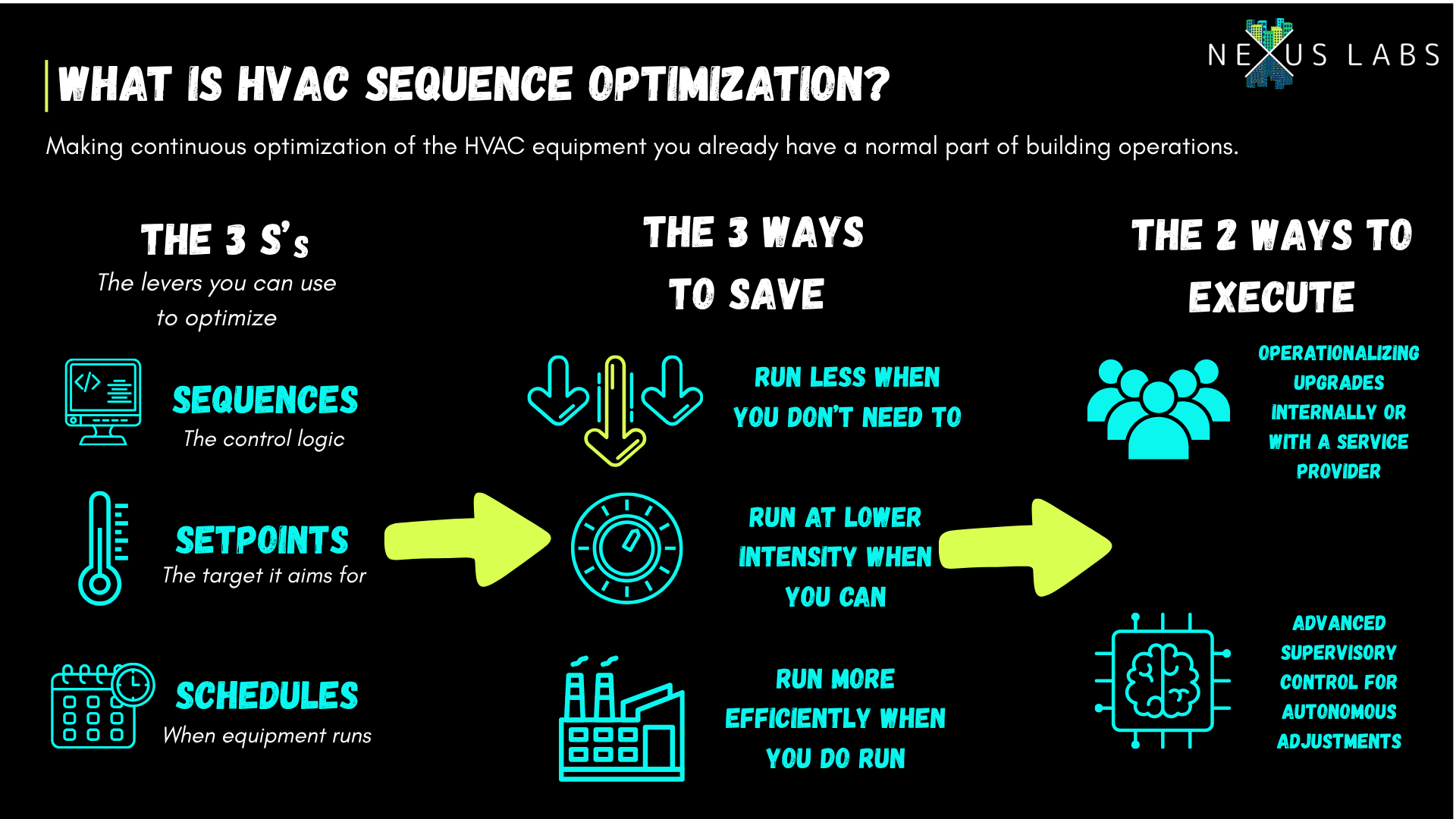
Anyone could probably define it differently. Um, the, the definition that I wrote down is making continuous optimization of the HVAC equipment you already have a normal part of building operations. Um, notice I say the words "equipment you already have" because I'm trying to stay away from the conversation of [00:11:00] capital improvements, where it's like, of course, I could have an old chiller and put, put in a much more efficient chiller and save energy there.
Um, and I'm also not trying to dive too far into demand management and flexibility, which I know we could probably do a whole nother episode on with you guys in terms of, um, how your utilities work, how you're understanding what's coming from the grid, what the price of that is, peak demand, all those things, and how you're, uh, managing that.
But we're not really talking about responding to, uh, the grid as much as just how can I optimize the stuff that's already in my building. Um, so I have this graphic that I can put in the show notes. Maybe this will be the first thing that I, um, would like to see if it resonates with you guys. But, um, to describe it to the audience if you're not looking at it I think of HVAC sequence optimization, I have three columns here.
First, there's the three S's. These are the levers that you can actually use to optimize. So there's the sequences actually written in your building automation system, the logic. You can change those. There's the set points, so you can, you know, broaden your set points [00:12:00] so you're not heating or cooling as much or anything like that.
Um, and then there's the schedules. When are you actually gonna run? And the three ways that you save with those three S's are, number one, you run less when you don't need to. That's kind of the scheduled part. Are you heating and cooling buildings when you don't need to? Number two, you lower intensity when you can.
So maybe you're at partial load, and this is the gift of the variable frequency drive, right? Is that we don't have to potentially run as much. Um, and then number three is you run more efficiently when you do run. There's a lot of ways to interpret that one. The example I thought of is, I heard of a, uh, a recent, um, portfolio that was...
had, had multiple steam boilers, and they changed the way that they were operating them to stage them more effectively. So it, it-- you could call that a sequence change, too, but staging your equipment to run it as, um, as well as possible. And then the two ways to execute, and then I want to hear you guys comment on this graphic, is that the most common way is kind of just, like, manually, right?
You're gonna actually have somebody, whether that's an internal or external stakeholder, [00:13:00] and they're gonna go in and change these sequences and set points and schedules to optimize. Um, and then the other way, which maybe we'll dive into a little later, maybe you guys have some comments on it now, is what we call advanced supervisory control, where you actually have an algorithm, a, a tech- a technology overlay that's gonna go in and autonomously change set points, call it every five minutes on a discharge chiller or discharge rooftop temperature sensor.
So, so set points so that you can, um, get as much optimization all the time. Do you guys buy into these ground rules of where we're starting? Does this, like, resonate with the work you're doing?
Gabe Sandoval: Um, I mean, I, I can speak first. I mean, it does. Yeah, def-definitely, I, I highly agree that those three, the sequences, set points, schedules are the, the key elements.
Um, I, I think w- if I was to, to prioritize it, though, I think that would be key to it as well because if, if I'm looking at those three, and if I was to recommend to somebody, "How are you going to optimize your building and your, your systems?" Schedules would be number one. That, [00:14:00] that is the, to me, the number one, um, energy leakage.
I mean, it, it's, it happens the easiest, the quickest. Um, it just takes one building operator to go in and change the start time because he feels like it's not warming up or cooling down, you know, fast enough during the day, and he moves it up two hours, and all of a sudden you're running two hours more than you need to.
Um, so I, I, I think to me, scheduling is like- Top priority, I, I would just list it in that order. Um, and set points and then sequences. Sequences is always a little more challenging because then you, you're getting into programming and, and- Sure ... understanding the code. So that gets a little bit more difficult to pull off.
So again, if I was putting this out to recommend just for the general energy manager out there, I think that's the priority that I would, I would probably focus in on to help them to make the decisions and what to look for.
Brad Bonavida: Mm-hmm. Yeah,
Patrick Testoni: that makes sense. Yeah, I agree. The one-- when you brought this up, I started thinking about all these things that can be accomplished in the three, but the one thing that we find in our phase of work is, I mean, the [00:15:00] sparks, right?
The equipment that's, the sensors and the equipments that aren't functioning correctly and how they can drive a system out of control. And there's two things we work on, which is how can we identify quicker those failures, right? 'Cause even with the best sequence and the right set points and the right schedules, if you have a bad sensor or piece of equipment, it can, um, short-circuit, right?
Yep. And that's what we found. And so there's t-two ways we address it, which is simplification, which is kind of sequences, right? Um, Gabe, I'm sure you still deal with it. You have Rev 1, 1.3, building gets changed, 1.5, 1.55, and you have, when you, when you go in there, um, sometimes you just need to simplify and overhaul sequence operation.
Um, and that's been a challenge in the industry, too. These new buildings are so complicated, they actually end up burning more energy 'cause they're more vulner- more volatile to flip on the other side of energy performance. So I think that's known now, [00:16:00] but in practice, and it's related to sequences, but I think, um, what I'm finding in our earl- re early phase of this is just how do we address all the, how do we address the maintenance and identification of systems that are, have equipment that's not performing correctly?
So I don't know how you fall that in, but it's a huge one.
Brad Bonavida: Yeah.
Patrick Testoni: Um, sometimes it means you just limit the control points you have, right? And then you can only have to focus on those points as the high, high priority ones to watch, but.
Brad Bonavida: Yeah, that's... I, I'm glad you brought that up here because there's, there's a real gray area between what we're trying to put in this box called sequence optimization and what we talked about in our last virtual event, which was what we called condition-based maintenance, and this, like, overlap between the two.
'Cause what I'm hearing you say is, like, you can get the, you can get these signals that something's not working right and respond to that, and often that's in terms of occupant experience or, um, [00:17:00] you know, uh, operational efficiency, but that goes so hand-in-hand with energy, I would imagine. Like, you guys, I, I want it, I want you to answer this, but it seems like those things wouldn't really even be that different to someone in your position, 'cause if you're improving operational efficiency, you're probably saving energy at the same time.
I mean, do you think of those separate or are they just overlapping
Patrick Testoni: and- Lower maintenance costs. Yeah. Lower operational costs. The one thing I'm looking right now is before it was, uh, basically do it now, right? When it fails, we replace it. Now, now it's these planned maintenance cycles, which are fixed and very work, very good.
But with this new technology, my whole thing is like, we don't need more labor to modernize. Maybe we should have modernize how we maintain equipment on demand-based maintenance, right? Mm-hmm. How can we shift the... 'Cause it, it results in maintenance improvements and there's a lot of inefficiency in maintenance, in my perspective.
I'd love to hear Gabe's feedback on it as well. I think there's an opportunity to improve maintenance efficiency to support this work.
Brad Bonavida: Yeah. And, and then, Gabe, a question on yours, you brought up the schedules as kind of, [00:18:00] like, a good starting point, which I think is good feedback. Are you-- In your head, were you thinking just simply, like, getting a hold of your schedules and where they're, where they're actually overridden or, or where they land?
Or you-- were you thinking all the way into, like, using occupancy as a proxy to understand when you should be running your buildings?
Gabe Sandoval: I mean, I, I think it's like, I think, like, early in your playbook you mentioned about drift and, um, you know, you have a building that you get day one, and it has... And generally, when a building's day one, you have a set time you're expected to operate, and you base your energy and utility usage off of that.
And I, I, I think that's what I'm focusing on. Why-- If we have to deviate from that, what are the reasons why we're deviating? Yeah. And so that's where you get into looking at occupancy of the building and what it's being used for, and has it changed, and are people overriding things? Um, you know, it can get a little bit, uh, d- I mean, even though schedules can be simple, it can get a little bit difficult to kind of pin down, you know, what's happening in a building and why, why is it that we're now running so many more hours during the week than we anticipated and our [00:19:00] utility bills are much higher.
So, uh, it's, it, it's... If you-- I wanna-- It's not as easy as just looking at occupancy, but it is one key element of it, though.
Brad Bonavida: Yeah. Yeah. That's a good segue into, uh, I, I need to get us to the steps, but the second part of the playbook that we wrote is why owners are actually ca- care about this, and I think we've covered a decent amount of that.
But, Gabe, you talked about drift and, um, you know, in, in the intro to the playbook, we talk about, uh... We give this scenario where, like, a building is commissioned and it's running optimally, and then every day you drift away from that of, like, you know, somebody commands a sensor and then, oh, there's an after-work event, so there's a schedule.
And oh, I don't know why that building is over- or that set point's overridden, so I'm not touching it. And, you know, all of a sudden you're two years out and you're very much not op- optimized. That's, that's the drift we're talking about. But really, that's just a-- that's something that you, you're fighting that drift so that you can reduce energy consumption, you can, um, reduce tenant complaints, which we were just talking about how that's so related to energy usage, and then [00:20:00] sustainability and, and compliance as well.
Um, so I wanna hear if you guys have any comments on why people are running this. But one other point is, Gabe, when I was writing that part, I was thinking about your presentation at Nexus Con because I start with when the building is commissioned, it's running optimized. And I could just picture you disagreeing with that because your whole Nexus Con presentation was a how about when the, you know, construction team walks out, it's actually still not even optimized.
So I'm kind of going in with this assumption that we're starting with an optimized building, but I know you talked a lot about that's not exactly how the op- the turnover from construction typically happens.
Gabe Sandoval: Yeah, you're reading my mind. I, I thought about, I thought about the same thing too when you wrote it.
I'm like, "Yeah, that doesn't happen too often and the building's at 100%." And I-- But I, I think it is... I w- I, I was thinking about this and how, uh, it is good though for energy managers and what, and people operating the building, that if you take on a building, don't ever assume that it ev- the building ever was running at 100%.
Um, and I, I, I find that happens many times that I walk into a, a building that we've taken [00:21:00] over, I start digging into the sequences, programming, controls, and I find, yeah, this reset never worked, these points never worked, this never worked, this has been disabled from day one. So I, I think it is a good lesson to learn that never to expect it to be at 100%, uh, though ideally would be nice.
But-
Brad Bonavida: Yep. Yep. Okay. So I got to keep us moving or else I'm never going to get through this. So I'm going to dive into the actual steps now. The playbook has, uh... I don't even remember off the top of my head. The playbook has 12 steps that we wrote, um, and it-- we kind of split it into three phases. There's the setup phase, the pilot phase, and then the, uh, the rollout phase.
For you guys, I would... You guys are both running pretty mature projects, so I'm going to say things like pilot. I don't really know if that applies super well to where you're at right now because you've done so much optimization that the term pilot, in this case, more applies to the building owner who, like, they haven't even thought about optimization.
And so they're going to want to start with, [00:22:00] like, testing something and seeing if how that works and then expand on. So we can dive into that. Um, but first, let's start at the setup phase. Um, the first, the first step is defining your outcomes. We already talked about that. You guys both mentioned, you know, what's driving you, this 2% reduction yearly.
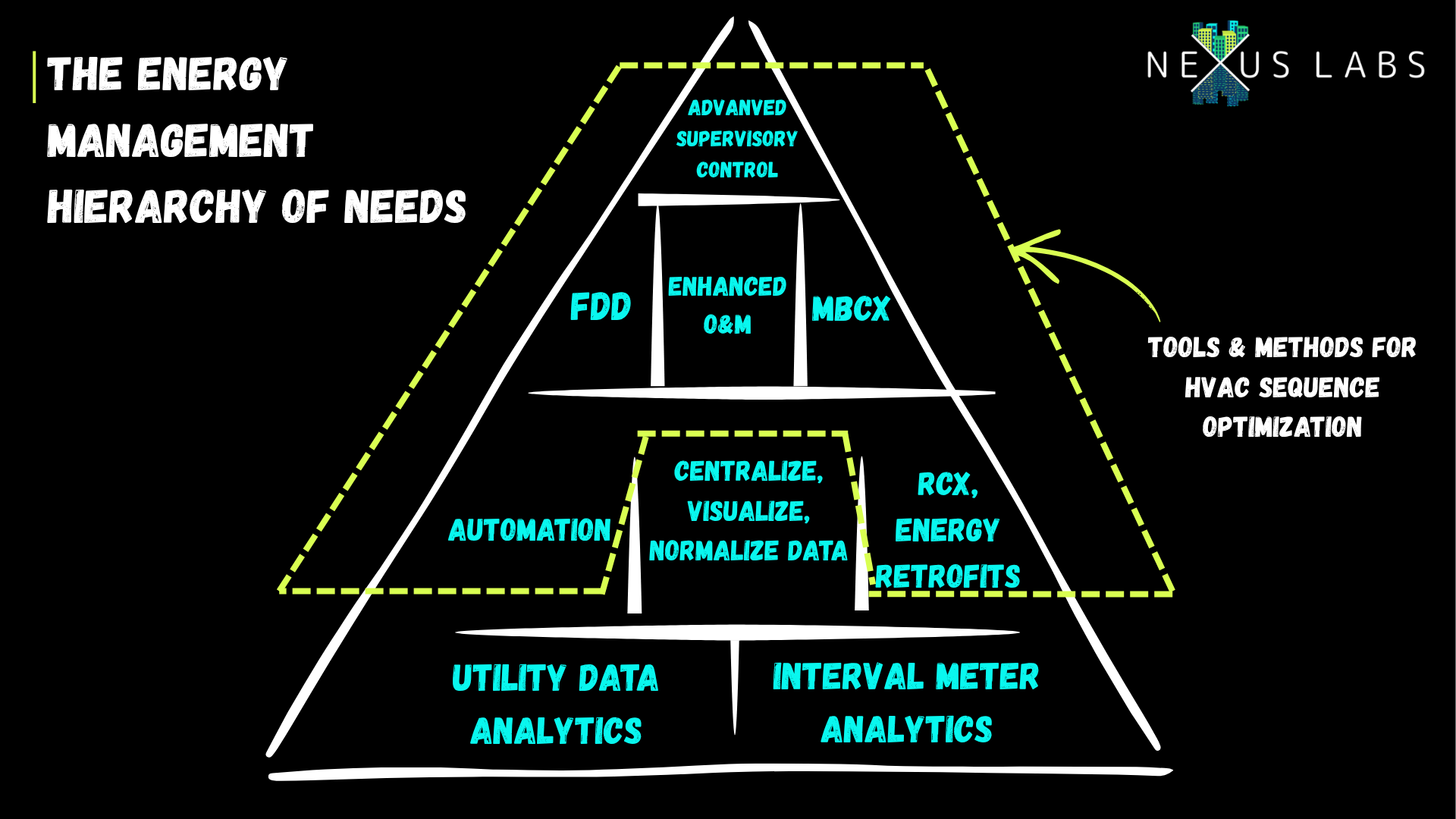
Um, energy prices are obviously increasing, sustainability goals. Y- as a building owner, you got to kind of determine what you're, what outcomes you're actually driving for. Um, but the next one I want to talk about is number two: confirming your energy management hierarchy of needs position, which is a mouthful, and we have another graphic here that we'll share.
But the idea here is really, like, you can't just go into a building and start optimizing right away if you don't have some foundational building blocks that are going to allow you to do that effectively. Do you need all the building blocks? No. But you're going to need some of these to be effective. And, and these building blocks in, in this pyramid are things like utility data analytics.
So do you understand what you're spending on your utility bill? Interval meter analytics. Do you have [00:23:00] submeters that can actually tell you what your, you know, worst energy users are? Um, automation and digital control. If you can't actually digitally change a set point, you're never going to succeed. Uh, centralizing data, if you don't have data in a place that you can access it.
Um, so those are like, I would say, probably the four biggest building blocks. Then on top of that, you can do these manual optimization things like, um, you know, uh, retro commissioning all the way up to advanced supervisory control. So I would love for you guys to comment on the pyramid. I think my question for you is, um, are you guys evaluating, like, a building by building in a similar lens?
Because I, I imagine that there's all these different maturity levels of how far along each of your buildings are. So is this a d- is this pyramid a different game for every building in your portfolio that you're playing over and over? Uh, Patrick, what do you think?
Patrick Testoni: So to clarify, it builds from the base up?
Brad Bonavida: Yeah. Yeah. So the base is like, these are the blocks that you need, and then the top is like, if you had those blocks, you can do these other things.
Patrick Testoni: No, it looks pretty good. I mean, [00:24:00] you know, definitely whenever we're looking at buildings, we look for the building level up, 'cause that's where you have most of your data.
Um, some people don't. But building level data, um, it's monthly data, then getting 15-minute data, that helps you evaluate, um, EUI, um, which in practice is the base of how I approach it, um, in my role. I'm looking at the campus and I'm gonna... You... Saving 2% on a high energy use building is gonna be equivalent in impact to saving 10% on a low impact building.
Brad Bonavida: Hmm.
Patrick Testoni: Also, buildings that run all the time and are high energy users, um, you make one small change and they can have a lot of energy. So these are the things you can notice, right, um, from looking at those data. Um, so I, you know, I, I think this is a good stack in how we've approached it. I mean, um, when Gabe and I first worked, we [00:25:00] were in the base of the pyramid working our way up, and now- Yeah.
Yeah ... we're kind of working our way up the pyramid as technology advances, so. Um, but it's also rebirthing too, because, um, you get new space, and equipment that was cutting edge and helped you out becomes legacy, and you need to improve it or it becomes stuff that we used 15 years ago isn't as, uh, easily usable, right, as systems update.
It's another piece, I don't want to go into details, but the migration of ITS, which is the linchpin of this work, can really have cascading impacts on your technology
Brad Bonavida: Sure. A- and, and centralizing the access to the building automation system. Like, do you, Patrick, at Santa Cruz, do you have, like, um, a centralized remote front end for all of your buildings that someone can access, or do you have still some disparate control systems throughout?
Patrick Testoni: For the most part, yes, centralized [00:26:00] system. Um, but as an example, uh, as ITS rolls out new security controls, then we, we get-- start having limited access to that data, at least from, like, in our example, SkySpark, right?
Brad Bonavida: Yeah.
Patrick Testoni: That's why I brought it up. You know, you can have new technology security issues that we're-- uh, you must update or you lose access.
Um, it's a, it's a functional, real thing, um, 'cause the-- it's such an evolving space, right? You really need- Mm-hmm ... to keep evolving, which means investing time and money.
Brad Bonavida: Yep. Yep. Gabe, what about you? Are you, are you guys building off of a similar pyramid? Like, does this resonate?
Gabe Sandoval: Oh, yeah, absolutely. And I think, like Patrick mentioned, you know, it's that base.
Um, that was the first thing, um, you know, when, when I started working at UC Santa Cruz almost 20 years ago, I was mainly controls. I wouldn't-- I was-- I didn't know anything about energy. Patrick was my mentor for energy. I didn't understand any of the terminology or any of it, and that was the number one thing when we started, um, retrofitting buildings, is he would say, "We [00:27:00] need meters."
And I'd say, "Okay. Let's go put meters in." And so we put meters in and automate them and bring them into the database. And, uh, but it taught me that that's the basis. You gotta have a-- we gotta have a way to measure, and that's really where you have to start at. Um, and then from there, you can kind of build up, you know.
You build up your automation- Yeah ... and you build it, you start building on the more advanced things.
Brad Bonavida: One, one quick detour, uh, o-on that point is y-you know, talking about bringing in meters and sub-metering is something we obviously cover a lot. I have heard this hot take that like, especially, um, around buildings that we're trying to achieve LEED certification, there's a level of sub-metering that occurred over the last decade or so that was like kind of overkill for some people, and they've got sub-meters that are doing...
Th-they can't keep track of them. They're, they don't even know if the data's accurate anymore. So I don't know, any thoughts on that or advice for somebody who's less far along on like how much is too much or not enough?
Patrick Testoni: There's a balance. You need to understand like, uh, the resolution, right? And it's, it's case dependent, right?
So the problem, a [00:28:00] lot of it is the code, and LEED and Title 24 are prescriptive, and without the understanding of why those exist, you can end up misappropriating that- Yeah ... that to get the points or meet the code and, and that can be as harmful too, 'cause then you're, you know, w- the more you add, the more you have to maintain, the more you have to upgrade.
Um, and a lot of times it's understanding, oh, we have VFDs. That is a meter, right? It's just about specifying it correctly. Uh, we have, um, a chiller. Let's make sure to put a, a Modbus card or a BACnet IP card in so we can get all the data that's available, 'cause that's a meter too, right? Mm-hmm. 'Cause it's really just tracking i- points that impact energy usage.
That's all a meter is, right? So it's really sometimes that happens from either a, a point chasing, which will happen on projects. There's chasing points without understanding of the reason Or mis- misapplication without the understanding of [00:29:00] code.
Brad Bonavida: Totally agree. Okay, let's, let's move on to this third step here.
We covered some of this, I'll still mention it. After you have, uh, you know, looked at your energy management hierarchy of needs, you have to audit your HVAC controls infrastructure, which is related, but a little more in depth. That means where do your controls live? So Patrick, we were just talking about how you guys more or less have one front end, you know, one remote area that people can access.
Is it cloud? Is it local? Is IT letting people, you know, access it remotely? All those questions. Um, what are your controls doing? So, um, I don't think we've yet mentioned ASHRAE Guideline 36, which we could get into as, like, a common, you know, standard that people are using to try to achieve good energy sequences through in their building-- throughout their buildings.
Do you have that or do you have something else? Where-- What are these sequences written based on? Was it the design engineer's original sequence? Did a, you know, a energy audit company come in and change them five years ago? Where are you at? And then who updates these today and how do they update them?
This is just kind of like taking an [00:30:00] inventory of, like, if I were gonna make a change, where does it change, what am I changing, and who is actually able to change it? And, um, I guess my question for you guys is I'm curious how difficult this is for you to get a grasp of in your campuses, and, and I'm thinking that it might be a little less difficult than other, uh, than other verticals.
Like for example, um, Amazon gave a presentation at Nexus Con last year about their, uh, fulfillment centers and they said this was one of the hardest things to do. But I think a lot of that is because they have fulfillment centers over the entire, you know, North America . So the, you know, the building automation system in the one in Seattle is probably has nothing to do with the building automation system or cloud connection in the one in Miami.
So they, they think this is really hard. I think you guys as campus owners have a, a little bit more control over it, but what do you think? Uh, do you feel like you have a good sense of your HVAC controls infrastructure and who has access to these things and how they update them, um, today? [00:31:00]
Gabe Sandoval: I mean, yes and no
It's, it's, it's a little challenging. I mean, we, we are a ca- a, a campus, but our campus is spread all over San Francisco and, and Oakland now. Mm-hmm. So trying to track down what we have out there is, is, is challenging. Um, I mean, we have a... I, I think, you know, our-- I-- Early on when I, I worked at, um... I was on the campus at UCSF for a while, and we worked with IT and we, we developed a really good relationship.
This was probably 10 plus years ago now. And, uh, we, we were able to build out our VLAN and get IT support and start going to IP-based controllers. We, we-- I think we were one of the first in the nations really to push it out widespread. And so we, we were able to get, you know, learn how to, um, you know, get access to our systems and be secure about it.
And so I think we have good visibility for, for everything that we have out there. I, you know, through the time that I've been here, I've been trying to track down all the different control systems we have. So I think we have a pretty good catalog of everything out there. Um, so [00:32:00] it's, it's, it's a, it's a process though.
It's not, it's not easy. Um, I think the age of our infrastructure makes it a challenge, but, um, I, I think, you know, we, we are working through it. I think we have a pretty good idea of what we have
Brad Bonavida: Yeah. Patrick, what about, like, who, who is, who has access to actually change these things? Like, do you guys have strict guidelines around who's actually able to go into a sequence and update it and tune it and, you know, empowering the right people, yet not risking, you know, giving somebody too much access that they can hurt things?
Patrick Testoni: Yeah, that's the balance, right? Um, so, um, the, that's... I lean on our controls department and our HVAC department. We don't implement the sequences. Um, so, and, you know, back to how Gabe and I know each other, that was such an important partnership because I couldn't do the work without him. He's, he was the one with the ideas and the, the technology and the access to implement.
And what we did is we traded, you know, he says mentor, but we really just traded knowledge and, and, and together we were able to [00:33:00] do a lot of stuff. And I, I bring that up because that's so important. I know he's doing that in his role now, and it changes over time. Uh, sometimes it can just be understanding how to get the funding, which is basically understand the, the savings, the benefit, right?
So a lot of the work, the economic work, I can fall into that role. Um, and that's what my role still is on the campus. So it's about, uh, folks, f- for me, I always say energy management's change management, because you have to be, uh, encourage people to make changes, which, uh, by nature, most people are, are change-averse and risk-averse.
And so it takes, uh, the ability to be able to take that risk, and Gabe has that, um, characteristic, which is why he's successful at what he does. I'm trying to encourage that, that characteristic when I'm dealing with our controls folks so that they, um, will make those changes, 'cause that's the way it works.
We recommend, we identify, and we collaborate with the technical team that's implementing it. I have a, I have an understanding of it. I know the wire sheets. I don't make the [00:34:00] changes. So that helps because I can come with a more educated input. Um, but it, that's an important partnership to have, whether it's you and your other technical staff or, in the case of other campuses, you're working with your contractors and your partners or your consultants, right?
Brad Bonavida: Yeah. It, it's such a, a cultural thing to build a, a culture of, like, wanting to optimize your equipment because, you know, as a, as a former controls technician, like, going into a central plant and changing the tuning on a PID loop or, or there's some set point in, you know, some pharmaceutical room that you don't think should be overridden, but you're not quite sure why it was in the first place, like, that stuff is, uh, nerve-wracking to change.
But if you-- it seems like you gotta really build this culture around people who are trained to do the right thing and empowered to make those changes so you're not leaving anybody unable- And
Patrick Testoni: this is the key thing. Um, the, the default setting is, "If I do what they've always told me to do, then I won't get [00:35:00] in trouble or be critiqued," even though that could be punishing Or making the equipment more vulnerable to the, all those things, right?
Brad Bonavida: Yep. Love it.
Patrick Testoni: That's, that's the mentality switch. It's the, the, the, um, impact of not making a decision, right?
Brad Bonavida: Mm-hmm.
Patrick Testoni: And so that's what I'm always preaching to. And, and, you know, even... And it's hard because I'm not the one making the decision to take the leadership to go, "We need to do this," because not doing it's costing the campus.
Yeah. And potentially has all those fears that doing that control point change will have, right?
Brad Bonavida: Completely agree. All right. Uh, the, the fourth step in the setup phase is designing the pilot, which I'm gonna kind of skip because designing the pilot is designing everything we're about to talk about in phase two, which you guys have all done some of this.
So, um, I th- I think we can go past that, but just know that if you're at step four and you're, you're following along, that is designing the next five steps we're gonna talk about. So the, the first, uh, the [00:36:00] first step in the pilot phase is, is really, like, where the rubber meets the road of optimization, and that's...
I, I couldn't find a better way to write it than deploying the optimization process because there's so many different things that you can do. A- and I, I'm trying to have you guys help me really, uh, bring this down to some, like, real world examples for the audience. Like, Gabe, you mentioned, you know, schedule changes as a good starting point.
That is something you can actually do. Um, going in and updating, you know, tuning loops or updating set points, that's something you can actually do. Um, I talked a little bit about advanced supervisory control. I'd like to know if you guys are experimenting at all with that. But, like, what are the examples of, like, the real things that you guys are seeing done in these buildings optimizationally that's actually moving the needle and, and saving energy?
Gabe Sandoval: Yeah, I mean, I can speak on this. I mean, I think, like I mentioned, scheduling is a huge factor. I mean, I think-
Brad Bonavida: Mm-hmm ...
Gabe Sandoval: I, I know it seems like such a simple thing, and probably the most unsexy thing, but, but it, it is-- it'll save you. [00:37:00] It is probably the biggest saver. I, I learned this early on, like, with the work that Patrick and I were doing.
Um, you know, part of the band-aid that he would give me is, "Okay, go replace all the controls." So we did all the work in-house, and so we, we did everything from scratch. We built the panels, control work. And he told me, "Just program it how it was originally designed." So that's, that was what we first did. So we replaced the controls, programmed it to the original design, and then he'd do a, a measurement.
We always would find out that we would save... Our biggest savings were there. It w- we'd hit 10, 15, 20% just off that, and you would think, "Well, how is that possible? You didn't change any sequencing, operate..." Well, it was scheduling. Um, we gained visibility of the buildings. We didn't have visibility before. It was, it w- visibility was a little, you know, desktop sitting under, under somebody's desk, and then we brought it on the web and everybody can see what's going on.
So, uh, it came down to, to me, was scheduling. That was such a huge factor. So we, we-- what, that is the first thing we look at, is scheduling. Have the buildings have... Are, did somebody go in and change the schedules? Mm-hmm. And, and it just inevitably it, it's [00:38:00] happened, and we have to go and figure out why it's happening.
So again, not a very technical thing to talk about, but I, I, I, I'll keep going back to that, is that I think if... Do one thing, just go through your schedules and you'll be surprised what you can find.
Brad Bonavida: That's great Patrick, what about you?
Patrick Testoni: Oh, yeah. Scheduling definitely huge, uh, but, uh, I'll give Gabe more credit.
Like, um, the, you know, like I've watched products roll out. Who was the last person in there and the one who's getting pushed out the quickest? The controls people, right? Yeah. So a lot of times these buildings just get buttoned up, and they were, they were never meeting design, especially the older ones.
Now there's tools to do that. So, uh, when Gabe did that work, I'd go farther than say it was scheduling. He, he, he implemented the design, the op- the sequence as designed, which probably was better than w- how it was left.
Brad Bonavida: Yeah.
Patrick Testoni: And it also cleans up all the hot and cold calls and quick fixes people made because they need to get on to the next work order.
And this is just all I've heard. You know, sometimes, like you just gotta resolve the issue and make that [00:39:00] faculty stop calling the dean, right? And so that builds up over time, and so just doing a wipe, clean, and restart, which is kind of what he did. We had an earth and marine science building that was, it was tremendous.
The demand savings just from implementing its design. But scheduling and cleaning, I've found, I've noticed now working, uh, with the team we have now, a lot of times it's, it's, uh, um, these, these buildings are living organisms, so they put a new wing in, they update, they add new equipment, but they don't renovate the whole space.
Um, they don't revisit the whole sequence. They just tune it for the new absorber or whatever, and, and those projects add up over time. You just need to go in and take a look at it again. And you see it in these, these sequences, these wire sheets. They've just been revved and revved and revved. Sometimes you just need to go in and start over.
So that's the work we're doing now. Um, the other piece is just sensor failure. SkySpark is what we're using. Um, that was, that was the first thing that popped up was just, like, sensor failures. [00:40:00] Um, and- Hmm ... and this comes down to simple things like, "Hey, maybe it's, even though it costs five times as much, we should specify better equipment," because you're paying someone $100, $200 an hour to get up there and make that fix, and that's not even counting the energy penalty.
So it co- those are the simple things. But honestly, day one, scheduling. Campuses are variable schedule. They don't fit into those boxes of weekly schedules and holidays. They have tons of holidays, and that's not even counting the simple stuff. All right, aca- we have a break between quarters. That means the students are gone, but the staff are there.
Okay, it's summer break. The students are gone, but the staff are there, right? Um, or another t- or Thanksgiving. The, some of the students are here, the staff are gone, right? These are living organisms, right? And so scheduling and maintenance of your scheduling is, is huge.
Brad Bonavida: So take that one step further for me, e- either of you.
But, you know, scheduling's huge. You guys are working on making [00:41:00]that effective nonstop. You're using, like you said, Patrick, just, like, the known schedule of the building. Like, it is there classes today? Is, is it a break? I- is anyone planning to be there? Are you also using any other sources rather than just, like, the, um, planned schedule for the building?
Are you using occupancy sensors, access controlled badge swipe data? I don't know, anything, anything fancy like that to help with when it's on and when it's off?
Patrick Testoni: Not yet. Um, we're definitely... You know, if you have an isolated space, uh- There was a project that was worked on years ago that Gabe and I worked on.
It was called, you know, demand control ventilation, but it was more than that. I called it demand-based scheduling, right? Using occupancy sensors and CO2 in a s- uh, a piece of equipment that, you know, like controls a certain space like a lecture hall, right? And then you don't have to worry about updating every quarter with the academic schedule because there's a class from 3:00 to 5:00 this quarter.
Next quarter it's 2:00 to 3:00. If the CO2's fine and the occupancy, not just reduce to [00:42:00] the minimum ventilation rates for v- you know, volatiles, let's turn it off. And people would be concerned about that, but my argument was, well, the janitor's there at 2:00 in the morning and the system's off, right? So it's safe.
Yeah. Right? Yeah. You got the... So 'cause that's the number one. People are always coming up with reasons why you shouldn't do this stuff. Yeah. But, um, that's what, that's the only thing we've done. We've been looking at the, the data you're talking about, which is, uh, I know, um, the Pelican system, I guess, where you can use your lighting and your HVAC together.
Either HVAC's informing lighting, lighting HVAC, or now they're talking Wi-Fi data. That's something we've been talking about. Yeah. But we haven't functionally implemented that yet.
Brad Bonavida: Okay. Gabe, what about you guys?
Gabe Sandoval: Um, I mean, for here, healthcare's a little trickier, you know, because I think we, because of the, what we're serving, and you got patients, and you have surgery centers, operating rooms, pharmacy.
So it, it, you know, getting into, um, that level where you can, you know, shut things down, we have to, you know, there's, there's a lot of caution to it. We have been, um, doing scheduling for operating [00:43:00] rooms, shutting down at night for the certain amount of operating rooms, so that, that's been a huge energy savings that we've found.
Um, I, I know when I was at Stanford, we, we were deploying, um, where we connected d- right directly to the, um, like the, uh, the scheduling system for rooms, so for, um, like auditoriums, classrooms, things like that. So we, we were able to manage, um, on/off times for zones, you know, to that level. Um, and I, I think we, we were able to drive quite a bit of savings through that.
So I think there are a lot of means out there. I, I think like what Patrick mentioned, I think some of the newer stuff is the Wi-Fi and, and, you know, Bluetooth- Yeah ... and things like that. I think there's a lot of promise in those areas for, you know, for doing some advanced scheduling.
Brad Bonavida: Yeah, definitely. All right, I'm gonna keep moving us along.
Uh, the next one is measurement and verification, which is you're answering the basic question of did the optimization produce the outcomes that you committed to? I think we can go past this one unless you guys have anything to add. We did talk about it a little bit when we were talking about the hierarchy of needs and the [00:44:00] balance of the amount of metering you need versus not.
But really, if you're doing this for the first time, you just deployed some optimization process and you need to now go check and prove that it actually did what you expected. Um, step seven then is testing and adjusting rules. We haven't talked about rules as much, so I do want to get into this one. This was hard to put together because there's, like, no prescription of the exact rules that you need to have a energy management program that focuses on HVAC optimization.
I came up with four people who are always involved, and these could be, like, the same person, right? Maybe one person is doing all four of these. Maybe it's four different people, maybe it's two. But there's always the program champion. That's the one common thread. That's the person who actually cares about this, whether it's because their job mandates them to or because they're just passionate about energy savings, one of those things.
You two are probably the program champions for your, for your, um, facilities. Um, the second is the opti- optimization opportunity finder and validator. So that could be a person or a technology, but who [00:45:00] is, like, going and saying, "That's what's u- using the most energy, and there's a way to fix it, and this is how we would do it."
And then after that happens, that proving that it actually worked. Um, and that could be related to the controls and automation team, but at the end of the day, if you've got your three S's, schedule, sequences, and set points, somebody on that controls team is actually typing in to change those things. And then finally, the facility manager or building operator.
If that's not the same as the people above, those people care about comfort, and if you're going in and optimizing a building when they're responsible for the comfort of it, you guys are gonna interact for sure and ma- got to make sure that you're, um, you know, going in the same direction. Um, so my question to you, Patrick, you can maybe answer first, is who are the ma-- like, the key roles would you say on your team that are enabling this HVAC optimization, whether it's internal or external?
Like, who are the key people? What are they doing?
Patrick Testoni: Yeah, it made me think about this. So I always think of it as technical, economical, financial, and leadership, right? So Technical. [00:46:00]You need someone who can make the changes, be it replacing sensors, changing operations. Uh, and this, these all overlap too, right?
Uh, implementing these sequences and making these changes to operations and maintenance. Then you have, like, the technical economical. That's energy in our, our team, right? Um, using technology to identify, like in our case sparks, SkySpark, fault analytics. Attaching the economic benefits of that because-
Brad Bonavida: Yeah
Patrick Testoni: um, understanding what you can do and how it's gonna save you from a sustainability perspective, but from a money perspective. You save money, everybody's on board, right? And that can be, you know, understanding how to measure it, too. And then you've got the financial. You've got the people with the money and the resources to really do the work, right?
To prioritize the work, to get it funded. And then you need, you know, leadership.
Brad Bonavida: Mm-hmm.
Patrick Testoni: You know, so those are the big, big components. When there is a-- [00:47:00] When you have all four components of those, you are humming along, right? And, and I've-- You know, Gabe and I had that. Like, him and I worked on it, and we had the financial and we had the leadership, right?
Um- When you don't have one of those or one of them's not as, uh, supportive as it could be, then things stall. But those are the big ones.
Brad Bonavida: Did you guys have time, at times when you were working together that, like, you were fighting for justification of the program? And I don't mean program as in, like, obviously you need operations and maintenance, but, like, it, it takes, it takes, like you were saying, Patrick, uh, leadership to see the value in putting extra effort into optimization and energy savings.
Like, was it, was that alwa- I mean, I'm sure there's been times in your career where it wasn't as smooth, right? Has there been times where you- Oh, no.
Patrick Testoni: It was, it was an amazing time. Um, um, we had a lot of liberty to do work. I mean- That's great. That's great ... you know, and, uh, and combined with, uh, [00:48:00] we, we both had the right skills to get the work done, you know, and I leaned on Gabe's skill a lot, but I was just like, "Show me the projects, I'll figure it out.
I'll do-- I'll submit and I'll, I'll evaluate, I'll get the money." And the money was available. Um- Yeah ... you know, and the basis was the loan payment would be less than the energy savings. Yeah. So, and you were-- we were looking at a campus that hadn't been addressed in a long time, which meant there was opportunities abound.
Gabe Sandoval: Mm-hmm.
Patrick Testoni: Um, and it hadn't been maintained in a while, right? So that's, as you-- when you're starting out this, it actually can be a great time because there's... I don't, I won't use the cliches anymore, but the opportunities can be easy to find and they're very beneficial.
Gabe Sandoval: Yeah.
Patrick Testoni: Um, as you wind down, um, you're looking deeper.
And also, as these programs mature, people start critiquing and evaluating them, so the money doesn't free up, you know. It's just, like, the nature of a program. Early on, it's usually easier. As they refine it, it gets more difficult.
Brad Bonavida: Yeah. The other thing there, too, is that if you're [00:49:00]going in and everyone knows you're doing all this optimization work, what a perfect scapegoat for any issues, right?
Like, "Oh, now we've got these issues over here. Oh, it's probably Gabe who was doing this optimization work who changed something and caused this." Like, I heard that a lot looking through our, our content that's covered this is, like, it's a scapegoat. You're changing things to try to save energy, so what an easy finger to point.
That can work
Patrick Testoni: against you, too. Yeah. That can work against you, too, because the utility rates can go, "Well, you saved energy, but why did my bill go up?"
Brad Bonavida: Hmm. Yeah.
Patrick Testoni: It's a double-edged sword, but yeah. Yeah, you can get, uh, in-- you can get, uh, extra credit or extra critique.
Brad Bonavida: Yeah, exactly. So, so in your example of when you two were working together, I would call you, Patrick, probably the program champion who was keeping this thing moving, and Gabe was the optimization oppor- opportunity finder, validator, and probably the controls automation team as well who was going in and doing this stuff.
So that's cool. Uh, Gabe, what about at your current role at UCSF, what, uh, are these-- do these roles resonate? Is this what you're seeing?
Gabe Sandoval: Yeah, I mean, [00:50:00] I think, um, I, I mean, I'll key on the one, the program champion is, is Probably the, the key. I mean, you have to have that, right? The ch- and it could be champion of champions, right?
This, there could be multiple people. Mm-hmm. It could be a team. Um, it, it just made me think how sometimes I've, I've noticed this over the years, 'cause, you know, you, you start being around enough, you start noticing patterns and, um, you know, you may see somebody like at Nexus Con who, who's with an organization and they're the program champion and they're up there and they're talking about all these energy savings.
Then the next year they're not there, and then I look around, I'm like, "What happened to this person?" Well, they changed to a different company, and then you never see that other company anymore, right? They were the program champions, and now the whole program has died. Yes. So the program champion is, is huge, right?
You have, you have to have one person or persons who are gonna believe this, push it, and really work hard at it, um, because it is challenging. I mean, I think, like Patrick mentioned, yeah, it was, we were-- it was really good for a time. It was a, a... I, I do remember, you know, I did have some pushback in the very beginning because I was like, "Hey, I wanna-- I'm gonna rip out all the controls for this engineering building, and we're gonna put all [00:51:00] new controls and it's gonna work better."
And then, you know, obviously you have people saying, "What are you doing? That's crazy. What are you talking-- You're gonna rip out all the controls? You're not a controls person. You're not, you're not a controls company." And but then after we did one or two projects, then I think we proved ourselves. And so, um, you know, it, after that it went well.
But I, I face those challenges now here. But, but anyways. But yeah, I think, I think going back to the program champion is, is the key. You gotta have that one person or persons.
Brad Bonavida: Yep, exactly. Okay, we'll keep rolling. Um, the last step in the pilot phase is evaluating the optimization pilot. I'll skim over this piece, but if you were new to this, you just did all these things and now you're evaluating whether it worked or not so that you can either try to scale that thing you did or go try to under- understand what didn't go right and potentially do a repi- uh, another pilot.
That's explained within the playbook. Um, and now going into phase three, the rollout phase, uh, standardized before scaling. We've kind of talked about this. I don't know if you guys have anything to add here, but I think what really the, [00:52:00] is key here is, like, how are you actually controlling who is optimizing sequences and, and we'd already kind of talked about the culture of, you know, people who are empowered to do this.
Um, maybe one thing that we haven't touched on or anything else you guys wanna add to standardizing is anything you can say about, um, um, commanded points. May-maybe one of you mench-mentioned earlier that it's commanded for a certain amount of time. But I'm an operator, I got a hot call, I just need this person to not be upset.
They're an important person, so I command that thing way cool, like, "This is gonna work," and then I go do the 75 other things I need to do and forget about it. And, like, how do you avoid that? That seems like the situation that always would come over, back up, over and over again.
Gabe Sandoval: Yeah. I think, um, that, that is probably one of mo-most difficult, um, challenges, at least I find, I, I found over the years.
I mean, we've, we've implemented, um, you know, in some, in some control systems front ends, you can implement a time period where [00:53:00] it can't be permanent Um, but I've, I've received a lot of pushback on that too. Facility people- Right ... hate it. They do not want it. They will fight you on it as much as they can
Brad Bonavida: to- 'Cause
Gabe Sandoval: that, that's
Brad Bonavida: kind of scary too, 'cause then it's just gonna release who knows when and-
Gabe Sandoval: Yeah.
watch as the
Brad Bonavida: costs come back.
Gabe Sandoval: Yeah. So yeah, it is, it is challenging. And so, you know, often, like, you know, if we're, if we're doing the graphics internally or upgrading them, you know, it is that choice, right? Do you make this point visible or do you hide it? You know, there's, there's things you can do. So it, it, it is a, it is a hot button issue and, and it's...
Um, but I, I think it's, it is key because, again, as we're talking about these overrides can kill energy and kill, you know, good operation of the system. So, um, you know, I, I think it's one of those things that I think every person, you know, has to kind of figure out and address, um, you know, with the facility team.
Brad Bonavida: Yep. Okay.
Patrick Testoni: Yeah. And our, our side, you know, on the energy management side, we're using our fault analytics or Spark, SkySpark to, um... We can't stop them from [00:54:00] doing that 'cause that's a different group. But we can, we can set up rules to identify when that's being done.
Brad Bonavida: Yeah.
Patrick Testoni: Uh, so mitigate it, right? 'Cause before it would be in blind.
Um, but yeah, it's, it's the, the technological whack-a-mole.
Brad Bonavida: Yeah, exactly. Really is. That's a good term for it. All right. Uh, so that was n- step nine, standardizing. Step 10 is scaling the roles. We just talked about the roles, so I'm not gonna dive back into this here, but that would be if you've got a distributed portfolio or just more buildings than you can cover with your internal team, how do you take that program champion, that opportunity finder and validator, and make sure that you have that everywhere that you need it?
Um, and then planning the expansion waves. So maybe we'll hit on this one quickly. Um, you know, y- we're picturing this, we're talking about this hypothetical situation where somebody started optimization, they planned this pilot, they did it, it was great, they want to repeat it, they're standardizing, and now they're gonna do these expansion waves.
I think you guys probably do do some form of this, even if you don't think about it this way. But w- you [00:55:00] guys have buildings that are all sorts of different levels of maturity. So, uh, we talked about it, but I'd like to hit on it again, like, how are you addressing the, the energy consumption of the new construction project that's happening on one side of the block to the building that has outdated, uh, digital controls on the other side of the block, and, like, managing those two projects that are in totally different life cycles at the same time, and what energy optimization that they need?
Gabe Sandoval: I don't, I don't know if there's any clear answer to that, I think, because, you know, we have buildings that are new and then we have buildings that go back, you know, 80, 90 years You know, where we have pneumatic or we have control systems that are, um, y- that are already legacy, no longer a-available. Um, so it gets it-- I, yeah, it, it is a challenge.
I, I mean, it, it, you do the best you can. You do the best with what you have, and I think that's the key part of it, is you have to look at what's there, and you have to be able to determine, you know, the most that you can expect out of any system and then [00:56:00] just hope to achieve that. You know, with the newer- Yeah
controls, obviously, you can, you can get, you know, to 100%, you know, really good optimization. With the old stuff, you're gonna be limited. So I, I think you just have to temper your expectations and just do the best you can with what you have.
Brad Bonavida: Sure. I think that the prioritization, Patrick, that you said earlier is pretty important here of like, you know, if you have a building that's a huge energy user, optimizing 2% there might be a lot more valuable than a building that doesn't even matter, but you're op- or doesn't even matter, I mean, doesn't use much energy, but you're optimizing like 25%.
You gotta kind of prioritize how valuable it is to the portfolio.
Patrick Testoni: Yeah, you make practical choices, right? So buildings that where you can do a lot of stuff, you try to do stuff, but, uh, the one example I'll talk about is we had this old lab building, which, you know, for every time I tried to do projects, they were like, "Oh, don't touch that building.
We're gonna knock it down." Um, after 15 years of hearing that, I was like, "They're not gonna knock this building down." So, but we couldn't go in and do a f- we didn't... You know, these products like this, which, well, commissioning's not [00:57:00] gonna work, so we do simple stuff. Like what we did is said, "Oh, well let's modernize its air changes per hour," 'cause it probably is still doing, uh, air changes per hour based on when it was built.
So we can do simple stuff like putting VFDs on exhaust and supply and, you know, just keep it simple, right? Um, updating old buildings to modern, um, requirements, right? So those are the type of things. You look for those simple, and like you mentioned, it's a 24/7 building, so... And happy to say that we, after being told for 15 years not to do anything, 12 years later, that building is still not knocked down and saving all that energy.
So you, you kind of make, to kind of, you ma- uh, you approach functional things you can do based on the technology, 'cause a lot of times this work's not gonna justify a full project. It can, right, especially in lab and science buildings, but the w- thing that Gabe and I both share is the climate we're in, which is amazing and beautiful, but when you're trying to [00:58:00] retrofit, um, a lab building in San Francisco or Santa Cruz versus one in the Central Coast of California where it's seeing like 110 degree days, um, that can have huge financial impacts in that because of the, the, the climate region it's in, right?
Um, we're at 55 degrees half the year, literally, you know, which is, is great for energy use, but hard for projects.
Brad Bonavida: Yeah. Sure. All right. The, the last step is step 12, sustaining the program. Um, Gabe, I think you already kind of covered this with your example of there's, there's a program champion at Nexus Con and then they switch companies, and then you never hear from that other company again.
Uh, that, uh- Tied also to you do this big retro commissioning effort, maybe you hire some, you know, energy auditor to do it, and things are great. Well, of course, you're going to just ignore those buildings for the next who knows when. So I think that, that sustaining the program is specifically hard for this [00:59:00] playbook because once you run it, like, everybody wants to forget about it.
But then, you know, in two, three, four years, you're gonna be in the same exact spot. So, a, a mature program is one that can be sustained even when that champion leaves your company, and that's, that means that you've got some actual integrated, um, standards in there. Okay. So last question related to kind of this playbook that I want to ask you guys.
It's just kind of more what's going on in your world. Uh, not to put you on the spot, but what is, like, a next on the horizon related to optimization that you're trying to do with your buildings? Whether it's installing a new technology or a new building that you're trying to address, what's something that you're kind of just getting started on your campus that's, uh, on the horizon that you're working on?
Gabe Sandoval: Let me think. I mean, I can... I, I... Well, I don't know if I want to go this way, but, um, I am working on, uh, well, this idea about keeping buildings from drifting. Um, I am working on this idea of using agentic AI as, as a way to monitor the [01:00:00] building. Um, so we're, we're currently bui- building something in-house to kind of address that.
Um, I, I don't know if that's too much farther, too far out there, but I, I think it's very doable. I think the technology's here. I think, I think it is, it is very doable now, and I, and I think it could... You know, I, I, I can see the industry, you know, shifting in this pattern of how would, how do, how is AI gonna help us?
And I think people are still trying to answer that question. Well, I think this You know, being able to keep a building from drifting I think is a re- is probably really a, a good example of how it can help us, you know, 'cause it can be able to monitor temperature points and monitor key, key indicators to determine if a building is losing, you know, its, uh, its energy, you know, its EUI, um, goals.
So it's something that we're working on right now. We're hoping to have it deployed within the next few months. Um, so I, I think, um, it's something I'm excited about and hopefully to see, you know, how it turns out.
Brad Bonavida: Yeah. And I, and I do recall that Gabe has submitted a abstract to present on that exact AI agent topic at Nexus [01:01:00] Con.
So if that part sounded interesting to you, you should probably come ta- see if, uh, if Gabe's talking about it in Detroit in October. All right, Patrick, what about you?
Patrick Testoni: I mean, there's so many things I'm working on related to this topic. The one thing I, I've been thinking about is really, uh, since there's limited s- usually the biggest pushback you hear is we, at least I hear, is we, "That sounds great, we should do this, but we have too much space and we already don't have enough people and money."
So revisiting, um, you know, uh, the one comment I heard back from one of our supervisors, I said, "How much do you spend a week on, uh, staff time doing planned maintenance?" And they said 30 per, 30 to 50% of their time is spent on planned maintenance. So why not use, uh, analytics and AI? I didn't think about AI until Gabe mentioned this.
I thought about analytics so that we can convert some of those old routine scheduling. Everybody talks about the filters and the DP and stuff, but how can we expand out maybe tracking the performance of a motor [01:02:00] so that we know when its efficiency drops, rather than just going, someone goes out and just reads the numbers on it, puts a logger on it and burns up time, right?
How can we modernize the efficiency of their time to free them up to do this work, right? So that's, that's the thing I'm working on right now. That's
Brad Bonavida: great. Cool. Yep, that, that seems to be a common one. People are get- getting AI into their work order systems to see if they can save time everywhere. So, um, it's a code that I don't think anyone's totally cracked yet, but a lot of people right, right there, so okay, cool.
Um, the end of the playbook is maturity framework. I'm going to leave this as a teaser for anyone who's listening because we're, we're short on time. But basically we've developed a five-step like grade yourself system. Um, and you can look at it in the playbook, but also during the Nexus Cast virtual event on June 17th where we're going through this, we're going to do a live poll of the building owner audience, which will be, you know, couple hundred building owners, and then we put the results of those poll on the, on the board and, and see where people are at with [01:03:00] this process.
We did this with condition-based maintenance and I, in, at our last event, and I think, uh, uh- 70 to 80% of the building owners who were present admitted that they were either a level one or two on a scale to five. So they're like, "We haven't figured this out yet. We're trying to." So there's plenty of work to do there.
I'll be very curious to see if people feel the same way about their maturity with, with this subject. Um, all right. Well, this has been great. We're gonna end as we always do on this podcast with carve-outs, so it's a total change of mindset compared to what we were talking about. This is just something fun that's been going on in your life, something you wanna share with our audience.
I'll go first. Um, I was gonna talk about a book, but I'm changing my mind. I'm actually doing something pretty cool this weekend. I'm, uh... I like to run. It's my hobby. I'm not fast, but I like to run, and I am doing this event called Ragnar this weekend, where there's eight of us. We're going to Aspen, Colorado, and we have to run, I think, uh, you have to run three different legs.
It's a relay, and each person runs three [01:04:00] legs, so that's 24 total legs. But, um, all in all, I think I run like 13 miles, like three, then five, then seven or something like that. Um, and, uh, it's all through the trails of Aspen, but it, it's just continuous. So it's gonna take us like 24 hours or 30 hours. And so, uh, you could be running through the middle of the Rocky Mountains in the middle of the night, uh, just with your flashlight.
So it's a little exhilarating, yet it's, you know, still running, which is boring to most people, but I'm looking forward to it, so it'll be fun. Uh, Gabe, what do you, what do you have to share?
Gabe Sandoval: Yeah, so mine is probably like the opposite end of what you're doing. I, I- I, I've been into making pizza. That's my latest thing.
Oh, nice. My daughter, my daughter was telling me, "Hey, ma- homemade pizza dough, it's really easy to do." It's... And she kept bugging me about doing it, so finally I did it, and that was like, "This is fantastic." So then I, I now went into this deep dive of pizza dough, and I'm learn how to do, like, cold fermentation, two-day cold fermentation.
Sweet. I got a pizza oven outside, and I just, I can't get enough of doing it. It's so [01:05:00] much fun, and it's, you know, it's delicious, and it's not running, but still, it's, it's, uh-
Brad Bonavida: That's awesome. Hey- ... I, I love it. Uh, so are you using like the dry yeast that you can buy at the grocery store, or where are you getting that?
Gabe Sandoval: No. This is, it's just basic yeast, but it's more the process. Okay. So it's, it's like you do a starter, and then the next day you do the dough, and then you- Yeah ... cold ferment it. You leave it in the refrigerator for two days, and it's supposed to help enhance the flavor of the dough, and all this fancy stuff.
But, uh- Love it ... it's a lot of fun. Peop- people love it. They come over. It's easy to make. Um, yeah. Yeah. It's, it's, it's a, it's a fun thing to do.
Brad Bonavida: That's great. All right, Patrick, what about you?
Patrick Testoni: Uh, there's a few things I've thought about, but I guess what I've been doing for the last few years is doing triathlons.
So I've been doing Ironman and Half Ironmans. Nice. The last three years I've done five Half Ironmans and two full Ironmans, so it's taught me a lot about, um, how much time you can spend each day working out. But- ... uh, it's, it's been a good, good thing to do. My goal is to qualify for Ironman [01:06:00]Hawaii. Cool.
It's a very, very tough goal. But I'll bring up what's interesting. I've been reading a lot of books or listening to a lot of books, 'cause I'm on the bike a lot, and Rick Rubin's book, The Creative Act, is so good. Okay. 'Cause he talks basically about how we all have the gift of creativity, whether we're writing a new song or inventing a new sandwich or a new pizza.
The creative act is within us all to do what we're doing, and this work is about... Everything we've talked about is kind of exemplifying what he's talking about, which is tapping into what your work is in life and how you can do the creative act with it. Really inspirational, really good stuff.
Brad Bonavida: I love that.
That's a, that's a great one to end on. So all right. Thank you everyone for coming.
Rosy Khalife: Okay, friends. Thank you for listening to this episode. As we continue to grow our global community of change makers, we need your help. For the next couple of months, we're challenging our listeners to [01:07:00]share a link to their favorite Nexus episode on LinkedIn with a short post about why you listen. It would really, really help us out.
Make sure to tag us in the post so we can see it. Have a good one.
Welcome to Nexus Labs, the home for the Connected Buildings Ecosystem—hosted by James Dice. If you’re new to Nexus Labs, sign up for our Connected Buildings Briefing, a 5-minute briefing on the people, tools, and playbooks changing how buildings run. Delivered every two weeks to 8,000+ building professionals.
The Nexus podcast (Apple | Spotify | YouTube | Other apps) is our chance to explore and learn with the brightest minds in the industry.
Nexus Labs runs an annual conference, NexusCon, and a quarterly virtual conference series, NexusCast.
Episode 198 is a conversation with Brad Bonavida from Nexus Labs, Gabe Sandoval from UCSF Health, and Patrick Testoni from the University of California, Santa Cruz.
Summary
This episode puts the Nexus Labs HVAC Sequence Optimization Playbook to the test with energy leaders from University of California, San Francisco Health and University of California, Santa Cruz. Together, they explore what it really takes to reduce HVAC energy consumption, combat operational drift, and maintain occupant comfort across complex building portfolios. The discussion walks through the playbook’s phases—from setup and pilot projects to scaling and sustaining optimization programs over time. Along the way, they share practical lessons on controls infrastructure, measurement and verification, team structure, and continuous improvement. It’s a candid look at how real-world energy managers are turning HVAC optimization into a repeatable, long-term operational strategy.
Mentions and Links
- Download the Condition-Based Maintenance Playbook
- NexusCast #3: The HVAC Sequence Optimization Playbook
- Patrick’s Book Recommendation
Highlights
Introduction (0:00)
At the Nexus (1:58)
Rapid fire context-setting (5:03)
What is HVAC Sequence Optimization (10:40)
Why building owners run HVAC optimization (19:11)
Phase 1: The Setup Phase (21:26)
Phase 2: The Pilot Phase (35:51)
Phase 3: The Rollout Phase (51:56)
Maturity Framework (1:02:31)
Carve Outs (1:03:25)
Music credits: There Is A Reality by Common Tiger—licensed under an Music Vine Limited Pro Standard License ID: S800157-16073.
Full transcript
Note: transcript was created using an imperfect machine learning tool and lightly edited by a human (so you can get the gist). Please forgive errors!
Brad Bonavida: [00:00:00] All right. Hello, friends. Welcome back to the Nexus Podcast. Uh, I am your host today, Brad Bonavita, Head of Product at Nexus Labs. This is where we talk about connected buildings and the playbooks behind them. This episode is for energy managers who are focused on lowering energy consumption across their building portfolio, but are working with a limited budget and limited resources.
Today is kind of a special episode. We're gonna dig into the HVAC sequence optimization playbook, and we're gonna h- see how it holds up against some real programs that real energy managers are running. This matters for energy teams because you're pressured to meet sustainability goals and energy goals, but you're constantly fighting buildings that are drifting from ideal performance, and it doesn't stop there.
This is also really important for facility managers who are trying to maintain equipment and keep tenants happy, because we all know that energy optimization and maintenance operations are super interrelated with one another, and those teams are often responsible f- for both things. A quick note, if you're trying to stay on top of this space without wading through all the vendor noise, we do write a [00:01:00] short newsletter.
It's called "The Connected Buildings Briefing." Comes out every two weeks. It's about five minutes long, and it tells you what's worth paying attention to. It's read over or read by over 8,000 people. We will put it in the show notes where you can grab it and sign up if you want to. Uh, in this episode, I have two guests joining me.
I have Gabe Sandoval, who's the senior controls and commissioning engineer at UCSF Health. How you doing, Gabe? Thanks for joining.
Gabe Sandoval: Doing really good. Thank you for having me.
Brad Bonavida: Of course. And our second guest was on your recommendation. We have Patrick Testoni, uh, director of energy at University of California, Santa Cruz.
How you doing, Patrick?
Patrick Testoni: I'm good. Thanks for having me.
Brad Bonavida: Yeah. And you two know each other from working together at the Santa Cruz campus, right?
Gabe Sandoval: Yeah. Yeah. I worked at UC Santa Cruz for about almost 10 years And, uh, Patrick and I did a lot of work together.
Brad Bonavida: Nice. I'm sure we will get into a lot of that. So like I mentioned, we're gonna get into the HVAC sequence optimization playbook.
So let me start with at [00:02:00] the, at the Nexus, which is our updates and, and maybe just a little bit of what the format of this podcast is. It was developed off this playbook. This playbook is now published. It's live for anyone to, uh, go download for free on our website. We'll have it in the show notes. It's going to be constantly updated because of conversations like this.
So you guys are gonna help me with my first iteration probably. But let me start by just quickly how I developed this, because I did use AI to help me, and I don't think this would've been possible without AI. So I'm actually pretty proud of the way it comes together. Um, so what I-- what we do is we, you know, we've been doing content since 2020.
Um, we have over 1,000 pieces of content between, uh, event recordings. You know, Gabe presented at the last Nexus Con, and then we write our, our blogs, and we have podcasts like this, and we've put that all into a database now that is searchable by Claude. And what I did is I teach Claude what I mean by HVAC sequence optimization, and I train it on, you know, exactly what I'm looking for, and then it goes and crawls our [00:03:00] 1,000 pieces of content and looks for examples of building owners who's ac- who've actually done this and how they've done it.
Um, when I go through that and I iterate on like what is real and what's BS, I ended up with 92 pieces of content that we've developed that are stories. It's not, it's not something we came up with. We're telling the stories of building owners who've done HVAC sequence of optimization and how they've done it And then with those 92 pieces, I'm able to tag what is being talked about there, whether that's, um, you know, they're sharing metrics that they're, they're, um, they're seeing in their program.
They have lessons learned that others need to avoid. Uh, maybe their organizational structure, or maybe they're talking about pilots, maybe they're talking about scaled programs. So I've got this big list. It's all sorted through. Then the hard work comes of, like, developing this outline, and it takes me days to actually write this thing so it's not full of AI hallucination and full of good material.
And out comes this document that's how we think people are doing this based on all the, um, building owners we've, you know, interviewed over the days. [00:04:00] So, um, for this one, I, I think there was, within those 92 pieces of content, there's over 35 building owners or, uh, about who, uh, are c- contributed to this, this playbook.
Uh, Dollar Tree, Empire State Realty Trust, Microsoft, Amazon, Lockheed Martin, KIPP DC School District, Wendy's, Ca- uh, California State, Dominguez Hills, DataBank, Lincoln Property. That's just some, but there's about 36. Um, and then to finish, why I built this playbook is that, uh, we're doing a Nexus Cast event, this is our virtual event series, on the HVAC Sequence Optimization Playbook on June 17th.
Um, so we are building content to support that. We're gonna have five or six different building owners telling case studies there as well, and this is all to bring together the ultimate guide, ultimate guide for anyone who's trying to run HVAC sequence optimization. So that's why we did this, and I am excited to have both of you 'cause you're gonna see if I've got a bunch of BS in here and see what applies and what [00:05:00] doesn't apply.
Um, but before we dive into that, I just wanna give more context to who you guys are and what you guys are doing. So this is supposed to be rapid fire so we don't get too into the weeds, but people wanna know your roles and why you are the experts in this field. So first, um, let's hear about your portfolios that you're responsible for.
You know, square foot, purpose, what the building types are. Gabe, why don't you go first with what your portfolio looks like?
Gabe Sandoval: Yeah. So we, um... It is a healthcare system, so, uh, we're primarily focused on hospital, medical office buildings, surgery centers, um, anything involved in healthcare. Um, so currently we're somewhere between three to four million square foot.
Um, we've been rapidly expanding. We just bought two more hospitals. We're absorbing Oakland Hospital. We're building two more hospitals, um, as well as a, a few MLBs that we have going on. So yeah, anything, anything related to healthcare is my primary focus.
Brad Bonavida: Okay. And Patrick, how about you?
Patrick Testoni: Uh, so UC Santa Cruz is a research institution, [00:06:00] so it's a variety of, uh, building types.
So it's about, I think it used to be two million square feet. I wouldn't be surprised if it's, like, 2.5 million square feet. Um, you've got academic buildings, residential, science buildings, labs, clean rooms, BSL labs. So it's a wide variety, um- So responsibility, I-- my primary responsibility is the state-funded side.
So, uh, we spend a lot of time focusing on the high energy users, which are the labs and the academic buildings. Um, my role varies, so a large subset of this work is related to energy efficiency, which is related to building performance
Brad Bonavida: Cool. And so you kind of answered my next question, um, but maybe you'll have something to add.
So Gabe, how about you? What i- what outcomes are driving your work as it relates to energy management? So, you know, I know you guys are in California. Sometimes there's man- state mandates, uh, there's the EUI you could be tracking, sustainability commitments. Like, what's really driving your day-to-day work and your goals?
Gabe Sandoval: Um, I mean, so I, I, I [00:07:00] reside within... Our department is the, um, part of its responsibilities is energy utilities. Um, and so the, the year-over-year goal we have is 2% reduction in energy usage, so that's part of what drives a lot of our work. Um, we also have the wider goal, which I think is, uh, all UC, including UCSC as well, we're under, which is, um, reduce carbon emissions.
Um, I think it's, like, 90% of the two- nine- 2019. I think Patrick probably knows it by heart. I don't know it as well. Uh, but that is also driving, driving a lot of our work to, uh, you know, reduce, uh, fossil fuel, uh, dependency. Um, so we're, we're, you know, rapidly switching over to all-electric buildings. Um, a lot of our new buildings now are, um, you know, we have EUI goals that we, we try to achieve.
And so, you know, much of my work is when a building gets turned over, you know, we're also working to try to make sure that building meets those EUI, um, design goals.
Brad Bonavida: Okay. Patrick, did he summarize it well? Is that, is that the [00:08:00] same for you?
Patrick Testoni: Well, it's a great summary. We work on, on very similar roles. So I'm, I'm, uh, dealing with the campus, so it's kind of like a layered approach.
So energy efficiency is, like, the al- always, almost always the tier one. Reduce the cleanest energy is the one you don't use. Yeah. But then it's about fuel switching to cleaner resources, uh, which is electricity. So we've got a, a movement at UC Santa Cruz and the whole UC system to switch away from fossil fuel burning, so that's a piece of the work.
Um, that 2% per year is a UC goal, so, uh, Gabe and I are working towards the same goal with different, um, factors because of the space we deal with. There's challenges, uh, for both of us in different areas 'cause the type of space we're dealing with. Um, but that is the goal, and it drives a lot of the work.
Um, and that t- varies over time. The work, uh, interesting Gabe and I did 15 years ago is kind of coming even more to the focus again because this, uh, smart building performance with technology improvements is kind of been the [00:09:00] overarching theme. That's how, uh, Gabe and I sat down the first time began working on projects, which at the time were just getting the baseline started.
But now with the analytics, you know, what do you do with all the data, right? First thing is, you know, 20 years ago, w- how do we get the data was the big primary. Now it's like, what do you do with all of it, right? So it's once again back to the simple building performance 'cause it helps With EUI, and it has other cascading impacts as well, but that's a driver
Brad Bonavida: So one point I did re- You know, Patrick, you were talking about how the work kind of differs in the way that you guys have different portfolios.
And one thing that I want to caveat with this playbook that made it really hard to write is that as you switch verticals and switch, uh, you know, building types, what people are doing for optimization changes drastically. So it was hard to write this in a way that's universal and helpful for a lot of people because, for example, um, Dollar Tree is talking at our upcoming Nexus Cast event, and, you know, they've got such a different challenge with [00:10:00] 9,000-plus tiny little buildings that are all the same versus a campus where everything's centralized, but maybe the buildings are a lot complex.
So we're gonna try to cover all those, and I imagine that you guys are gonna raise your hand a couple times and say, "This doesn't apply." And my counterargument's gonna be, "Yeah, it doesn't apply to you, but it applies to others." But we'll see. So, um, okay. We're gonna, we're gonna kick it off and dive into this.
And again, what I'm asking from you guys is like, you can raise your hand, you can just interrupt me, but challenge me or agree with me or give me some anecdotes of where you've seen this apply or how you guys have applied this, um, as we go through. Um, so I do have a set of steps that we'll go through, but before, we have to, like, set the b- the guidera- the guardrails of what is HVAC optimization.
Anyone could probably define it differently. Um, the, the definition that I wrote down is making continuous optimization of the HVAC equipment you already have a normal part of building operations. Um, notice I say the words "equipment you already have" because I'm trying to stay away from the conversation of [00:11:00] capital improvements, where it's like, of course, I could have an old chiller and put, put in a much more efficient chiller and save energy there.
Um, and I'm also not trying to dive too far into demand management and flexibility, which I know we could probably do a whole nother episode on with you guys in terms of, um, how your utilities work, how you're understanding what's coming from the grid, what the price of that is, peak demand, all those things, and how you're, uh, managing that.
But we're not really talking about responding to, uh, the grid as much as just how can I optimize the stuff that's already in my building. Um, so I have this graphic that I can put in the show notes. Maybe this will be the first thing that I, um, would like to see if it resonates with you guys. But, um, to describe it to the audience if you're not looking at it I think of HVAC sequence optimization, I have three columns here.
First, there's the three S's. These are the levers that you can actually use to optimize. So there's the sequences actually written in your building automation system, the logic. You can change those. There's the set points, so you can, you know, broaden your set points [00:12:00] so you're not heating or cooling as much or anything like that.
Um, and then there's the schedules. When are you actually gonna run? And the three ways that you save with those three S's are, number one, you run less when you don't need to. That's kind of the scheduled part. Are you heating and cooling buildings when you don't need to? Number two, you lower intensity when you can.
So maybe you're at partial load, and this is the gift of the variable frequency drive, right? Is that we don't have to potentially run as much. Um, and then number three is you run more efficiently when you do run. There's a lot of ways to interpret that one. The example I thought of is, I heard of a, uh, a recent, um, portfolio that was...
had, had multiple steam boilers, and they changed the way that they were operating them to stage them more effectively. So it, it-- you could call that a sequence change, too, but staging your equipment to run it as, um, as well as possible. And then the two ways to execute, and then I want to hear you guys comment on this graphic, is that the most common way is kind of just, like, manually, right?
You're gonna actually have somebody, whether that's an internal or external stakeholder, [00:13:00] and they're gonna go in and change these sequences and set points and schedules to optimize. Um, and then the other way, which maybe we'll dive into a little later, maybe you guys have some comments on it now, is what we call advanced supervisory control, where you actually have an algorithm, a, a tech- a technology overlay that's gonna go in and autonomously change set points, call it every five minutes on a discharge chiller or discharge rooftop temperature sensor.
So, so set points so that you can, um, get as much optimization all the time. Do you guys buy into these ground rules of where we're starting? Does this, like, resonate with the work you're doing?
Gabe Sandoval: Um, I mean, I, I can speak first. I mean, it does. Yeah, def-definitely, I, I highly agree that those three, the sequences, set points, schedules are the, the key elements.
Um, I, I think w- if I was to, to prioritize it, though, I think that would be key to it as well because if, if I'm looking at those three, and if I was to recommend to somebody, "How are you going to optimize your building and your, your systems?" Schedules would be number one. That, [00:14:00] that is the, to me, the number one, um, energy leakage.
I mean, it, it's, it happens the easiest, the quickest. Um, it just takes one building operator to go in and change the start time because he feels like it's not warming up or cooling down, you know, fast enough during the day, and he moves it up two hours, and all of a sudden you're running two hours more than you need to.
Um, so I, I, I think to me, scheduling is like- Top priority, I, I would just list it in that order. Um, and set points and then sequences. Sequences is always a little more challenging because then you, you're getting into programming and, and- Sure ... understanding the code. So that gets a little bit more difficult to pull off.
So again, if I was putting this out to recommend just for the general energy manager out there, I think that's the priority that I would, I would probably focus in on to help them to make the decisions and what to look for.
Brad Bonavida: Mm-hmm. Yeah,
Patrick Testoni: that makes sense. Yeah, I agree. The one-- when you brought this up, I started thinking about all these things that can be accomplished in the three, but the one thing that we find in our phase of work is, I mean, the [00:15:00] sparks, right?
The equipment that's, the sensors and the equipments that aren't functioning correctly and how they can drive a system out of control. And there's two things we work on, which is how can we identify quicker those failures, right? 'Cause even with the best sequence and the right set points and the right schedules, if you have a bad sensor or piece of equipment, it can, um, short-circuit, right?
Yep. And that's what we found. And so there's t-two ways we address it, which is simplification, which is kind of sequences, right? Um, Gabe, I'm sure you still deal with it. You have Rev 1, 1.3, building gets changed, 1.5, 1.55, and you have, when you, when you go in there, um, sometimes you just need to simplify and overhaul sequence operation.
Um, and that's been a challenge in the industry, too. These new buildings are so complicated, they actually end up burning more energy 'cause they're more vulner- more volatile to flip on the other side of energy performance. So I think that's known now, [00:16:00] but in practice, and it's related to sequences, but I think, um, what I'm finding in our earl- re early phase of this is just how do we address all the, how do we address the maintenance and identification of systems that are, have equipment that's not performing correctly?
So I don't know how you fall that in, but it's a huge one.
Brad Bonavida: Yeah.
Patrick Testoni: Um, sometimes it means you just limit the control points you have, right? And then you can only have to focus on those points as the high, high priority ones to watch, but.
Brad Bonavida: Yeah, that's... I, I'm glad you brought that up here because there's, there's a real gray area between what we're trying to put in this box called sequence optimization and what we talked about in our last virtual event, which was what we called condition-based maintenance, and this, like, overlap between the two.
'Cause what I'm hearing you say is, like, you can get the, you can get these signals that something's not working right and respond to that, and often that's in terms of occupant experience or, um, [00:17:00] you know, uh, operational efficiency, but that goes so hand-in-hand with energy, I would imagine. Like, you guys, I, I want it, I want you to answer this, but it seems like those things wouldn't really even be that different to someone in your position, 'cause if you're improving operational efficiency, you're probably saving energy at the same time.
I mean, do you think of those separate or are they just overlapping
Patrick Testoni: and- Lower maintenance costs. Yeah. Lower operational costs. The one thing I'm looking right now is before it was, uh, basically do it now, right? When it fails, we replace it. Now, now it's these planned maintenance cycles, which are fixed and very work, very good.
But with this new technology, my whole thing is like, we don't need more labor to modernize. Maybe we should have modernize how we maintain equipment on demand-based maintenance, right? Mm-hmm. How can we shift the... 'Cause it, it results in maintenance improvements and there's a lot of inefficiency in maintenance, in my perspective.
I'd love to hear Gabe's feedback on it as well. I think there's an opportunity to improve maintenance efficiency to support this work.
Brad Bonavida: Yeah. And, and then, Gabe, a question on yours, you brought up the schedules as kind of, [00:18:00] like, a good starting point, which I think is good feedback. Are you-- In your head, were you thinking just simply, like, getting a hold of your schedules and where they're, where they're actually overridden or, or where they land?
Or you-- were you thinking all the way into, like, using occupancy as a proxy to understand when you should be running your buildings?
Gabe Sandoval: I mean, I, I think it's like, I think, like, early in your playbook you mentioned about drift and, um, you know, you have a building that you get day one, and it has... And generally, when a building's day one, you have a set time you're expected to operate, and you base your energy and utility usage off of that.
And I, I, I think that's what I'm focusing on. Why-- If we have to deviate from that, what are the reasons why we're deviating? Yeah. And so that's where you get into looking at occupancy of the building and what it's being used for, and has it changed, and are people overriding things? Um, you know, it can get a little bit, uh, d- I mean, even though schedules can be simple, it can get a little bit difficult to kind of pin down, you know, what's happening in a building and why, why is it that we're now running so many more hours during the week than we anticipated and our [00:19:00] utility bills are much higher.
So, uh, it's, it, it's... If you-- I wanna-- It's not as easy as just looking at occupancy, but it is one key element of it, though.
Brad Bonavida: Yeah. Yeah. That's a good segue into, uh, I, I need to get us to the steps, but the second part of the playbook that we wrote is why owners are actually ca- care about this, and I think we've covered a decent amount of that.
But, Gabe, you talked about drift and, um, you know, in, in the intro to the playbook, we talk about, uh... We give this scenario where, like, a building is commissioned and it's running optimally, and then every day you drift away from that of, like, you know, somebody commands a sensor and then, oh, there's an after-work event, so there's a schedule.
And oh, I don't know why that building is over- or that set point's overridden, so I'm not touching it. And, you know, all of a sudden you're two years out and you're very much not op- optimized. That's, that's the drift we're talking about. But really, that's just a-- that's something that you, you're fighting that drift so that you can reduce energy consumption, you can, um, reduce tenant complaints, which we were just talking about how that's so related to energy usage, and then [00:20:00] sustainability and, and compliance as well.
Um, so I wanna hear if you guys have any comments on why people are running this. But one other point is, Gabe, when I was writing that part, I was thinking about your presentation at Nexus Con because I start with when the building is commissioned, it's running optimized. And I could just picture you disagreeing with that because your whole Nexus Con presentation was a how about when the, you know, construction team walks out, it's actually still not even optimized.
So I'm kind of going in with this assumption that we're starting with an optimized building, but I know you talked a lot about that's not exactly how the op- the turnover from construction typically happens.
Gabe Sandoval: Yeah, you're reading my mind. I, I thought about, I thought about the same thing too when you wrote it.
I'm like, "Yeah, that doesn't happen too often and the building's at 100%." And I-- But I, I think it is... I w- I, I was thinking about this and how, uh, it is good though for energy managers and what, and people operating the building, that if you take on a building, don't ever assume that it ev- the building ever was running at 100%.
Um, and I, I, I find that happens many times that I walk into a, a building that we've taken [00:21:00] over, I start digging into the sequences, programming, controls, and I find, yeah, this reset never worked, these points never worked, this never worked, this has been disabled from day one. So I, I think it is a good lesson to learn that never to expect it to be at 100%, uh, though ideally would be nice.
But-
Brad Bonavida: Yep. Yep. Okay. So I got to keep us moving or else I'm never going to get through this. So I'm going to dive into the actual steps now. The playbook has, uh... I don't even remember off the top of my head. The playbook has 12 steps that we wrote, um, and it-- we kind of split it into three phases. There's the setup phase, the pilot phase, and then the, uh, the rollout phase.
For you guys, I would... You guys are both running pretty mature projects, so I'm going to say things like pilot. I don't really know if that applies super well to where you're at right now because you've done so much optimization that the term pilot, in this case, more applies to the building owner who, like, they haven't even thought about optimization.
And so they're going to want to start with, [00:22:00] like, testing something and seeing if how that works and then expand on. So we can dive into that. Um, but first, let's start at the setup phase. Um, the first, the first step is defining your outcomes. We already talked about that. You guys both mentioned, you know, what's driving you, this 2% reduction yearly.
Um, energy prices are obviously increasing, sustainability goals. Y- as a building owner, you got to kind of determine what you're, what outcomes you're actually driving for. Um, but the next one I want to talk about is number two: confirming your energy management hierarchy of needs position, which is a mouthful, and we have another graphic here that we'll share.
But the idea here is really, like, you can't just go into a building and start optimizing right away if you don't have some foundational building blocks that are going to allow you to do that effectively. Do you need all the building blocks? No. But you're going to need some of these to be effective. And, and these building blocks in, in this pyramid are things like utility data analytics.
So do you understand what you're spending on your utility bill? Interval meter analytics. Do you have [00:23:00] submeters that can actually tell you what your, you know, worst energy users are? Um, automation and digital control. If you can't actually digitally change a set point, you're never going to succeed. Uh, centralizing data, if you don't have data in a place that you can access it.
Um, so those are like, I would say, probably the four biggest building blocks. Then on top of that, you can do these manual optimization things like, um, you know, uh, retro commissioning all the way up to advanced supervisory control. So I would love for you guys to comment on the pyramid. I think my question for you is, um, are you guys evaluating, like, a building by building in a similar lens?
Because I, I imagine that there's all these different maturity levels of how far along each of your buildings are. So is this a d- is this pyramid a different game for every building in your portfolio that you're playing over and over? Uh, Patrick, what do you think?
Patrick Testoni: So to clarify, it builds from the base up?
Brad Bonavida: Yeah. Yeah. So the base is like, these are the blocks that you need, and then the top is like, if you had those blocks, you can do these other things.
Patrick Testoni: No, it looks pretty good. I mean, [00:24:00] you know, definitely whenever we're looking at buildings, we look for the building level up, 'cause that's where you have most of your data.
Um, some people don't. But building level data, um, it's monthly data, then getting 15-minute data, that helps you evaluate, um, EUI, um, which in practice is the base of how I approach it, um, in my role. I'm looking at the campus and I'm gonna... You... Saving 2% on a high energy use building is gonna be equivalent in impact to saving 10% on a low impact building.
Brad Bonavida: Hmm.
Patrick Testoni: Also, buildings that run all the time and are high energy users, um, you make one small change and they can have a lot of energy. So these are the things you can notice, right, um, from looking at those data. Um, so I, you know, I, I think this is a good stack in how we've approached it. I mean, um, when Gabe and I first worked, we [00:25:00] were in the base of the pyramid working our way up, and now- Yeah.
Yeah ... we're kind of working our way up the pyramid as technology advances, so. Um, but it's also rebirthing too, because, um, you get new space, and equipment that was cutting edge and helped you out becomes legacy, and you need to improve it or it becomes stuff that we used 15 years ago isn't as, uh, easily usable, right, as systems update.
It's another piece, I don't want to go into details, but the migration of ITS, which is the linchpin of this work, can really have cascading impacts on your technology
Brad Bonavida: Sure. A- and, and centralizing the access to the building automation system. Like, do you, Patrick, at Santa Cruz, do you have, like, um, a centralized remote front end for all of your buildings that someone can access, or do you have still some disparate control systems throughout?
Patrick Testoni: For the most part, yes, centralized [00:26:00] system. Um, but as an example, uh, as ITS rolls out new security controls, then we, we get-- start having limited access to that data, at least from, like, in our example, SkySpark, right?
Brad Bonavida: Yeah.
Patrick Testoni: That's why I brought it up. You know, you can have new technology security issues that we're-- uh, you must update or you lose access.
Um, it's a, it's a functional, real thing, um, 'cause the-- it's such an evolving space, right? You really need- Mm-hmm ... to keep evolving, which means investing time and money.
Brad Bonavida: Yep. Yep. Gabe, what about you? Are you, are you guys building off of a similar pyramid? Like, does this resonate?
Gabe Sandoval: Oh, yeah, absolutely. And I think, like Patrick mentioned, you know, it's that base.
Um, that was the first thing, um, you know, when, when I started working at UC Santa Cruz almost 20 years ago, I was mainly controls. I wouldn't-- I was-- I didn't know anything about energy. Patrick was my mentor for energy. I didn't understand any of the terminology or any of it, and that was the number one thing when we started, um, retrofitting buildings, is he would say, "We [00:27:00] need meters."
And I'd say, "Okay. Let's go put meters in." And so we put meters in and automate them and bring them into the database. And, uh, but it taught me that that's the basis. You gotta have a-- we gotta have a way to measure, and that's really where you have to start at. Um, and then from there, you can kind of build up, you know.
You build up your automation- Yeah ... and you build it, you start building on the more advanced things.
Brad Bonavida: One, one quick detour, uh, o-on that point is y-you know, talking about bringing in meters and sub-metering is something we obviously cover a lot. I have heard this hot take that like, especially, um, around buildings that we're trying to achieve LEED certification, there's a level of sub-metering that occurred over the last decade or so that was like kind of overkill for some people, and they've got sub-meters that are doing...
Th-they can't keep track of them. They're, they don't even know if the data's accurate anymore. So I don't know, any thoughts on that or advice for somebody who's less far along on like how much is too much or not enough?
Patrick Testoni: There's a balance. You need to understand like, uh, the resolution, right? And it's, it's case dependent, right?
So the problem, a [00:28:00] lot of it is the code, and LEED and Title 24 are prescriptive, and without the understanding of why those exist, you can end up misappropriating that- Yeah ... that to get the points or meet the code and, and that can be as harmful too, 'cause then you're, you know, w- the more you add, the more you have to maintain, the more you have to upgrade.
Um, and a lot of times it's understanding, oh, we have VFDs. That is a meter, right? It's just about specifying it correctly. Uh, we have, um, a chiller. Let's make sure to put a, a Modbus card or a BACnet IP card in so we can get all the data that's available, 'cause that's a meter too, right? Mm-hmm. 'Cause it's really just tracking i- points that impact energy usage.
That's all a meter is, right? So it's really sometimes that happens from either a, a point chasing, which will happen on projects. There's chasing points without understanding of the reason Or mis- misapplication without the understanding of [00:29:00] code.
Brad Bonavida: Totally agree. Okay, let's, let's move on to this third step here.
We covered some of this, I'll still mention it. After you have, uh, you know, looked at your energy management hierarchy of needs, you have to audit your HVAC controls infrastructure, which is related, but a little more in depth. That means where do your controls live? So Patrick, we were just talking about how you guys more or less have one front end, you know, one remote area that people can access.
Is it cloud? Is it local? Is IT letting people, you know, access it remotely? All those questions. Um, what are your controls doing? So, um, I don't think we've yet mentioned ASHRAE Guideline 36, which we could get into as, like, a common, you know, standard that people are using to try to achieve good energy sequences through in their building-- throughout their buildings.
Do you have that or do you have something else? Where-- What are these sequences written based on? Was it the design engineer's original sequence? Did a, you know, a energy audit company come in and change them five years ago? Where are you at? And then who updates these today and how do they update them?
This is just kind of like taking an [00:30:00] inventory of, like, if I were gonna make a change, where does it change, what am I changing, and who is actually able to change it? And, um, I guess my question for you guys is I'm curious how difficult this is for you to get a grasp of in your campuses, and, and I'm thinking that it might be a little less difficult than other, uh, than other verticals.
Like for example, um, Amazon gave a presentation at Nexus Con last year about their, uh, fulfillment centers and they said this was one of the hardest things to do. But I think a lot of that is because they have fulfillment centers over the entire, you know, North America . So the, you know, the building automation system in the one in Seattle is probably has nothing to do with the building automation system or cloud connection in the one in Miami.
So they, they think this is really hard. I think you guys as campus owners have a, a little bit more control over it, but what do you think? Uh, do you feel like you have a good sense of your HVAC controls infrastructure and who has access to these things and how they update them, um, today? [00:31:00]
Gabe Sandoval: I mean, yes and no
It's, it's, it's a little challenging. I mean, we, we are a ca- a, a campus, but our campus is spread all over San Francisco and, and Oakland now. Mm-hmm. So trying to track down what we have out there is, is, is challenging. Um, I mean, we have a... I, I think, you know, our-- I-- Early on when I, I worked at, um... I was on the campus at UCSF for a while, and we worked with IT and we, we developed a really good relationship.
This was probably 10 plus years ago now. And, uh, we, we were able to build out our VLAN and get IT support and start going to IP-based controllers. We, we-- I think we were one of the first in the nations really to push it out widespread. And so we, we were able to get, you know, learn how to, um, you know, get access to our systems and be secure about it.
And so I think we have good visibility for, for everything that we have out there. I, you know, through the time that I've been here, I've been trying to track down all the different control systems we have. So I think we have a pretty good catalog of everything out there. Um, so [00:32:00] it's, it's, it's a, it's a process though.
It's not, it's not easy. Um, I think the age of our infrastructure makes it a challenge, but, um, I, I think, you know, we, we are working through it. I think we have a pretty good idea of what we have
Brad Bonavida: Yeah. Patrick, what about, like, who, who is, who has access to actually change these things? Like, do you guys have strict guidelines around who's actually able to go into a sequence and update it and tune it and, you know, empowering the right people, yet not risking, you know, giving somebody too much access that they can hurt things?
Patrick Testoni: Yeah, that's the balance, right? Um, so, um, the, that's... I lean on our controls department and our HVAC department. We don't implement the sequences. Um, so, and, you know, back to how Gabe and I know each other, that was such an important partnership because I couldn't do the work without him. He's, he was the one with the ideas and the, the technology and the access to implement.
And what we did is we traded, you know, he says mentor, but we really just traded knowledge and, and, and together we were able to [00:33:00] do a lot of stuff. And I, I bring that up because that's so important. I know he's doing that in his role now, and it changes over time. Uh, sometimes it can just be understanding how to get the funding, which is basically understand the, the savings, the benefit, right?
So a lot of the work, the economic work, I can fall into that role. Um, and that's what my role still is on the campus. So it's about, uh, folks, f- for me, I always say energy management's change management, because you have to be, uh, encourage people to make changes, which, uh, by nature, most people are, are change-averse and risk-averse.
And so it takes, uh, the ability to be able to take that risk, and Gabe has that, um, characteristic, which is why he's successful at what he does. I'm trying to encourage that, that characteristic when I'm dealing with our controls folks so that they, um, will make those changes, 'cause that's the way it works.
We recommend, we identify, and we collaborate with the technical team that's implementing it. I have a, I have an understanding of it. I know the wire sheets. I don't make the [00:34:00] changes. So that helps because I can come with a more educated input. Um, but it, that's an important partnership to have, whether it's you and your other technical staff or, in the case of other campuses, you're working with your contractors and your partners or your consultants, right?
Brad Bonavida: Yeah. It, it's such a, a cultural thing to build a, a culture of, like, wanting to optimize your equipment because, you know, as a, as a former controls technician, like, going into a central plant and changing the tuning on a PID loop or, or there's some set point in, you know, some pharmaceutical room that you don't think should be overridden, but you're not quite sure why it was in the first place, like, that stuff is, uh, nerve-wracking to change.
But if you-- it seems like you gotta really build this culture around people who are trained to do the right thing and empowered to make those changes so you're not leaving anybody unable- And
Patrick Testoni: this is the key thing. Um, the, the default setting is, "If I do what they've always told me to do, then I won't get [00:35:00] in trouble or be critiqued," even though that could be punishing Or making the equipment more vulnerable to the, all those things, right?
Brad Bonavida: Yep. Love it.
Patrick Testoni: That's, that's the mentality switch. It's the, the, the, um, impact of not making a decision, right?
Brad Bonavida: Mm-hmm.
Patrick Testoni: And so that's what I'm always preaching to. And, and, you know, even... And it's hard because I'm not the one making the decision to take the leadership to go, "We need to do this," because not doing it's costing the campus.
Yeah. And potentially has all those fears that doing that control point change will have, right?
Brad Bonavida: Completely agree. All right. Uh, the, the fourth step in the setup phase is designing the pilot, which I'm gonna kind of skip because designing the pilot is designing everything we're about to talk about in phase two, which you guys have all done some of this.
So, um, I th- I think we can go past that, but just know that if you're at step four and you're, you're following along, that is designing the next five steps we're gonna talk about. So the, the first, uh, the [00:36:00] first step in the pilot phase is, is really, like, where the rubber meets the road of optimization, and that's...
I, I couldn't find a better way to write it than deploying the optimization process because there's so many different things that you can do. A- and I, I'm trying to have you guys help me really, uh, bring this down to some, like, real world examples for the audience. Like, Gabe, you mentioned, you know, schedule changes as a good starting point.
That is something you can actually do. Um, going in and updating, you know, tuning loops or updating set points, that's something you can actually do. Um, I talked a little bit about advanced supervisory control. I'd like to know if you guys are experimenting at all with that. But, like, what are the examples of, like, the real things that you guys are seeing done in these buildings optimizationally that's actually moving the needle and, and saving energy?
Gabe Sandoval: Yeah, I mean, I can speak on this. I mean, I think, like I mentioned, scheduling is a huge factor. I mean, I think-
Brad Bonavida: Mm-hmm ...
Gabe Sandoval: I, I know it seems like such a simple thing, and probably the most unsexy thing, but, but it, it is-- it'll save you. [00:37:00] It is probably the biggest saver. I, I learned this early on, like, with the work that Patrick and I were doing.
Um, you know, part of the band-aid that he would give me is, "Okay, go replace all the controls." So we did all the work in-house, and so we, we did everything from scratch. We built the panels, control work. And he told me, "Just program it how it was originally designed." So that's, that was what we first did. So we replaced the controls, programmed it to the original design, and then he'd do a, a measurement.
We always would find out that we would save... Our biggest savings were there. It w- we'd hit 10, 15, 20% just off that, and you would think, "Well, how is that possible? You didn't change any sequencing, operate..." Well, it was scheduling. Um, we gained visibility of the buildings. We didn't have visibility before. It was, it w- visibility was a little, you know, desktop sitting under, under somebody's desk, and then we brought it on the web and everybody can see what's going on.
So, uh, it came down to, to me, was scheduling. That was such a huge factor. So we, we-- what, that is the first thing we look at, is scheduling. Have the buildings have... Are, did somebody go in and change the schedules? Mm-hmm. And, and it just inevitably it, it's [00:38:00] happened, and we have to go and figure out why it's happening.
So again, not a very technical thing to talk about, but I, I, I, I'll keep going back to that, is that I think if... Do one thing, just go through your schedules and you'll be surprised what you can find.
Brad Bonavida: That's great Patrick, what about you?
Patrick Testoni: Oh, yeah. Scheduling definitely huge, uh, but, uh, I'll give Gabe more credit.
Like, um, the, you know, like I've watched products roll out. Who was the last person in there and the one who's getting pushed out the quickest? The controls people, right? Yeah. So a lot of times these buildings just get buttoned up, and they were, they were never meeting design, especially the older ones.
Now there's tools to do that. So, uh, when Gabe did that work, I'd go farther than say it was scheduling. He, he, he implemented the design, the op- the sequence as designed, which probably was better than w- how it was left.
Brad Bonavida: Yeah.
Patrick Testoni: And it also cleans up all the hot and cold calls and quick fixes people made because they need to get on to the next work order.
And this is just all I've heard. You know, sometimes, like you just gotta resolve the issue and make that [00:39:00] faculty stop calling the dean, right? And so that builds up over time, and so just doing a wipe, clean, and restart, which is kind of what he did. We had an earth and marine science building that was, it was tremendous.
The demand savings just from implementing its design. But scheduling and cleaning, I've found, I've noticed now working, uh, with the team we have now, a lot of times it's, it's, uh, um, these, these buildings are living organisms, so they put a new wing in, they update, they add new equipment, but they don't renovate the whole space.
Um, they don't revisit the whole sequence. They just tune it for the new absorber or whatever, and, and those projects add up over time. You just need to go in and take a look at it again. And you see it in these, these sequences, these wire sheets. They've just been revved and revved and revved. Sometimes you just need to go in and start over.
So that's the work we're doing now. Um, the other piece is just sensor failure. SkySpark is what we're using. Um, that was, that was the first thing that popped up was just, like, sensor failures. [00:40:00] Um, and- Hmm ... and this comes down to simple things like, "Hey, maybe it's, even though it costs five times as much, we should specify better equipment," because you're paying someone $100, $200 an hour to get up there and make that fix, and that's not even counting the energy penalty.
So it co- those are the simple things. But honestly, day one, scheduling. Campuses are variable schedule. They don't fit into those boxes of weekly schedules and holidays. They have tons of holidays, and that's not even counting the simple stuff. All right, aca- we have a break between quarters. That means the students are gone, but the staff are there.
Okay, it's summer break. The students are gone, but the staff are there, right? Um, or another t- or Thanksgiving. The, some of the students are here, the staff are gone, right? These are living organisms, right? And so scheduling and maintenance of your scheduling is, is huge.
Brad Bonavida: So take that one step further for me, e- either of you.
But, you know, scheduling's huge. You guys are working on making [00:41:00]that effective nonstop. You're using, like you said, Patrick, just, like, the known schedule of the building. Like, it is there classes today? Is, is it a break? I- is anyone planning to be there? Are you also using any other sources rather than just, like, the, um, planned schedule for the building?
Are you using occupancy sensors, access controlled badge swipe data? I don't know, anything, anything fancy like that to help with when it's on and when it's off?
Patrick Testoni: Not yet. Um, we're definitely... You know, if you have an isolated space, uh- There was a project that was worked on years ago that Gabe and I worked on.
It was called, you know, demand control ventilation, but it was more than that. I called it demand-based scheduling, right? Using occupancy sensors and CO2 in a s- uh, a piece of equipment that, you know, like controls a certain space like a lecture hall, right? And then you don't have to worry about updating every quarter with the academic schedule because there's a class from 3:00 to 5:00 this quarter.
Next quarter it's 2:00 to 3:00. If the CO2's fine and the occupancy, not just reduce to [00:42:00] the minimum ventilation rates for v- you know, volatiles, let's turn it off. And people would be concerned about that, but my argument was, well, the janitor's there at 2:00 in the morning and the system's off, right? So it's safe.
Yeah. Right? Yeah. You got the... So 'cause that's the number one. People are always coming up with reasons why you shouldn't do this stuff. Yeah. But, um, that's what, that's the only thing we've done. We've been looking at the, the data you're talking about, which is, uh, I know, um, the Pelican system, I guess, where you can use your lighting and your HVAC together.
Either HVAC's informing lighting, lighting HVAC, or now they're talking Wi-Fi data. That's something we've been talking about. Yeah. But we haven't functionally implemented that yet.
Brad Bonavida: Okay. Gabe, what about you guys?
Gabe Sandoval: Um, I mean, for here, healthcare's a little trickier, you know, because I think we, because of the, what we're serving, and you got patients, and you have surgery centers, operating rooms, pharmacy.
So it, it, you know, getting into, um, that level where you can, you know, shut things down, we have to, you know, there's, there's a lot of caution to it. We have been, um, doing scheduling for operating [00:43:00] rooms, shutting down at night for the certain amount of operating rooms, so that, that's been a huge energy savings that we've found.
Um, I, I know when I was at Stanford, we, we were deploying, um, where we connected d- right directly to the, um, like the, uh, the scheduling system for rooms, so for, um, like auditoriums, classrooms, things like that. So we, we were able to manage, um, on/off times for zones, you know, to that level. Um, and I, I think we, we were able to drive quite a bit of savings through that.
So I think there are a lot of means out there. I, I think like what Patrick mentioned, I think some of the newer stuff is the Wi-Fi and, and, you know, Bluetooth- Yeah ... and things like that. I think there's a lot of promise in those areas for, you know, for doing some advanced scheduling.
Brad Bonavida: Yeah, definitely. All right, I'm gonna keep moving us along.
Uh, the next one is measurement and verification, which is you're answering the basic question of did the optimization produce the outcomes that you committed to? I think we can go past this one unless you guys have anything to add. We did talk about it a little bit when we were talking about the hierarchy of needs and the [00:44:00] balance of the amount of metering you need versus not.
But really, if you're doing this for the first time, you just deployed some optimization process and you need to now go check and prove that it actually did what you expected. Um, step seven then is testing and adjusting rules. We haven't talked about rules as much, so I do want to get into this one. This was hard to put together because there's, like, no prescription of the exact rules that you need to have a energy management program that focuses on HVAC optimization.
I came up with four people who are always involved, and these could be, like, the same person, right? Maybe one person is doing all four of these. Maybe it's four different people, maybe it's two. But there's always the program champion. That's the one common thread. That's the person who actually cares about this, whether it's because their job mandates them to or because they're just passionate about energy savings, one of those things.
You two are probably the program champions for your, for your, um, facilities. Um, the second is the opti- optimization opportunity finder and validator. So that could be a person or a technology, but who [00:45:00] is, like, going and saying, "That's what's u- using the most energy, and there's a way to fix it, and this is how we would do it."
And then after that happens, that proving that it actually worked. Um, and that could be related to the controls and automation team, but at the end of the day, if you've got your three S's, schedule, sequences, and set points, somebody on that controls team is actually typing in to change those things. And then finally, the facility manager or building operator.
If that's not the same as the people above, those people care about comfort, and if you're going in and optimizing a building when they're responsible for the comfort of it, you guys are gonna interact for sure and ma- got to make sure that you're, um, you know, going in the same direction. Um, so my question to you, Patrick, you can maybe answer first, is who are the ma-- like, the key roles would you say on your team that are enabling this HVAC optimization, whether it's internal or external?
Like, who are the key people? What are they doing?
Patrick Testoni: Yeah, it made me think about this. So I always think of it as technical, economical, financial, and leadership, right? So Technical. [00:46:00]You need someone who can make the changes, be it replacing sensors, changing operations. Uh, and this, these all overlap too, right?
Uh, implementing these sequences and making these changes to operations and maintenance. Then you have, like, the technical economical. That's energy in our, our team, right? Um, using technology to identify, like in our case sparks, SkySpark, fault analytics. Attaching the economic benefits of that because-
Brad Bonavida: Yeah
Patrick Testoni: um, understanding what you can do and how it's gonna save you from a sustainability perspective, but from a money perspective. You save money, everybody's on board, right? And that can be, you know, understanding how to measure it, too. And then you've got the financial. You've got the people with the money and the resources to really do the work, right?
To prioritize the work, to get it funded. And then you need, you know, leadership.
Brad Bonavida: Mm-hmm.
Patrick Testoni: You know, so those are the big, big components. When there is a-- [00:47:00] When you have all four components of those, you are humming along, right? And, and I've-- You know, Gabe and I had that. Like, him and I worked on it, and we had the financial and we had the leadership, right?
Um- When you don't have one of those or one of them's not as, uh, supportive as it could be, then things stall. But those are the big ones.
Brad Bonavida: Did you guys have time, at times when you were working together that, like, you were fighting for justification of the program? And I don't mean program as in, like, obviously you need operations and maintenance, but, like, it, it takes, it takes, like you were saying, Patrick, uh, leadership to see the value in putting extra effort into optimization and energy savings.
Like, was it, was that alwa- I mean, I'm sure there's been times in your career where it wasn't as smooth, right? Has there been times where you- Oh, no.
Patrick Testoni: It was, it was an amazing time. Um, um, we had a lot of liberty to do work. I mean- That's great. That's great ... you know, and, uh, and combined with, uh, [00:48:00] we, we both had the right skills to get the work done, you know, and I leaned on Gabe's skill a lot, but I was just like, "Show me the projects, I'll figure it out.
I'll do-- I'll submit and I'll, I'll evaluate, I'll get the money." And the money was available. Um- Yeah ... you know, and the basis was the loan payment would be less than the energy savings. Yeah. So, and you were-- we were looking at a campus that hadn't been addressed in a long time, which meant there was opportunities abound.
Gabe Sandoval: Mm-hmm.
Patrick Testoni: Um, and it hadn't been maintained in a while, right? So that's, as you-- when you're starting out this, it actually can be a great time because there's... I don't, I won't use the cliches anymore, but the opportunities can be easy to find and they're very beneficial.
Gabe Sandoval: Yeah.
Patrick Testoni: Um, as you wind down, um, you're looking deeper.
And also, as these programs mature, people start critiquing and evaluating them, so the money doesn't free up, you know. It's just, like, the nature of a program. Early on, it's usually easier. As they refine it, it gets more difficult.
Brad Bonavida: Yeah. The other thing there, too, is that if you're [00:49:00]going in and everyone knows you're doing all this optimization work, what a perfect scapegoat for any issues, right?
Like, "Oh, now we've got these issues over here. Oh, it's probably Gabe who was doing this optimization work who changed something and caused this." Like, I heard that a lot looking through our, our content that's covered this is, like, it's a scapegoat. You're changing things to try to save energy, so what an easy finger to point.
That can work
Patrick Testoni: against you, too. Yeah. That can work against you, too, because the utility rates can go, "Well, you saved energy, but why did my bill go up?"
Brad Bonavida: Hmm. Yeah.
Patrick Testoni: It's a double-edged sword, but yeah. Yeah, you can get, uh, in-- you can get, uh, extra credit or extra critique.
Brad Bonavida: Yeah, exactly. So, so in your example of when you two were working together, I would call you, Patrick, probably the program champion who was keeping this thing moving, and Gabe was the optimization oppor- opportunity finder, validator, and probably the controls automation team as well who was going in and doing this stuff.
So that's cool. Uh, Gabe, what about at your current role at UCSF, what, uh, are these-- do these roles resonate? Is this what you're seeing?
Gabe Sandoval: Yeah, I mean, [00:50:00] I think, um, I, I mean, I'll key on the one, the program champion is, is Probably the, the key. I mean, you have to have that, right? The ch- and it could be champion of champions, right?
This, there could be multiple people. Mm-hmm. It could be a team. Um, it, it just made me think how sometimes I've, I've noticed this over the years, 'cause, you know, you, you start being around enough, you start noticing patterns and, um, you know, you may see somebody like at Nexus Con who, who's with an organization and they're the program champion and they're up there and they're talking about all these energy savings.
Then the next year they're not there, and then I look around, I'm like, "What happened to this person?" Well, they changed to a different company, and then you never see that other company anymore, right? They were the program champions, and now the whole program has died. Yes. So the program champion is, is huge, right?
You have, you have to have one person or persons who are gonna believe this, push it, and really work hard at it, um, because it is challenging. I mean, I think, like Patrick mentioned, yeah, it was, we were-- it was really good for a time. It was a, a... I, I do remember, you know, I did have some pushback in the very beginning because I was like, "Hey, I wanna-- I'm gonna rip out all the controls for this engineering building, and we're gonna put all [00:51:00] new controls and it's gonna work better."
And then, you know, obviously you have people saying, "What are you doing? That's crazy. What are you talking-- You're gonna rip out all the controls? You're not a controls person. You're not, you're not a controls company." And but then after we did one or two projects, then I think we proved ourselves. And so, um, you know, it, after that it went well.
But I, I face those challenges now here. But, but anyways. But yeah, I think, I think going back to the program champion is, is the key. You gotta have that one person or persons.
Brad Bonavida: Yep, exactly. Okay, we'll keep rolling. Um, the last step in the pilot phase is evaluating the optimization pilot. I'll skim over this piece, but if you were new to this, you just did all these things and now you're evaluating whether it worked or not so that you can either try to scale that thing you did or go try to under- understand what didn't go right and potentially do a repi- uh, another pilot.
That's explained within the playbook. Um, and now going into phase three, the rollout phase, uh, standardized before scaling. We've kind of talked about this. I don't know if you guys have anything to add here, but I think what really the, [00:52:00] is key here is, like, how are you actually controlling who is optimizing sequences and, and we'd already kind of talked about the culture of, you know, people who are empowered to do this.
Um, maybe one thing that we haven't touched on or anything else you guys wanna add to standardizing is anything you can say about, um, um, commanded points. May-maybe one of you mench-mentioned earlier that it's commanded for a certain amount of time. But I'm an operator, I got a hot call, I just need this person to not be upset.
They're an important person, so I command that thing way cool, like, "This is gonna work," and then I go do the 75 other things I need to do and forget about it. And, like, how do you avoid that? That seems like the situation that always would come over, back up, over and over again.
Gabe Sandoval: Yeah. I think, um, that, that is probably one of mo-most difficult, um, challenges, at least I find, I, I found over the years.
I mean, we've, we've implemented, um, you know, in some, in some control systems front ends, you can implement a time period where [00:53:00] it can't be permanent Um, but I've, I've received a lot of pushback on that too. Facility people- Right ... hate it. They do not want it. They will fight you on it as much as they can
Brad Bonavida: to- 'Cause
Gabe Sandoval: that, that's
Brad Bonavida: kind of scary too, 'cause then it's just gonna release who knows when and-
Gabe Sandoval: Yeah.
watch as the
Brad Bonavida: costs come back.
Gabe Sandoval: Yeah. So yeah, it is, it is challenging. And so, you know, often, like, you know, if we're, if we're doing the graphics internally or upgrading them, you know, it is that choice, right? Do you make this point visible or do you hide it? You know, there's, there's things you can do. So it, it, it is a, it is a hot button issue and, and it's...
Um, but I, I think it's, it is key because, again, as we're talking about these overrides can kill energy and kill, you know, good operation of the system. So, um, you know, I, I think it's one of those things that I think every person, you know, has to kind of figure out and address, um, you know, with the facility team.
Brad Bonavida: Yep. Okay.
Patrick Testoni: Yeah. And our, our side, you know, on the energy management side, we're using our fault analytics or Spark, SkySpark to, um... We can't stop them from [00:54:00] doing that 'cause that's a different group. But we can, we can set up rules to identify when that's being done.
Brad Bonavida: Yeah.
Patrick Testoni: Uh, so mitigate it, right? 'Cause before it would be in blind.
Um, but yeah, it's, it's the, the technological whack-a-mole.
Brad Bonavida: Yeah, exactly. Really is. That's a good term for it. All right. Uh, so that was n- step nine, standardizing. Step 10 is scaling the roles. We just talked about the roles, so I'm not gonna dive back into this here, but that would be if you've got a distributed portfolio or just more buildings than you can cover with your internal team, how do you take that program champion, that opportunity finder and validator, and make sure that you have that everywhere that you need it?
Um, and then planning the expansion waves. So maybe we'll hit on this one quickly. Um, you know, y- we're picturing this, we're talking about this hypothetical situation where somebody started optimization, they planned this pilot, they did it, it was great, they want to repeat it, they're standardizing, and now they're gonna do these expansion waves.
I think you guys probably do do some form of this, even if you don't think about it this way. But w- you [00:55:00] guys have buildings that are all sorts of different levels of maturity. So, uh, we talked about it, but I'd like to hit on it again, like, how are you addressing the, the energy consumption of the new construction project that's happening on one side of the block to the building that has outdated, uh, digital controls on the other side of the block, and, like, managing those two projects that are in totally different life cycles at the same time, and what energy optimization that they need?
Gabe Sandoval: I don't, I don't know if there's any clear answer to that, I think, because, you know, we have buildings that are new and then we have buildings that go back, you know, 80, 90 years You know, where we have pneumatic or we have control systems that are, um, y- that are already legacy, no longer a-available. Um, so it gets it-- I, yeah, it, it is a challenge.
I, I mean, it, it, you do the best you can. You do the best with what you have, and I think that's the key part of it, is you have to look at what's there, and you have to be able to determine, you know, the most that you can expect out of any system and then [00:56:00] just hope to achieve that. You know, with the newer- Yeah
controls, obviously, you can, you can get, you know, to 100%, you know, really good optimization. With the old stuff, you're gonna be limited. So I, I think you just have to temper your expectations and just do the best you can with what you have.
Brad Bonavida: Sure. I think that the prioritization, Patrick, that you said earlier is pretty important here of like, you know, if you have a building that's a huge energy user, optimizing 2% there might be a lot more valuable than a building that doesn't even matter, but you're op- or doesn't even matter, I mean, doesn't use much energy, but you're optimizing like 25%.
You gotta kind of prioritize how valuable it is to the portfolio.
Patrick Testoni: Yeah, you make practical choices, right? So buildings that where you can do a lot of stuff, you try to do stuff, but, uh, the one example I'll talk about is we had this old lab building, which, you know, for every time I tried to do projects, they were like, "Oh, don't touch that building.
We're gonna knock it down." Um, after 15 years of hearing that, I was like, "They're not gonna knock this building down." So, but we couldn't go in and do a f- we didn't... You know, these products like this, which, well, commissioning's not [00:57:00] gonna work, so we do simple stuff. Like what we did is said, "Oh, well let's modernize its air changes per hour," 'cause it probably is still doing, uh, air changes per hour based on when it was built.
So we can do simple stuff like putting VFDs on exhaust and supply and, you know, just keep it simple, right? Um, updating old buildings to modern, um, requirements, right? So those are the type of things. You look for those simple, and like you mentioned, it's a 24/7 building, so... And happy to say that we, after being told for 15 years not to do anything, 12 years later, that building is still not knocked down and saving all that energy.
So you, you kind of make, to kind of, you ma- uh, you approach functional things you can do based on the technology, 'cause a lot of times this work's not gonna justify a full project. It can, right, especially in lab and science buildings, but the w- thing that Gabe and I both share is the climate we're in, which is amazing and beautiful, but when you're trying to [00:58:00] retrofit, um, a lab building in San Francisco or Santa Cruz versus one in the Central Coast of California where it's seeing like 110 degree days, um, that can have huge financial impacts in that because of the, the, the climate region it's in, right?
Um, we're at 55 degrees half the year, literally, you know, which is, is great for energy use, but hard for projects.
Brad Bonavida: Yeah. Sure. All right. The, the last step is step 12, sustaining the program. Um, Gabe, I think you already kind of covered this with your example of there's, there's a program champion at Nexus Con and then they switch companies, and then you never hear from that other company again.
Uh, that, uh- Tied also to you do this big retro commissioning effort, maybe you hire some, you know, energy auditor to do it, and things are great. Well, of course, you're going to just ignore those buildings for the next who knows when. So I think that, that sustaining the program is specifically hard for this [00:59:00] playbook because once you run it, like, everybody wants to forget about it.
But then, you know, in two, three, four years, you're gonna be in the same exact spot. So, a, a mature program is one that can be sustained even when that champion leaves your company, and that's, that means that you've got some actual integrated, um, standards in there. Okay. So last question related to kind of this playbook that I want to ask you guys.
It's just kind of more what's going on in your world. Uh, not to put you on the spot, but what is, like, a next on the horizon related to optimization that you're trying to do with your buildings? Whether it's installing a new technology or a new building that you're trying to address, what's something that you're kind of just getting started on your campus that's, uh, on the horizon that you're working on?
Gabe Sandoval: Let me think. I mean, I can... I, I... Well, I don't know if I want to go this way, but, um, I am working on, uh, well, this idea about keeping buildings from drifting. Um, I am working on this idea of using agentic AI as, as a way to monitor the [01:00:00] building. Um, so we're, we're currently bui- building something in-house to kind of address that.
Um, I, I don't know if that's too much farther, too far out there, but I, I think it's very doable. I think the technology's here. I think, I think it is, it is very doable now, and I, and I think it could... You know, I, I, I can see the industry, you know, shifting in this pattern of how would, how do, how is AI gonna help us?
And I think people are still trying to answer that question. Well, I think this You know, being able to keep a building from drifting I think is a re- is probably really a, a good example of how it can help us, you know, 'cause it can be able to monitor temperature points and monitor key, key indicators to determine if a building is losing, you know, its, uh, its energy, you know, its EUI, um, goals.
So it's something that we're working on right now. We're hoping to have it deployed within the next few months. Um, so I, I think, um, it's something I'm excited about and hopefully to see, you know, how it turns out.
Brad Bonavida: Yeah. And I, and I do recall that Gabe has submitted a abstract to present on that exact AI agent topic at Nexus [01:01:00] Con.
So if that part sounded interesting to you, you should probably come ta- see if, uh, if Gabe's talking about it in Detroit in October. All right, Patrick, what about you?
Patrick Testoni: I mean, there's so many things I'm working on related to this topic. The one thing I, I've been thinking about is really, uh, since there's limited s- usually the biggest pushback you hear is we, at least I hear, is we, "That sounds great, we should do this, but we have too much space and we already don't have enough people and money."
So revisiting, um, you know, uh, the one comment I heard back from one of our supervisors, I said, "How much do you spend a week on, uh, staff time doing planned maintenance?" And they said 30 per, 30 to 50% of their time is spent on planned maintenance. So why not use, uh, analytics and AI? I didn't think about AI until Gabe mentioned this.
I thought about analytics so that we can convert some of those old routine scheduling. Everybody talks about the filters and the DP and stuff, but how can we expand out maybe tracking the performance of a motor [01:02:00] so that we know when its efficiency drops, rather than just going, someone goes out and just reads the numbers on it, puts a logger on it and burns up time, right?
How can we modernize the efficiency of their time to free them up to do this work, right? So that's, that's the thing I'm working on right now. That's
Brad Bonavida: great. Cool. Yep, that, that seems to be a common one. People are get- getting AI into their work order systems to see if they can save time everywhere. So, um, it's a code that I don't think anyone's totally cracked yet, but a lot of people right, right there, so okay, cool.
Um, the end of the playbook is maturity framework. I'm going to leave this as a teaser for anyone who's listening because we're, we're short on time. But basically we've developed a five-step like grade yourself system. Um, and you can look at it in the playbook, but also during the Nexus Cast virtual event on June 17th where we're going through this, we're going to do a live poll of the building owner audience, which will be, you know, couple hundred building owners, and then we put the results of those poll on the, on the board and, and see where people are at with [01:03:00] this process.
We did this with condition-based maintenance and I, in, at our last event, and I think, uh, uh- 70 to 80% of the building owners who were present admitted that they were either a level one or two on a scale to five. So they're like, "We haven't figured this out yet. We're trying to." So there's plenty of work to do there.
I'll be very curious to see if people feel the same way about their maturity with, with this subject. Um, all right. Well, this has been great. We're gonna end as we always do on this podcast with carve-outs, so it's a total change of mindset compared to what we were talking about. This is just something fun that's been going on in your life, something you wanna share with our audience.
I'll go first. Um, I was gonna talk about a book, but I'm changing my mind. I'm actually doing something pretty cool this weekend. I'm, uh... I like to run. It's my hobby. I'm not fast, but I like to run, and I am doing this event called Ragnar this weekend, where there's eight of us. We're going to Aspen, Colorado, and we have to run, I think, uh, you have to run three different legs.
It's a relay, and each person runs three [01:04:00] legs, so that's 24 total legs. But, um, all in all, I think I run like 13 miles, like three, then five, then seven or something like that. Um, and, uh, it's all through the trails of Aspen, but it, it's just continuous. So it's gonna take us like 24 hours or 30 hours. And so, uh, you could be running through the middle of the Rocky Mountains in the middle of the night, uh, just with your flashlight.
So it's a little exhilarating, yet it's, you know, still running, which is boring to most people, but I'm looking forward to it, so it'll be fun. Uh, Gabe, what do you, what do you have to share?
Gabe Sandoval: Yeah, so mine is probably like the opposite end of what you're doing. I, I- I, I've been into making pizza. That's my latest thing.
Oh, nice. My daughter, my daughter was telling me, "Hey, ma- homemade pizza dough, it's really easy to do." It's... And she kept bugging me about doing it, so finally I did it, and that was like, "This is fantastic." So then I, I now went into this deep dive of pizza dough, and I'm learn how to do, like, cold fermentation, two-day cold fermentation.
Sweet. I got a pizza oven outside, and I just, I can't get enough of doing it. It's so [01:05:00] much fun, and it's, you know, it's delicious, and it's not running, but still, it's, it's, uh-
Brad Bonavida: That's awesome. Hey- ... I, I love it. Uh, so are you using like the dry yeast that you can buy at the grocery store, or where are you getting that?
Gabe Sandoval: No. This is, it's just basic yeast, but it's more the process. Okay. So it's, it's like you do a starter, and then the next day you do the dough, and then you- Yeah ... cold ferment it. You leave it in the refrigerator for two days, and it's supposed to help enhance the flavor of the dough, and all this fancy stuff.
But, uh- Love it ... it's a lot of fun. Peop- people love it. They come over. It's easy to make. Um, yeah. Yeah. It's, it's, it's a, it's a fun thing to do.
Brad Bonavida: That's great. All right, Patrick, what about you?
Patrick Testoni: Uh, there's a few things I've thought about, but I guess what I've been doing for the last few years is doing triathlons.
So I've been doing Ironman and Half Ironmans. Nice. The last three years I've done five Half Ironmans and two full Ironmans, so it's taught me a lot about, um, how much time you can spend each day working out. But- ... uh, it's, it's been a good, good thing to do. My goal is to qualify for Ironman [01:06:00]Hawaii. Cool.
It's a very, very tough goal. But I'll bring up what's interesting. I've been reading a lot of books or listening to a lot of books, 'cause I'm on the bike a lot, and Rick Rubin's book, The Creative Act, is so good. Okay. 'Cause he talks basically about how we all have the gift of creativity, whether we're writing a new song or inventing a new sandwich or a new pizza.
The creative act is within us all to do what we're doing, and this work is about... Everything we've talked about is kind of exemplifying what he's talking about, which is tapping into what your work is in life and how you can do the creative act with it. Really inspirational, really good stuff.
Brad Bonavida: I love that.
That's a, that's a great one to end on. So all right. Thank you everyone for coming.
Rosy Khalife: Okay, friends. Thank you for listening to this episode. As we continue to grow our global community of change makers, we need your help. For the next couple of months, we're challenging our listeners to [01:07:00]share a link to their favorite Nexus episode on LinkedIn with a short post about why you listen. It would really, really help us out.
Make sure to tag us in the post so we can see it. Have a good one.


This is a great piece!
I agree.