
.png)
Why building system knowledge can’t live in people’s heads anymore
This article is part of our Building Owner Signal series. We're highlighting patterns we see across conversations with building owners. These short insights focus on operational risks, emerging priorities, and what owner teams should pay attention to now.
We're seeing owner teams confronting a growing risk: the knowledge of how building systems actually run disappearing when people leave.
For decades, facilities teams have relied on superstar operators or technicians who have been around for 20–30 years and simply know how everything works. When those people retire or move on, that knowledge often disappears with them.
This isn't new, but here's the timely part: mitigating that risk is the same work required to make AI useful in buildings.
AI can’t reason about building systems unless the data has context—what equipment points represent, how devices relate to each other, and how systems were designed to operate.
"They know this building like the back of their hands. I need to get the back of their hands in the cloud, " said Thano Lambinos of Quadreal Property Group at one of our events.
That's why more organizations are now working to institutionalize building system knowledge—capturing how systems actually operate so that expertise survives turnover and operations can modernize.
The gotcha: while most buildings already have documentation, it’s usually out of date. As-built drawings no longer match the building. Control sequences drift as overrides and retrofits accumulate.
The work happening now across many Connected Buildings programs is about turning static documentation and tribal knowledge into living system knowledge—including the operational processes needed to stay aligned with the physical truth.
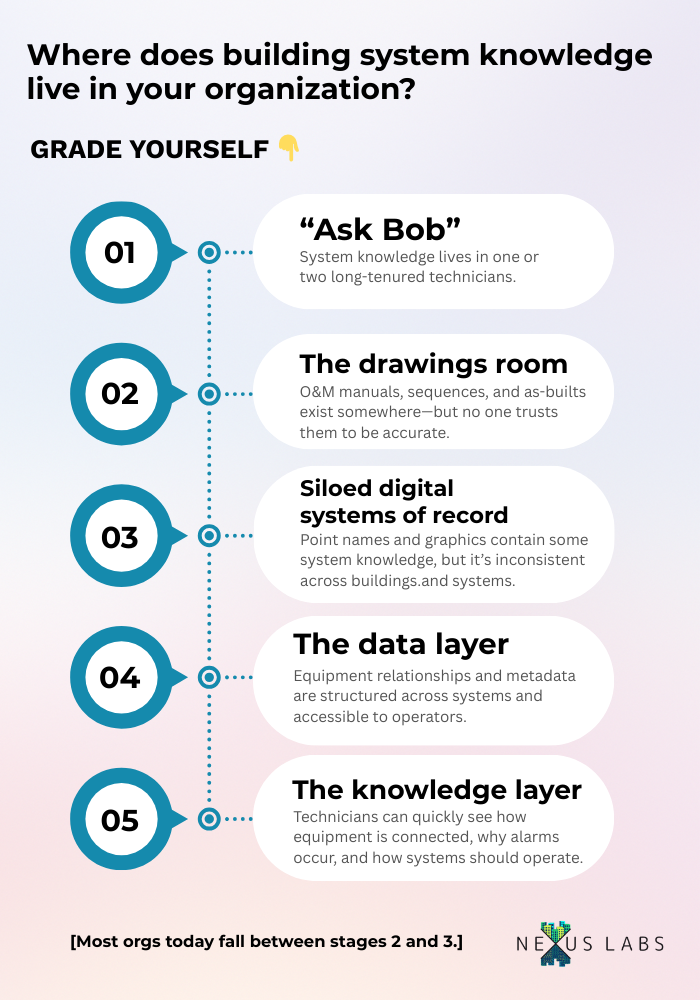
🔎 Grade your program
If institutionalizing system knowledge is the goal, where does your program stand today? Email us at hello@nexuslabs.online and we'll respond with our professional feedback.
This article is part of our Building Owner Signal series. We're highlighting patterns we see across conversations with building owners. These short insights focus on operational risks, emerging priorities, and what owner teams should pay attention to now.
We're seeing owner teams confronting a growing risk: the knowledge of how building systems actually run disappearing when people leave.
For decades, facilities teams have relied on superstar operators or technicians who have been around for 20–30 years and simply know how everything works. When those people retire or move on, that knowledge often disappears with them.
This isn't new, but here's the timely part: mitigating that risk is the same work required to make AI useful in buildings.
AI can’t reason about building systems unless the data has context—what equipment points represent, how devices relate to each other, and how systems were designed to operate.
"They know this building like the back of their hands. I need to get the back of their hands in the cloud, " said Thano Lambinos of Quadreal Property Group at one of our events.
That's why more organizations are now working to institutionalize building system knowledge—capturing how systems actually operate so that expertise survives turnover and operations can modernize.
The gotcha: while most buildings already have documentation, it’s usually out of date. As-built drawings no longer match the building. Control sequences drift as overrides and retrofits accumulate.
The work happening now across many Connected Buildings programs is about turning static documentation and tribal knowledge into living system knowledge—including the operational processes needed to stay aligned with the physical truth.
🔎 Grade your program
If institutionalizing system knowledge is the goal, where does your program stand today? Email us at hello@nexuslabs.online and we'll respond with our professional feedback.


This is a great piece!
I agree.