
.png)
Doing More With Less Staff
This article is part of our Building Owner Signal series. We're highlighting patterns we see across conversations with building owners. These short insights focus on operational risks, emerging priorities, and what owner teams should pay attention to now.
If you’re like me, you saw Anthropic’s analysis of AI labor impacts and thought, “I like to work in my yard… maybe I could be a groundskeeper.”
The research suggests AI will put most white-collar workers (us newsletter writers) out of work, while having a limited impact on grounds, installation, repair, and maintenance jobs.
In other words, the field roles that keep buildings running aren’t going away.
At the same time, I keep hearing about operations teams having to cover more buildings with fewer people. At Lincoln Property Company, for example, the average engineer went from managing 125k sqft to 300k sqft. At Sleep Country, they have 2 facilities managers for 320 locations across Canada.
I asked the community on LinkedIn; here’s what others are seeing:
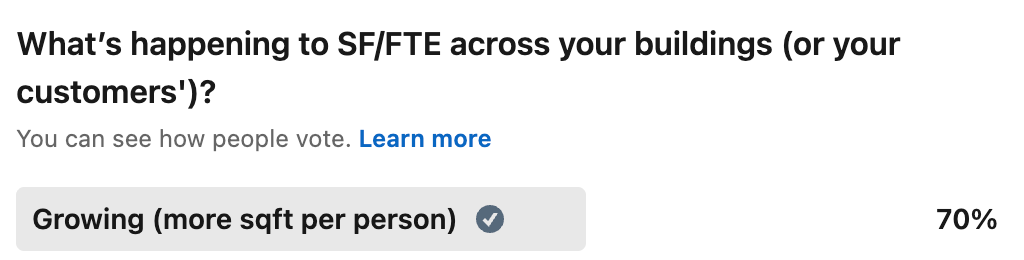
Most respondents report SF/FTE is growing.
And the broader data suggests that’s not changing anytime soon. JLL’s latest State of Facilities Management report highlights persistent labor shortages and an aging workforce across the industry.
One common response: outsource more of the work. But that doesn’t solve the problem—it just moves it. Service providers are hiring from the same constrained labor pool, so their ability to meet demand is similarly limited. As a time-based service contract grows, more people are required to support it, and costs rise alongside it. CBRE’s FM Cost Trends report backs that up.
So the real question owners are wrestling with right now is: How can we provide better outcomes with fewer technicians, operators, and engineers?
One big opportunity: All the time spent figuring things out.
Technicians’ days are still dominated by walking the building, checking things out, jumping between systems to diagnose issues, searching for information, coordinating with vendors, and coming back later to confirm the fix.
Another big opportunity: Where system knowledge actually lives today.
Before a problem can be solved, Boiler Bob has to remember how the system works, what’s been changed, and where to look.
We asked this community last week:
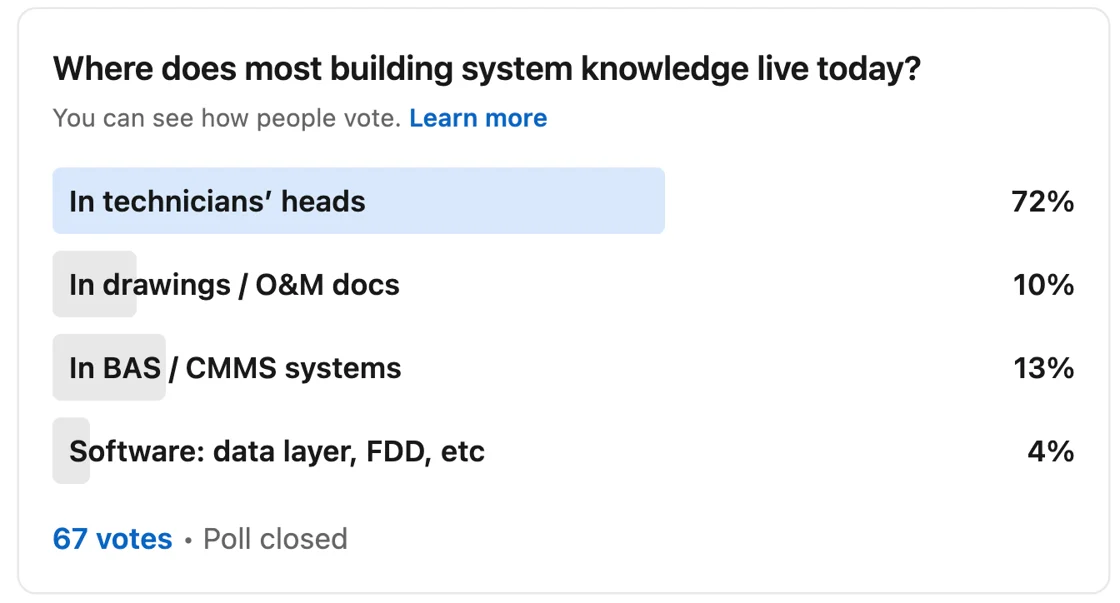
Most respondents said it lives in technicians’ heads.
Across this community, we’re seeing teams deploying technology and changing processes to reduce their Bob-dependence (he won’t mind… he’s retiring soon) and cut the time not turning wrenches:
.webp)
- Remote access & cloud control → fewer site visits
- Converged networks → systems visible in one place
- Data layers → tribal knowledge becomes structured and accessible
- Sensors → routine inspections replaced with continuous monitoring
- Analytics & FDD → limited time prioritized on what actually matters
- CMMS integration → insights flow directly into workflows instead of getting lost
- UX & gamification → less friction, higher adoption, and tasks actually get completed
None of this replaces technicians (obvi)—it changes how they spend their time.
Instead of manually searching for problems, systems are surfacing them. Instead of starting from scratch, technicians have context. Instead of defaulting to a truck roll, teams can triage remotely and only dispatch when needed. The work becomes more targeted, less repetitive, and less dependent on individuals’ experience.
That’s where AI actually fits into this story. It will continue to be embedded into every layer of the stack—data, analytics, and workflows—reducing the time spent on inspection, triage, and diagnosis.
In an industry that already can’t fill open roles, a building that can be operated and maintained with fewer people—without sacrificing performance—is fundamentally more valuable.
The technology stack, then, isn’t a collection of niche tools. These systems are what enable the shift in how the building is operated. The Connected Buildings program is what delivers that shift.
I’m curious: where are you in that shift?
.webp)
What are you seeing in your portfolio?
Is SF/FTE increasing—and where is your team feeling it first?
Email us at hello@nexuslabs.online and we'll respond with our professional feedback.
This article is part of our Building Owner Signal series. We're highlighting patterns we see across conversations with building owners. These short insights focus on operational risks, emerging priorities, and what owner teams should pay attention to now.
If you’re like me, you saw Anthropic’s analysis of AI labor impacts and thought, “I like to work in my yard… maybe I could be a groundskeeper.”
The research suggests AI will put most white-collar workers (us newsletter writers) out of work, while having a limited impact on grounds, installation, repair, and maintenance jobs.
In other words, the field roles that keep buildings running aren’t going away.
At the same time, I keep hearing about operations teams having to cover more buildings with fewer people. At Lincoln Property Company, for example, the average engineer went from managing 125k sqft to 300k sqft. At Sleep Country, they have 2 facilities managers for 320 locations across Canada.
I asked the community on LinkedIn; here’s what others are seeing:
Most respondents report SF/FTE is growing.
And the broader data suggests that’s not changing anytime soon. JLL’s latest State of Facilities Management report highlights persistent labor shortages and an aging workforce across the industry.
One common response: outsource more of the work. But that doesn’t solve the problem—it just moves it. Service providers are hiring from the same constrained labor pool, so their ability to meet demand is similarly limited. As a time-based service contract grows, more people are required to support it, and costs rise alongside it. CBRE’s FM Cost Trends report backs that up.
So the real question owners are wrestling with right now is: How can we provide better outcomes with fewer technicians, operators, and engineers?
One big opportunity: All the time spent figuring things out.
Technicians’ days are still dominated by walking the building, checking things out, jumping between systems to diagnose issues, searching for information, coordinating with vendors, and coming back later to confirm the fix.
Another big opportunity: Where system knowledge actually lives today.
Before a problem can be solved, Boiler Bob has to remember how the system works, what’s been changed, and where to look.
We asked this community last week:
Most respondents said it lives in technicians’ heads.
Across this community, we’re seeing teams deploying technology and changing processes to reduce their Bob-dependence (he won’t mind… he’s retiring soon) and cut the time not turning wrenches:
- Remote access & cloud control → fewer site visits
- Converged networks → systems visible in one place
- Data layers → tribal knowledge becomes structured and accessible
- Sensors → routine inspections replaced with continuous monitoring
- Analytics & FDD → limited time prioritized on what actually matters
- CMMS integration → insights flow directly into workflows instead of getting lost
- UX & gamification → less friction, higher adoption, and tasks actually get completed
None of this replaces technicians (obvi)—it changes how they spend their time.
Instead of manually searching for problems, systems are surfacing them. Instead of starting from scratch, technicians have context. Instead of defaulting to a truck roll, teams can triage remotely and only dispatch when needed. The work becomes more targeted, less repetitive, and less dependent on individuals’ experience.
That’s where AI actually fits into this story. It will continue to be embedded into every layer of the stack—data, analytics, and workflows—reducing the time spent on inspection, triage, and diagnosis.
In an industry that already can’t fill open roles, a building that can be operated and maintained with fewer people—without sacrificing performance—is fundamentally more valuable.
The technology stack, then, isn’t a collection of niche tools. These systems are what enable the shift in how the building is operated. The Connected Buildings program is what delivers that shift.
I’m curious: where are you in that shift?
What are you seeing in your portfolio?
Is SF/FTE increasing—and where is your team feeling it first?
Email us at hello@nexuslabs.online and we'll respond with our professional feedback.


This is a great piece!
I agree.