
.png)
LAX Migrates From Excel-Based Meter Tracking to Automated Data Mapping for Environmental Compliance
Los Angeles World Airports (LAWA, the owner of LAX airport) is working to eliminate one of the least scalable and most archaic parts of its environmental sustainability program: taking photos of meters and typing the numbers into Excel.
Andres Ramirez Fromm, Environmental Specialist at Los Angeles World Airports, explained the most outdated process the energy management team is taksed with. Data from analog meters is recorded as an image, which then resides as an attachment in an email thread dating back to 2010. From the email thread, it's manually transcribed into Excel, and then uploaded to Energy Star Portfolio Manager and Cority for Title V compliance.
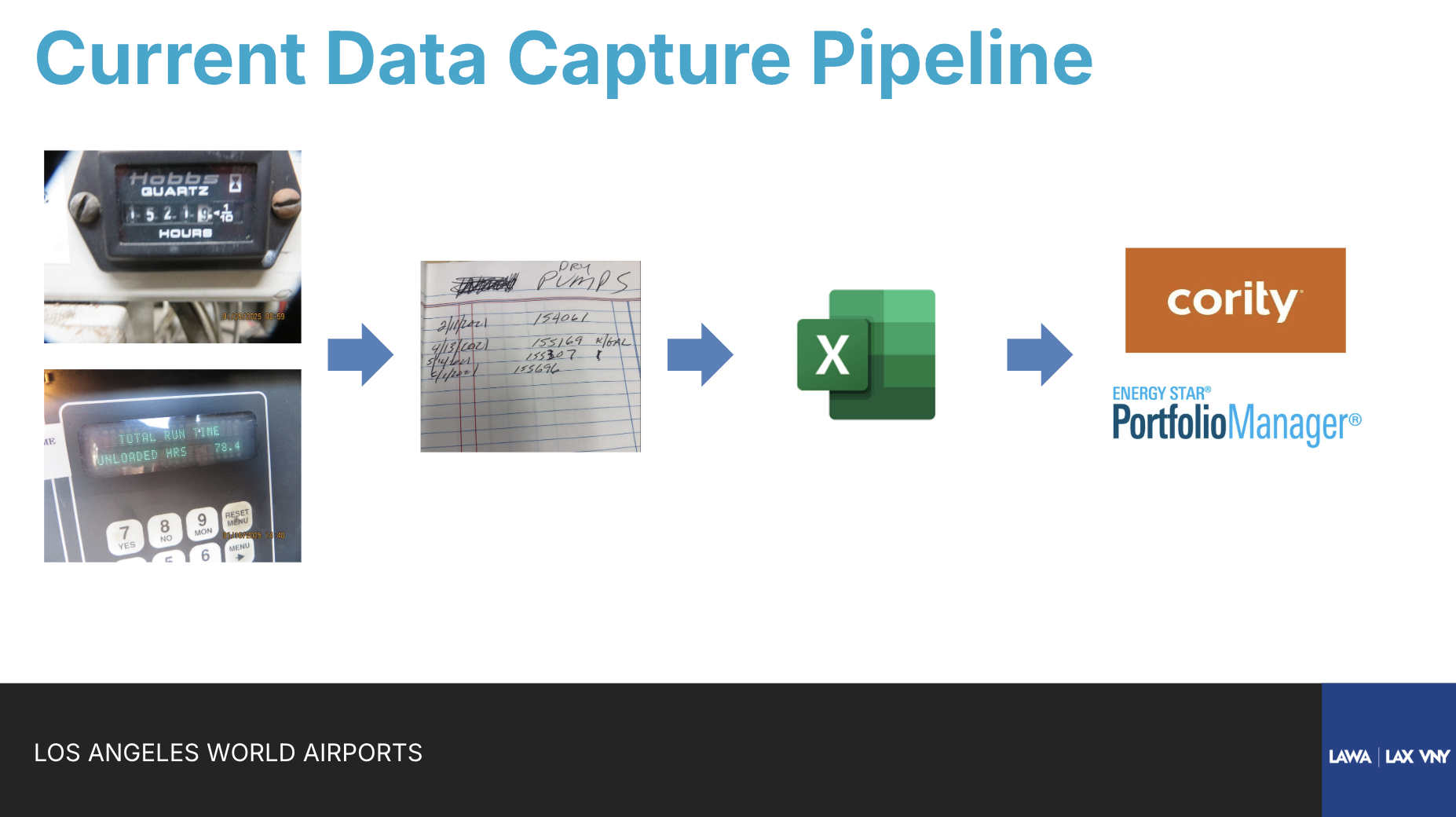
This process introduces the potential for human error at just about every step of the way, and limits granularity to monthly reads because field visits are labor-intensive. When staff are out sick, the data point is missed.
Outdated processes due to old equipment will always be an obstacle at a 20-million-square-foot, 24/7 airport with more than 80 major buildings and equipment dating back to the 1960s. It's a spectrum: new builds and retrofits have top-of-the-line digital meters, yet analog meters are far from extinct.
The airport’s current approach is phased: retrofit older equipment where feasible, connect and centralize what already produces digital data, normalize it, and begin building historical visibility. Only then does daily or sub-daily clarity become realistic.
To get there, LAX is deploying Mapped to normalize and centralize data from a mix of analog, digital, and partially connected meters. The goal: move from fragmented monthly reporting to daily or sub-daily visibility.
The new platform is already ingesting over 1.2 million points from an existing monitoring system that previously historized almost none of them.
For Ramirez Fromm and his team, better connectivity and centralized storage are prerequisites to the next step: targeting energy and water reductions per load rather than per building. That granularity gives the resolution needed to effectively prioritize energy projects.
For energy teams with large portfolios, maturing from manual, labor-intensive data reporting to real-time, historized reporting is key to meeting new sustainability targets. Sustainability starts with good data.
Register for the next Nexus Labs event
Sign up for the newsletter to get 5 stories like this per week
Los Angeles World Airports (LAWA, the owner of LAX airport) is working to eliminate one of the least scalable and most archaic parts of its environmental sustainability program: taking photos of meters and typing the numbers into Excel.
Andres Ramirez Fromm, Environmental Specialist at Los Angeles World Airports, explained the most outdated process the energy management team is taksed with. Data from analog meters is recorded as an image, which then resides as an attachment in an email thread dating back to 2010. From the email thread, it's manually transcribed into Excel, and then uploaded to Energy Star Portfolio Manager and Cority for Title V compliance.
This process introduces the potential for human error at just about every step of the way, and limits granularity to monthly reads because field visits are labor-intensive. When staff are out sick, the data point is missed.
Outdated processes due to old equipment will always be an obstacle at a 20-million-square-foot, 24/7 airport with more than 80 major buildings and equipment dating back to the 1960s. It's a spectrum: new builds and retrofits have top-of-the-line digital meters, yet analog meters are far from extinct.
The airport’s current approach is phased: retrofit older equipment where feasible, connect and centralize what already produces digital data, normalize it, and begin building historical visibility. Only then does daily or sub-daily clarity become realistic.
To get there, LAX is deploying Mapped to normalize and centralize data from a mix of analog, digital, and partially connected meters. The goal: move from fragmented monthly reporting to daily or sub-daily visibility.
The new platform is already ingesting over 1.2 million points from an existing monitoring system that previously historized almost none of them.
For Ramirez Fromm and his team, better connectivity and centralized storage are prerequisites to the next step: targeting energy and water reductions per load rather than per building. That granularity gives the resolution needed to effectively prioritize energy projects.
For energy teams with large portfolios, maturing from manual, labor-intensive data reporting to real-time, historized reporting is key to meeting new sustainability targets. Sustainability starts with good data.
Register for the next Nexus Labs event
Sign up for the newsletter to get 5 stories like this per week


This is a great piece!
I agree.