
.webp)
Why Occupancy-Based HVAC Control in a NYC High-Rise Required Sensors, Gateways, VLANs, and a FieldServer Before Touching the BMS
The complexity of occupancy-based ventilation control runs well beyond installing sensors and writing new sequences. For the approach to work and be accepted by the people who operate the building, the occupancy data must first be transmitted safely into the building automation system.
At NexusCon 2025, Elizabeth Redmond, head of strategic accounts at R-Zero, and John Villani, a vice president at Grumman Butkus and the building's consulting engineer, walked through what it took to run demand-controlled ventilation off measured occupancy in a Manhattan tower of more than a million square feet. Because the upper floors share large headered air handlers on common risers rather than floor-by-floor units, the team pushed control down to individual HVAC zones.
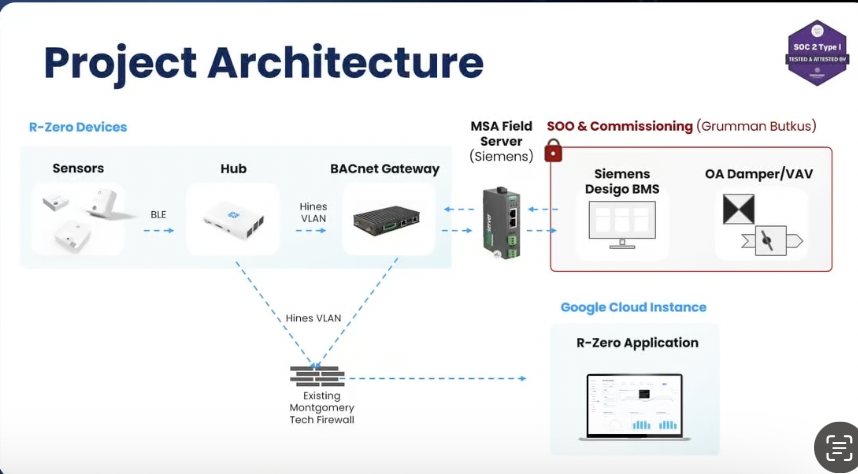
The were not allowed to communicate directly with the building management system. R-Zero's devices connect to a hub over Bluetooth, which then hands off to a BACnet gateway that communicates with the BMS over BACnet. "So we have a piece of infrastructure in the middle here that's another communication arm," Redmond said. All of it rides on a dedicated VLAN through the building's existing Montgomery Technology firewall, keeping the R-Zero-supplied occupancy sensors off the wider operational network.
Then the owner added a requirement most sensor deployments skip: an MSA FieldServer as "our last gate between your devices that could be unruly" and the building systems. The FieldServer "is essentially the last security gate," Redmond said. Behind it, control stays local in the Siemens Desigo BMS while R-Zero's analytics run in a Google Cloud instance, separating what watches the building from what actuates it. Only then did Villani's team map the sensors to zones and write new operating sequences.
Villani's framing was blunt. "When you're going to deploy a technology solution, this is the level in the weeds you need to get to." The occupancy sensor is a commodity. The networking, the security gate, and the sequence work are the project.
Register for the next Nexus Labs event.
Sign up for the newsletter to get 5 stories like this per week:
The complexity of occupancy-based ventilation control runs well beyond installing sensors and writing new sequences. For the approach to work and be accepted by the people who operate the building, the occupancy data must first be transmitted safely into the building automation system.
At NexusCon 2025, Elizabeth Redmond, head of strategic accounts at R-Zero, and John Villani, a vice president at Grumman Butkus and the building's consulting engineer, walked through what it took to run demand-controlled ventilation off measured occupancy in a Manhattan tower of more than a million square feet. Because the upper floors share large headered air handlers on common risers rather than floor-by-floor units, the team pushed control down to individual HVAC zones.
The were not allowed to communicate directly with the building management system. R-Zero's devices connect to a hub over Bluetooth, which then hands off to a BACnet gateway that communicates with the BMS over BACnet. "So we have a piece of infrastructure in the middle here that's another communication arm," Redmond said. All of it rides on a dedicated VLAN through the building's existing Montgomery Technology firewall, keeping the R-Zero-supplied occupancy sensors off the wider operational network.
Then the owner added a requirement most sensor deployments skip: an MSA FieldServer as "our last gate between your devices that could be unruly" and the building systems. The FieldServer "is essentially the last security gate," Redmond said. Behind it, control stays local in the Siemens Desigo BMS while R-Zero's analytics run in a Google Cloud instance, separating what watches the building from what actuates it. Only then did Villani's team map the sensors to zones and write new operating sequences.
Villani's framing was blunt. "When you're going to deploy a technology solution, this is the level in the weeds you need to get to." The occupancy sensor is a commodity. The networking, the security gate, and the sequence work are the project.
Register for the next Nexus Labs event.
Sign up for the newsletter to get 5 stories like this per week:


This is a great piece!
I agree.