

The Misaligned Incentives of Owners and Service Providers
Raise your hand if you've seen one of these artifacts of building service contracts:
- You have 5 hours of leftover service work for the month you haven't used, so your pricey service technician spends the rest of those hours prettifying graphics no one looks at and shooting the shit with your maintenance personnel.
- It's time for the bi-annual scheduled PMs (preventative maintenance rounds) you paid for, so your service contractor heads to the roof to replace every filter and "have a look around," work based on nothing more than the date on the calendar.
- Days after the scheduled PMs are complete, a piece of equipment fails catastrophically, so you pay a premium to get your service provider to come back to the building and fix it immediately.
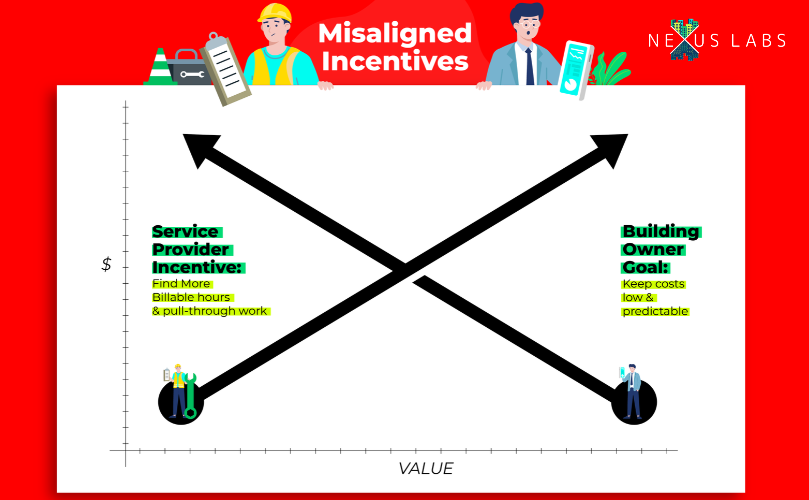
The misaligned incentives of service providers have plagued the industry for decades: when someone is paid to fix things, they get paid more when there's more to fix.
Here are two service provider terms that prove how misaligned their incentives are from the building owners they serve:
- Utilization rate: the percentage of hours a service technician was working that can be billed to the end customer. The higher the utilization rate, the better they are doing.
- Pull-through work: finding problems during inspections beyond the base scope of work, triggering time-and-materials charges. The more pull-through work they are finding, the better they are doing.
Building owners and service providers pushing the frontier of the connected buildings industry are rethinking the misaligned incentives in two ways: technology-enabled services and outcome-based services. That's exactly what our community will be nerding out about at NexusCast #4 on Wednesday, December 9th.
Striving for Tech-Enabled Services
Nexus Labs has spent the better half of a decade covering the tools and techniques of condition-based maintenance. Technology now exists to make maintenance more proactive than reactive.
What seems to be lagging is the ability for a building owner and their service providers to find ways to mutually benefit from these technology advancements.
I recently spoke with a building owner/occupier with a relatively mature condition-based maintenance program: a single FDD instance deployed across millions of square feet. When I asked how his service providers were using his FDD platform, he said, "Not at all. I'm not even sure we've talked about it."
They have the magic crystal ball that tells them how to maintain their building proactively, yet most people maintaining it (aka the service providers) aren't even using the data.
Procuring and owning a technology like FDD can feel like too much effort for many building owners. If external service providers are doing the majority of the work in your buildings, shouldn't they own the tool? As Brian Turner of Adaptive Buildings put it, "It's the service provider's tool. Are they going to ask [the building owner] to buy a drill for them too?"
We've covered how service providers like RYCOM and MacDonald Miller are using condition-based maintenance platforms to enhance their service offerings. However, examples of this are still few and far between. Most service providers lack the reason to complicate things. With skyrocketing demand for service and limited supply, why waste your time changing techniques?
Outcome-Based Services: The Great Realignment
A building owner doesn't care about the number of visits they receive. They care about the number of hot/cold complaints, the number of catastrophic failures, and the amount of wasted energy. When new technology provides the ability to proactively solve maintenance issues and the data to grade the quality of service you're receiving, suddenly the owner gains leverage to demand better quality of work.
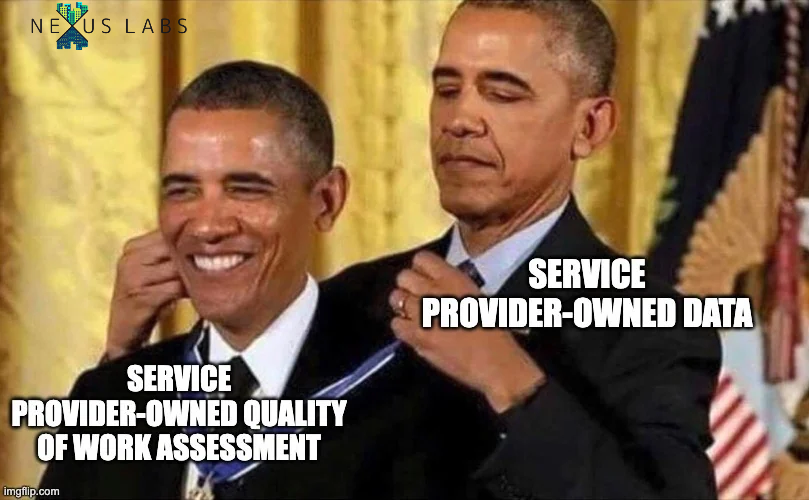
If the service provider owns the analytics and data associated with their work, you may be getting good service, but it remains hard to prove. One smart buildings program director told us, "We'd love to incorporate KPIs on actual PPMs (planned preventative maintenance) and energy consumption, but if we were to do that today, they [the service providers] would be the ones who would be reporting on how they did."
Data ownership becomes extremely important to grading quality of work, or else the service provider becomes the main character in this meme:
When the building owner gets to the point of: a) adopting technology-enabled services and b) owning the data to quantify those services, they can finally start to create leverage in their service contracts that was previously impossible. We'll be hearing two examples of this on the virtual stage at NexusCast #4:
Andrew Knueppel, Senior Engineering Program Manager at LinkedIn, will describe how LinkedIn is creating fee-at-risk contracts with their service providers: tying compensation to metrics like proactive work orders completed and building comfort scores.
Tom Balme, National Building Services & Technology Manager at Lendlease, will walk us through how Lendlease has handed access of their FDD platform over to each of their service providers, and is actively grading the quality of service they get from each provider based on the metrics available to his team within the FDD platform.
Join the conversation at NexusCast #4
We're collecting more examples, good and bad, of technology-enabled, outcome-based services ahead of our December event. Learn more and register for NexusCast #4 here.
Sign up for our biweekly newsletter to get more stories like this, plus updates on all upcoming Nexus Labs events:
Raise your hand if you've seen one of these artifacts of building service contracts:
- You have 5 hours of leftover service work for the month you haven't used, so your pricey service technician spends the rest of those hours prettifying graphics no one looks at and shooting the shit with your maintenance personnel.
- It's time for the bi-annual scheduled PMs (preventative maintenance rounds) you paid for, so your service contractor heads to the roof to replace every filter and "have a look around," work based on nothing more than the date on the calendar.
- Days after the scheduled PMs are complete, a piece of equipment fails catastrophically, so you pay a premium to get your service provider to come back to the building and fix it immediately.
The misaligned incentives of service providers have plagued the industry for decades: when someone is paid to fix things, they get paid more when there's more to fix.
Here are two service provider terms that prove how misaligned their incentives are from the building owners they serve:
- Utilization rate: the percentage of hours a service technician was working that can be billed to the end customer. The higher the utilization rate, the better they are doing.
- Pull-through work: finding problems during inspections beyond the base scope of work, triggering time-and-materials charges. The more pull-through work they are finding, the better they are doing.
Building owners and service providers pushing the frontier of the connected buildings industry are rethinking the misaligned incentives in two ways: technology-enabled services and outcome-based services. That's exactly what our community will be nerding out about at NexusCast #4 on Wednesday, December 9th.
Striving for Tech-Enabled Services
Nexus Labs has spent the better half of a decade covering the tools and techniques of condition-based maintenance. Technology now exists to make maintenance more proactive than reactive.
What seems to be lagging is the ability for a building owner and their service providers to find ways to mutually benefit from these technology advancements.
I recently spoke with a building owner/occupier with a relatively mature condition-based maintenance program: a single FDD instance deployed across millions of square feet. When I asked how his service providers were using his FDD platform, he said, "Not at all. I'm not even sure we've talked about it."
They have the magic crystal ball that tells them how to maintain their building proactively, yet most people maintaining it (aka the service providers) aren't even using the data.
Procuring and owning a technology like FDD can feel like too much effort for many building owners. If external service providers are doing the majority of the work in your buildings, shouldn't they own the tool? As Brian Turner of Adaptive Buildings put it, "It's the service provider's tool. Are they going to ask [the building owner] to buy a drill for them too?"
We've covered how service providers like RYCOM and MacDonald Miller are using condition-based maintenance platforms to enhance their service offerings. However, examples of this are still few and far between. Most service providers lack the reason to complicate things. With skyrocketing demand for service and limited supply, why waste your time changing techniques?
Outcome-Based Services: The Great Realignment
A building owner doesn't care about the number of visits they receive. They care about the number of hot/cold complaints, the number of catastrophic failures, and the amount of wasted energy. When new technology provides the ability to proactively solve maintenance issues and the data to grade the quality of service you're receiving, suddenly the owner gains leverage to demand better quality of work.
If the service provider owns the analytics and data associated with their work, you may be getting good service, but it remains hard to prove. One smart buildings program director told us, "We'd love to incorporate KPIs on actual PPMs (planned preventative maintenance) and energy consumption, but if we were to do that today, they [the service providers] would be the ones who would be reporting on how they did."
Data ownership becomes extremely important to grading quality of work, or else the service provider becomes the main character in this meme:
When the building owner gets to the point of: a) adopting technology-enabled services and b) owning the data to quantify those services, they can finally start to create leverage in their service contracts that was previously impossible. We'll be hearing two examples of this on the virtual stage at NexusCast #4:
Andrew Knueppel, Senior Engineering Program Manager at LinkedIn, will describe how LinkedIn is creating fee-at-risk contracts with their service providers: tying compensation to metrics like proactive work orders completed and building comfort scores.
Tom Balme, National Building Services & Technology Manager at Lendlease, will walk us through how Lendlease has handed access of their FDD platform over to each of their service providers, and is actively grading the quality of service they get from each provider based on the metrics available to his team within the FDD platform.
Join the conversation at NexusCast #4
We're collecting more examples, good and bad, of technology-enabled, outcome-based services ahead of our December event. Learn more and register for NexusCast #4 here.
Sign up for our biweekly newsletter to get more stories like this, plus updates on all upcoming Nexus Labs events:


This is a great piece!
I agree.