
🎧 #192: Steve Burrell of NAU on the Campus's 10 Year Smart Buildings Transformation
Welcome to Nexus, a newsletter and podcast for smart people applying smart building technology—hosted by James Dice. If you’re new to Nexus, you might want to start here.
The Nexus podcast (Apple | Spotify | YouTube | Other apps) is our chance to explore and learn with the brightest in our industry—together. The project is directly funded by listeners like you who have joined the Nexus Pro membership community.
You can join Nexus Pro to get a weekly-ish deep dive, access to the Nexus Vendor Landscape, and invites to exclusive events with a community of smart buildings nerds.
Sign-up (or refer a friend!) to the Nexus Newsletter.
Learn more about the Smart Building Strategist Course and the Nexus Courses Platform.
Check out the Nexus Labs Marketplace.
Learn more about Nexus Partnership Opportunities.
Episode 192 is a conversation with James Dice and Brad Bonavida from Nexus Lab, as well as Dr. Steve Burrell from Northern Arizona University.
Summary
Episode 192 is a conversation with James Dice and Brad Bonavida from Nexus Lab, as well as Dr. Steve Burrell from Northern Arizona University. In this episode of the Nexus Podcast, the Nexus Labs team breaks down the top stories relevant to energy managers, facility managers, IT/OT managers, and workplace managers.
Mentions and Links
- Northern Arizona University (1:15)
- Steve’s NexusCon recording 1 (1:40)
- Steve’s NexusCon recording 2 (1:40)
- Sign up for NexusCast #2 on Condition-Based Maintenance (2:21)
- Steve’s AI Enabled Smart sustainable campus master plan
Highlights
Introduction (0:50)
At the Nexus (1:52)
Bringing Steve into the Conversation (7:58)
Sign off (46:41)
Music credits: There Is A Reality by Common Tiger—licensed under an Music Vine Limited Pro Standard License ID: S706971-16073.
Full transcript
Note: transcript was created using an imperfect machine learning tool and lightly edited by a human (so you can get the gist). Please forgive errors!
James Dice: [00:00:00] Hey friends, if you like the Nexus Podcast, the best way to continue the learning is to join our community. There are three ways to do that. First, you can join the Nexus Pro membership. It's our global community of smart Boeing professionals. We have monthly events, paywall, deep dive content, and a private chat room, and it's just $35 a month.
Second, you can upgrade from the pro membership to our courses offering. It's headlined by our flagship course, the Smart Building Strategist, and we're building a catalog of courses taught by world leading experts on each topic under the smart buildings umbrella. Third, and finally, our marketplace is how we connect leading vendors with buyers looking for their solutions.
The links are below in the show notes. And now let's go on the podcast.
Brad Bonavida: Welcome back to the Nexus Podcast everybody. I'm Brad. I've got James with me here. Um, your favorite Smart Buildings and Connected Buildings podcast. [00:01:00] Uh, for the full experience, always subscribe to our newsletter. If you're not yet, that's where you hear about everything that we're doing. Go to Nexus Labs online.
You can subscribe to our newsletter right there. Um, so today we are excited to bring Dr. Steve Burrell to the podcast. He's the former CIO of Northern Arizona University. He just retired this year. Welcome Steve. Thanks for joining us.
Steve Burrell: Thanks. It's great to be here.
Brad Bonavida: Steve spoke twice at Nexus Con 2025. He spoke in the facility management track, uh, on a presentation called How N-A-N-A-U uses AI and copilot for various FM use cases.
And Steve also spoke in the ITOT track, the networking track on a scalable realization of digital twins with an IDL. So tons of stuff to talk about. We're gonna bring Steven to it for just in just a second, but first we gotta do our at the nexus, which is what's going on in our world between James and I.
Uh, James, do you wanna start us here with what's going on with you? [00:02:00]
James Dice: Well, I think it's funny that you said the, you know, this is, this is people's favorite Smart Buildings podcast. 'cause I, I actually don't know of another one. Um, and so we're like one out of one
Brad Bonavida: defacto.
James Dice: Yeah. Yeah. Um, I'll start with our next event, which is on April 15th.
We're gonna dive deep into condition-based maintenance. Um, it is a Nexus cast, so that means it's a virtual conference and what that means for people if you don't, if didn't go to the first one, which we did in January. It's basically, we're gonna set the context at the beginning, so we'll have a presentation.
Kind of like our old buyer's guides for people that used to, uh, go to those when we did those a few years back. And then we'll have five, six, um, what we're calling playbook accelerators. So we'll present the playbook and then we'll have speakers come in and talk about where they met obstacles, where they experience friction in that playbook.[00:03:00]
And we're actually gonna have them teach. The solution this time. So it's not necessarily focused on here's what we did and like, like a case study, but we actually we're actually trying to put together. Um, lessons for people that they can come and, and take back into their own buildings immediately. And so this is the first time we've done an event with that format.
We're gonna see if it works and hopefully then take it to all of our future events, uh, moving forward. So come check that out. We will have, at, as of, as of this time, we have. Clockworks Code Labs, uh, demand Logic as three vendors that will definitely be presenting, but we're obviously working on, uh, filling out that lineup.
So definitely come visit.
Brad Bonavida: Yeah. And for those, uh, you were talking about the playbook, accelerators, this kind of new format where we're trying to find the, like the tidbits, the golden nuggets, the lessons learned that people can share about their experience. We're going out and finding those in the world as we're talking to people who've [00:04:00] done condition-based maintenance or are at some level of that.
So if you are either in the trenches struggling with it, just getting started with it, or if you've like, succeeded and seen all the skeletons in the closet, reach out to us. Um, 'cause we'd love to talk to you about your experience so that we can, you know, bring those lessons into what we, we teach.
James Dice: And I'd say we're a little bit nervous about this format because it's new, but.
And it's, I think I'm also nervous about it, Brad, because it's not what anyone in the industry is used to before. What, what we found ourselves talking about over the last few weeks is when, you know, we've watched hundreds of presentations at our conferences and events at this point, and what we often find ourselves saying is that someone talks for 15 minutes or 10 minutes.
And what we actually wanted the 10 to 15 minutes to be about was like. Half of that 14th slide, which is like really the nugget where it's like [00:05:00]someone could take, we want you to teach that we don't need the full context and the full story. And so for us it's uncomfortable 'cause we're asking people to do stuff that they're not used to.
And so we'll see how it goes.
Brad Bonavida: Yeah, and I, I think that's a good segue in just the second, uh, at the Nexus thing, which is that we just released our nexus con call for abstract. So for our in-person conference in October, you can now go to our website and submit that you want to speak there, but we're following all the same rules that James just explained there.
So the application looks a little differently. We don't want to hear like your whole story of how you implemented some technology into your portfolio and it changed everything. We wanna hear that terrible struggle that you went through for one month and how you figured out the right way to approach it differently and how that can save somebody some time.
So it's like the context, just like James explained, it's gonna be at the beginning of the sessions at Nexus Con. We want you [00:06:00] to zoom way in on that teaching that you can give somebody. That's the playbook accelerator. So go apply. We'd love to, um, hear what you can share with us at Nexus Con.
James Dice: And our, our main thesis here is that the industry doesn't need more case studies.
We've done a lot of case studies. Um, we don't need more, um, sorry to all the vendors out there, but we don't need more validators like case studies being used as validation for a vendor. Being legit, like we have a lot of vendors that are legit and they will be exhibiting at the conference and they will be demoing.
What we need now is for the building owners that are in the in the muck, we need to help them get unstuck. And so that's our thesis. And if that sounds good, we'll see you. Yeah, we'll see you at. In Detroit.
Brad Bonavida: Yeah, very last thing before we dive into it. I explained this last week, but just to touch on it again, we've got this building owner VIP process this year where basically the more [00:07:00] involved you are in helping us prepare for Nexus Con.
You're submitting abstracts, you're giving us feedback, all these things, you are earning your spot at this, you know, exclusive. A dozen people at a VIP dinner the first night of Nexus Con for building owners. Um, and all the ways that you can, um, you know, participate and get on that list, uh, will be emailed to you once you sign up for the conference, which is free you for building owners to sign up for.
There you go. So if you wanna come to dinner with us, it a very nice, fancy, fun dinner Monday night of the conference. Check that out and help us out because we wanna make this as good as possible for you guys.
James Dice: We should give a shout out to the, the people at Honor Health, which is down in Steve's neck of the woods, uh, in Arizona.
They heard the last podcast episode and now we have, I don't know how many people coming to Nexus Con, so they're,
Brad Bonavida: yeah,
James Dice: that's great. They're obviously plugged in to the co to the podcast and, uh, excited to host you all in Detroit.
Brad Bonavida: Can't Wait. Okay, let's bring Steve into it. So, Steve. I always [00:08:00] think since this is about buildings, we gotta start with like this context setting.
So tell me about Northern Arizona University and what kind of the campus is like, what your portfolio of buildings was like.
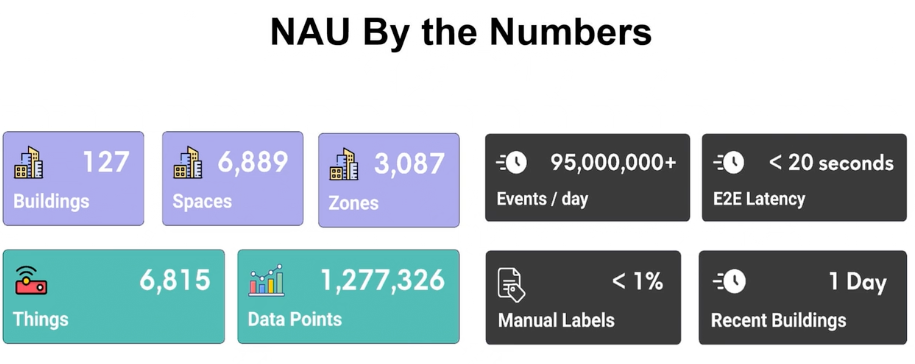
Steve Burrell: Yeah, so, um, uh, something like 700 acres, uh, on the main campus in Flagstaff, Arizona, 127 buildings, uh, something just shy of 7,000 spaces, 3000 zones. Uh. Almost 7,000 IO ot, things that we monitor for about 1.3 million data points.
Um, and, you know, very typical kind of regional university of about 30,000 students, a heavy residential population. I think at one point we had 25,000 students, uh, in local housing and, and on campus. Uh, so, you know, it's not a small enterprise. Um, it sets in a gorgeous place. Uh, if anybody's been to [00:09:00] Flagstaff, I think you know that, uh, and, uh, uh, but, you know, the conditions can be challenging.
Most people think Arizona is all hot and deserty. Uh, Flagstaff sits up on the Colorado plateau and the largest contiguous Ponderosa pine forest, uh, at 7,000 feet. And so, you know, lots of swings in, uh, temperature seasonally. Uh, up, you know, over a hundred inches of snow typically during, uh, wintertime. Um, and the summers are pretty mild and beautiful, uh, you know, um, so anyway, it kind of gives you some context about there.
I, um, I was, as you mentioned, I just retired from there in January. Uh, having spent 10 years as a CIO there on the back end of a 43 year career in higher education, IT leadership, and, uh. Just a fantastic experience. Um, and it was a real exciting, uh, opportunity for us to, uh, you know, peel back some, some new [00:10:00] layers to, to write a new 10 year master plan to create, uh, the AI enabled sustainable smart campus.
And, um. So I think a lot of what I talk today will probably be my lived experiences based on, uh, bringing that to fruition, um, you know, over the last, uh, four or five years.
Brad Bonavida: Sure. I, I think it's fascinating that you. You are. You were the CIO, the Chief Information Officer, and you were tasked with that. I think that's kind of unique.
We usually don't hear that role as the champion of the Smart Buildings program. And maybe that's part of the reason that you guys had so much success. I mean, did you feel like that was unique that you were assigned to that, with that title?
Steve Burrell: Well, in some ways, yes. I mean, um, it, it all started with a 10 year master planning process, which is very typical of higher education institutions to go through.
So, you know, it's typically you're thinking about where the roads go, sidewalks go, where are the new buildings? What are we gonna tear down? That kind of stuff. Um, but I had a very progressive president, [00:11:00] um, Jose Luis Cruz Rivera, who said, you know, Steve, we need to push the boundaries on this a little bit.
AI is gonna be a thing. We know that. Uh, but smart campus initiatives that we had kind of toyed with and played with a few were having some great impact. So we rolled all of that into the Sustainable Smart Campus master plan. And that process, which took us about two and a half years to complete. Um, and, you know, through that process, um, the facilities officer and I, you know, we're, we're partnering around lots of concepts and whatnot.
So, yeah, it is unique and, uh, like, you know, when I, when I go to Nexus Con again next year, I might be the only CIO in the room. Who knows? But I've been to a number of other conferences where, you know, I, it's a bit of an imposter syndrome. Um. And, you know, CIOs are being, um, browbeat a little bit about, you know, all the, uh, by building owners about, you know, the kinds of things my CIO's [00:12:00] making us do and whatnot.
And, and so I understand it and it's been, um. It's been an interesting journey. I'm really excited to try and, uh, you know, bridge the chief facilities officer, chief information officer's roles, uh, and in fact, uh, in retirement. I've been writing a book about that because I think it's a significant issue.
Um, and just, uh, positioning it, uh, so that either. Perspective can understand each others and move the institutions forward because there's such great opportunity in this. And I can tell you from 40 some years of experience, most CIOs have not been, you know, a tangential this, it's all been about, uh, you know, HVAC in my computer room or the fire stop I need, you know, for my low voltage networks.
Um, and, and you know, project plans. It's never been an integrated conversation with facilities. So, uh, it's an exciting time and, and, uh, NAU is an [00:13:00] exciting process and remains an exciting institution to follow.
James Dice: We, um, we see that this same theme playing out Steve, where when we see all the universities engaged with, with Nexus Con and, and our events and community, we see it from one department usually.
Um, there's a lot of energy managers, like higher ed energy managers in our community. A lot of, um, folks that are, you know, full-time on the university side in FM that are focused on controls. Those are the two main angles I feel like we see, you know, there, you know, there are maybe 30 universities that are gonna be at Nexus Con this year, and that's, those are the two personas and it's interesting.
Um, thinking about how in other verticals there are smart buildings, titles and their job is to go across departments, but at universities it doesn't seem to be that way.
Steve Burrell: It's, it's starting to get there, but it's, [00:14:00] it's, uh, you know. By, by no means is it a pervasive concept. Mm-hmm. And, uh, uh, I think, uh, part of my retirement and lived experiences and opportunities like I'm having with you today is to share that perspective and say there is great opportunity there.
Uh, and you know, if you're a CIO at one of these institutions and you're. Uh, you know, just wanting to understand what OT and, you know, um, controls and digital twins and all this kind of stuff really means, um, go have lunch with your chief facilities officer or somebody and start asking some questions.
Um,
James Dice: yeah, '
Steve Burrell: cause there's real opportunity, there is increase efficiencies and effectiveness, um, uh, across the enterprise.
James Dice: I'm wondering if you have advice for those energy managers and people in the FM groups. How do they get their CIOs engaged in the conversation?
Steve Burrell: Uh, reach out, um, you know, reach out with the opportunity, like I said, in a [00:15:00] casual setting, not through some kind of governance or formal thing, but very casually, uh, invite yourself to the opportunity I've.
Uh, my doctorate's in leadership and I've mentored and coached a lot of people, and the one piece of advice I give people is just have the courage to say, to invite yourself to a meeting. Um, and, you know, have a few questions preformed and, uh, no surprises, but. Uh, just engage, uh, most CIOs that I know are happy to have that conversation, uh, to learn more.
Um, and it doesn't have to be a threatening conversation, but, um, you know, bring some awareness, some educational to that. Um, you know, um, talk about, um, uh, how the back networks, uh, because I guarantee 'em a lot of CEOs have no idea what back net's all about. Um, and they, they may not even heard building management system.
In their career. Um, so, you know, uh, ask for that meeting. Uh, take an educational approach, [00:16:00] ask a few good questions, and, you know, ask, uh, what the best opportunity is to follow up with people on their staff. And, and CIOs should entertain that conversation. And then should, you know, um, oversee people getting together to talk, uh, informally.
Exploratory, if you will, the art of the possible when it comes to these things. Um, and just begin sharing a body of knowledge. And frankly, that's what the book I'm writing is gonna try to do. Mm-hmm. Cast the perspectives, you know, cast what's common, and then, uh, you know, prescriptively try to give people a, a, a way forward that might work.
Um, but just to raise the awareness of it, uh, and the opportunity. So yeah. Cool.
Brad Bonavida: That's great.
Steve Burrell: Have the courage to say yes.
Brad Bonavida: I, I wanna, I wanna get into condition based maintenance 'cause it's top of mind for us and Right. I think you've got quite a bit of experience there. So like. Your, your presentation at Nexus Con is in AI for fm.
[00:17:00] You talk about LLM generated insights on systemic issues, which is maybe like level 10 of condition-based maintenance. Level 10 outta 10. But, um, if we like rewind all the way, you know, in your, in your, uh, AI enabled sustainable campus master plan, it's like page five where you introduce like going from.
Uh, from reactive to proactive. So I wanna like kind of rewind you before we get all the way to the AI use cases here. Eight, five. It's, it's like I saw it right away. So like, talk about like 2016 or I don't, you know, you choose, but like you get there and like, what's the status of maintenance and where you're trying to take it?
Steve Burrell: Uh, NAU is typical of any large regional university. I mean, you know, um. We're, we're in firefighting mode, uh, to use a Western analogy, right? Uh, we, we couldn't, um, we couldn't get away from firefighting long enough to, to prune the forest, to prevent it from happening. Um, [00:18:00]and, you know, resources and just the mindset, um, very much reactionary.
Um, when I came into CIO around 2016, um. Uh, we, you know, we had some budget cuts or some consolidation. We were centralizing it, so we were naturally looking for some efficiencies and some economies. One of those that we found was in how we managed our classrooms, uh, over 400 classrooms on that campus, and a staff of maybe 10 or 12 people to do it.
But, you know, again, they were, and we were in firefighting mode. So we, we bought some technologies, uh, that allowed us to have insights and deployed the technology and the software to have insights into what was going on in the classrooms with our projectors and our podium computers, and the audio amplifiers and all this kinda stuff, which is really kind of.
Point on a university's mission was instruction and we were just having too many issues where, you know, things [00:19:00] would break. Uh, and we would lose that hour, hour and a half of opportunity to educate the students and, and you know, it's a 16 week semester faculty don't get that back. So there was a, there was a great use case there to be more proactive and, and so we deployed these things and we did it, and we were able to do that kind of just in time thing, right?
And so instead of having the periodic maintenance of going around every summer and cleaning fans, which was everybody's favorite thing to do. Um, you know, the fan filters so that these laser projectors and, and projectors wouldn't burn up During the year, we, we, we monitored, uh, the equipment, uh, iot type devices and software so we could see where, and set thresholds where certain, uh, devices, you know, probably needed some attention and we could get out there before it failed.
Um, and we kind of just flipped the chart on the whole thing, uh, to, to being. Not reactive or doing, um, you know, periodic [00:20:00] repetitive preventative maintenance, but really based on the conditions of that classroom, uh, responding to the needs and, and doing remote support. And we, you know, we standardized technology, which some faculty were very afraid of.
And. Uh, we're concerned about, but in the end, uh, tremendous compliments, um, you know, to my staff about how they use that technology to turn around and do a proactive condition-based responses. So the faculty weren't using and losing that time in the classroom, um, and really, you know, turn things around in, in a lot of other ways.
So that, that's kind of where it all started from a smart campus kind of thing. And then that evolved in through, you know, our, our ability to do some other things that way across campus, uh, like with our network, uh, components and some other things, but. When it came to an AI enabled sustainable, smart campus, uh, master plan, [00:21:00] we had to take that same kind of, uh, attitude and approach to how we were maintaining the institution on whole.
And that meant facilities having to rethink it. Um. We had tried for, you know, uh, 18 months, uh, using PhD experts to, to create, uh, data ontologies and consolidate, you know, 7,000 data points, uh, or things across, you know, multimillions of data points. And we failed horrendously. Um, so during the smart, uh, campus planning process, we met some vendors and we chose one of them to implement a digital twin.
And we did that, and that gave us the insights that we needed into, you know, what was going on with, uh, HVAC systems or lighting systems or water systems, et cetera, et cetera. Um, but like most institutions, I mean, our work center was [00:22:00] still very much, uh, human operated, you know, not. I would say principle based, you know, um, we knew who the, whom, we knew who the squeaky wheels were and we didn't want them to squeak.
Um, we spent a lot of time appeasing people, you know, as it being too hot or too cold. Um, and, and not really making a lot of progress, still being reactionary. But somewhere along the way we started getting this data and these insights out of our digital twin that allowed us to. Really begin to see some things right.
And, and see that, uh, you know, that, that, uh, blower motors running 24 7, 365. Something's not right. Um, and, um, you know, we were trying to get back and understand what design looked like. Right. Was that part of the design? Was that, um. It was that the way the building was intended to perform, and we found a lot of variation in that, [00:23:00] right?
And we're like, how did we get here with, you know, well, we had individual BMS and four or five different people operating those things over the course of 10 or 15 years, and we got away from baseline and, and it was, it was frankly ugly, um, and very inefficient with the data coming in. We, we, you know, we were then able to start pivoting and, and start being a little more proactive about some things.
Um, but yet we still had the human factor, which is really, really important in all this, you know, not really understanding what, what those base conditions were, what were the parameters, what were the, what were the thresholds, you know, that would trigger, um, some kind of, um, you know, a proactive response.
Um. You know, based on what was happening out there. Um, and how do we carve time out for the tradespeople who are going around fighting fires? How, how do we make this thing, how do we turn this ship without hitting [00:24:00]the rocks? Um, and, you know, and bring the resources and change the mindset, and it takes time.
Uh, first you have to trust what you're seeing. Uh, secondly, you have to be willing to, you know, sit down and rethink what's a priority. What's important, uh, what's critical, what needs to be done now? Uh, and frankly, it, it took serious several, you know, pretty serious incidents. Um. One we had, we had a, a dampener that stuck open in the springtime.
Uh, and it can be very cold and Flagstaff, you know, 20 in the twenties in the, in the morning or at night and get 'em in the sixties during the day. I mean, there's these wide swings at 7,000 feet of elevation that you get. And, uh, well, you know, the dampener stayed open at night. The glycol froze in the HVAC unit, and we had a huge water spill in the forestry building, which cost millions of dollars.
That's the short of it. It. Um, and had we been paying attention [00:25:00] and trusting what we were seeing and had adjusted how our work center was looking at that information and our managers were looking at that information to actually affect, um, you know, a, a change or a fix before something bad happened, we could have avoided that.
Uh, we ended up avoiding that very same scenario in another building six months later. So. You know, um, did it help us? Yeah. Was it painful? Certainly. Um, but it, there was those kinds of catalysts that we had to embody in, in order to really make condition-based responses. Uh, I
James Dice: feel like this is the first lesson of condition-based maintenance, which is wait for some sort of multimillion dollar damage to happen and then say, I have a better idea.
Steve Burrell: Yeah. Yeah. Yeah.
Brad Bonavida: Steve you that you just like explained I think kind of a fascinating trajectory through all that, that I think is a little unique. And I'm gonna oversimplify, but since, since you're the CIO, you kind of started by talking about like audio [00:26:00] visual and IOT and kind of nailing that and then it kind of started to get into HVAC and facilities management where.
James Dice: He's saying Brad, he started within his own department, right?
Brad Bonavida: Yeah,
James Dice: exactly. I'm gonna start in it and I'm gonna prove this out. And then he is like, well, if we're gonna really do this thing, we gotta go to the facilities group to, to change how they're doing. Yeah.
Brad Bonavida: And that's where you started with like a.
Data's problem. And you had, right. 'cause they, they had all these different systems. It's actually it when you're in your Nexus Con presentation with mapped Jose De Castro from Mapped, he says, yeah, uh, uh, NAU had a converged network. So that part was easy. I've never heard a vendor say that about a, uh, a building owner before that.
He was like, you, you did that part. So they really came in for the. Ontology aspect. That's pretty cool.
Steve Burrell: Yeah, we, you know, I, I had this vision for a smart campus and what it should be, and, you know, so we, we did a lot of that kind of pre-work, um, to converge the networks and, and you know, et cetera, et cetera, et cetera.
There's a lot, a lot [00:27:00] of mindset and cultural change that happened too on the IT side and then, but to scale it. Through a master planning process, you know, meant involving not just facilities people, but uh, the people over in our health clinic, uh, the people in athletics, uh, a lot of the stakeholders, you know, who are doing a lot of things on their own too, that need to be, to be brought into that, uh, you know, change of mindset.
It's not just about automating things and making things better. Um, it's not about just deploying technology. We, we have to. Change the minds and hearts of people along the process as well.
James Dice: Totally. When you were, were talking about the transition with the facilities group, Steve, you, you mentioned, well, there was a couple steps in there that mapped to, as we, as we developed this condition-based maintenance playbook for, for others, there's a couple of steps you mentioned there that kind of map to the steps that we have in there so far.
One of them is trusting what you see. [00:28:00] And I'm wondering if you could talk a little bit more about that. You guys use Willow who has mapped in their stack, so, so Willow is what is providing the insights, right? And that was what a lot of your presentation on AI was about. Can you talk about how you got the facilities team to trust those insights?
And maybe it was this huge emergency hit the forestry building you were talking about, but what does that process look like?
Steve Burrell: Yeah, I mean, there's nothing like a disaster to bring people together. Um, but you know, I, I think we were a little naive about things, to be honest. Um, uh, you know, that, that being on the IT side of things, uh, and working with the chief data officer and, you know, um, ERP systems and the LMS, of course we trust the data.
Of course, we trust what we see, uh, coming in. Um, it was, you know, a mindset, uh, uh, and a and a. A professional practice that was just natural on [00:29:00] the facility side. That's not necessarily true. I mean, you know, it's the old story of the trades guy who can go out and put his hand on a compressor and say, yeah, it's good for another six months.
Um, you know, I, I've, I've met those people. I mean, I've had those kinds of people in my home telling me, yeah, you don't worry about your hot, forced hot, um, or, or, you know, hot water heating system. Uh, you got enough glycol in there and the guy just tasted it. You know, I mean, who does this kind of stuff? I mean, so, you know, let, let's, let's tip our hat to the tradespeople who really understand these buildings and know things and.
Learned. Um, but, you know, um, the, the data can be trusted. It, it speaks what it speaks. And particularly as we see turnover in the trades and younger people coming in US or people who are maybe unfamiliar with what's going on in a particular building or a particular system, um, we have to rely more and more on that data.
Now, another example. [00:30:00] Um, um, we detected, uh, a water, uh, flow meter was running pretty high across the weekend. And so we start looking at that and we're thinking, um, you know, there's probably a water leak somewhere because there shouldn't be anybody in that building, uh, over the course of a weekend, especially during the summer.
So, you know, why does the flow not necessarily depreciate or, or, you know. Uh, become less on Saturday and Sunday. So we sent the facilities, folks, sent, uh, some people out there to find the leak, you know, and, and of course the trades guys were like, ah, there's no leak. If there's a leak, we'd have found it years ago or something, or months ago.
Well, they sent 'em out and they'll say, well, go look again. And they, they come back and say, Hey, yeah, we found the leak. You know, it was in a. Uh, an odd place, you know, someplace that wouldn't be detected. And the soils and Flagstaff are very volcanic, uh, pumice. And so water flows into the ground very well.
Anyway, [00:31:00] so we come back and yeah, the, you know, the indicators and the meters show that a little less water, but still pretty high. So we sent 'em back out. So there must be another leak. They're like, nah, there's, there's, there's not a, there's not another leak. So they go out and, and they find another leak and they fix it.
And then we see the waters based on the data going down to a consumption level that we would expect in that building, uh, on a, on a long weekend. Well, that kind of experience then, uh, ignited some, you know, trust in them, which was really pivotal and they started looking at the rest of the data, like, well, I, Hey, I wonder if there might be a leak over in this particular area, or Look at the irrigation system over here.
That seems like. The flow's too high, and we don't run irrigation on those days. So why is it, and so that experience, that lived experience that the tradespeople had. Lined up with the data, um, allowed them to build trust in the system and then, you know, really kind of turn the page to [00:32:00] start a, a more proactive look at that data, um, and the ability to go out and, you know, maybe during Slack time, you know, of course, of course we're gonna go deal with plumbing issues in residence halls today, but hey, we've got a couple hours of slack time.
Let's go look at that problem we had in the irrigation system. Um, and you know, it really does form practice and it really did increase the efficiencies and the effectiveness of individuals. Uh, and again, these are tradespeople who have worked in these environments for maybe decades. Um, right. But, uh, that, that trust issue, I think is one that has to be learned.
And, uh, in hindsight, uh, I think leadership could have done more orchestration around that to find some opportunities, set them up as examples and tackle it, you know, as a team as opposed to just, you know, um, getting cross with people and saying, yeah, you know, you need to get out and look at that. Um,
James Dice: yeah.
Yeah,
Steve Burrell: I think [00:33:00] there's a softer approach and one that's ultimately more effective.
James Dice: It reminds me of, um, Lockheed Martin's, um, golden Nugget. I think that's what they called it. Program Brad. That's right. Yeah. Where, um, the leadership, which is Devon Tracy, who's a great, great leader of their program. She just started celebrating these fines.
Right. Uh, you know, the. FDD found this, and then we went and got and looked at it and we found that the duct was fully caked over to where there was no airflow. And then you're, you're basically giving that person an award right? For, for using the data to find the thing. And I thought that was a, a, a really cool practice.
Um, Steve, I have one more question before we talk about the AI piece of this, which is. Once they then started to trust the data, what was the process like to then change their day-to-day workflows? Right. So you kind of hinted at it a little bit, but I think, I think people are wondering, how do I make this not something that's just sitting off on the side and, [00:34:00] and more deeply integrated into their actual workflows that work?
Steve Burrell: Well, we recognized the need that our, our work management system, uh, TMA, needed to be integrated with Willow so that, um, we could set some, some conditions that would allow us to create work orders that were proactive, right? So meeting certain criteria. So we went through a painful process of doing some technical upgrades, but the more painful process of sitting down with people.
Um, and saying, well, what are the kinds of conditions that would warrant, you know, a priority response? And getting people in the room and stakeholders together to like flesh that out and, and create, you know, some kind of chart, some kind of methodology to that so that we could program that in, um, you know, to our work, uh, management system and as well as the willow system.
Um, and so, you know, there were still human aspects of [00:35:00] that to be overcome because everybody kind of wanted to pick things apart and say, well, what if this happens and this happens at the same time? Which one are we gonna choose? Um. And again, it's kind of a process you gotta let people go through because if they do that, then they kind of own it on the backend.
So we integrated the work management, uh, tickets and workflow bidirectionally with Willow, which was extraordinarily helpful. Um, we set some parameters, um, you know, about what would flag, um, and we made those part of a priority schema on any given day of like, here, here are the things that probably aren't burning down the house, but you should probably go look at.
Um, uh, in a, in a preventative, um, preemptive kind of way. And, you know, the university's still working its way through those kinds of things as it learns more and more and more about, you know, things that are going on. But ultimately that was a, a mindset in how, uh, in a [00:36:00] methodology using the digital twin as to how, you know, we could respond to that.
And, and we took a lot of the mundane retyping and stuff and made and automated all of that. So that that information, once it was uh, addressed, we could go back, throw that into Willow as, as part of the case and, you know, do some comparisons to see, you know, in fact, uh, you know, did, could we measure rectification of that issue?
And if so, how? And again, uh, that. That cyclical kind of human intervention, technological infusion integration, um, and practice. Um, right. It was an accelerator. It was pushing the flywheel every day, as Jim Collins might say, to, you know, towards, uh, really being, um, proactive and, um, condition-based and managing this, the site based on the conditions at hand.
Uh, is, is it perfect there? No, [00:37:00] um, lots of credit to our new facilities Vice president there, Jeff McKay, um, who, you know, is, is looking at, um, of all of this and, and starting to reformulate. You know, really the strategic approach to how facilities is run. Um, he decided to bring some stuff back in house. Um, as a result of what we were learning and what we were able to do.
Um, we were holding our vendors more accountable to outcomes, right, to the work that they did, um, as well. Because, you know, Nova works in an environment where, uh, they're using just their own people to respond to a lot of these things. So it had lots of tentacles, uh, that are going out, all of which, you know, I think were positive.
Um, um, but yet, you know, not fully developed yet. And so it's an ongoing story and, uh. One that's critically needed because universities are facing across the nation are facing, you know, uh, people, [00:38:00] talent shortages, uh, budget shortages. Um, you know, um, a lot of institutions are having to downsize, um, because, uh, the demographic cliff of students just aren't there.
Mergers, repurposing buildings, et cetera, et cetera, et cetera. All of this, uh, and that kind of proactive approach, very important to institutions being able to manage the future.
Brad Bonavida: Sure. So I think that when people wanna hear these, these juicy AI use cases, and you can hear them in depth on the, you know, recording that, that we have of Steve's presentation.
But you were just talking about like getting your, uh, maintenance personnel to trust the data. And that's kind of what the, your, some of your AI use cases is just kind of, I think, extrapolating on that. So the first one was, uh, you guys talked about ingesting. 6,000 building documents, so as-builts o and m manuals, uh, into your system so that basically technicians could use it in co-pilot, as I understand.[00:39:00]
Yeah. Was that the main motivation is that this is just like more trust, trusted data that technicians can use so that when you're losing. Older personnel with experience, you're accelerating the new people with this, uh, access to data.
Steve Burrell: Well, I, I, you know, I think that was part of it. I mean, uh, very similar to that, right?
It's just empowering the people who are there. We may not have been losing people, but you know, it. Just empowering people's time. I mean, how long would it take for a technician who maybe, you know, hasn't seen that compressor, that HVAC unit in a long time to understand, you know, what's needed? And you know, like I do on my home projects, how many trips to Lowe's or Home Depot, back and forth do I have to.
Yeah. Right. And the efficiencies of that. So I think part of it was an efficiencies standpoint to help people understand, uh, the problem, the specifications they should be seeing, uh, how the, how the device should be behaving. And then, you know. Providing, uh, some prescriptive [00:40:00] part numbers and a process Yeah.
That they can review before they even leave the facilities building to go out into the field and, you know, make that process, uh, much more efficient. So I think that was part of it, and, and that works really well in that context. Um,
James Dice: what I like about that is like, in terms of change management and like getting the technicians to change their workflows, right?
What I like about that is it sounds like it either. Has happened or it's started to happen, where Willow can become the place where they go for answers rather than digging somewhere else. And if that's the place you go for answers, that's also where you get your insights. So it's just like getting them more like acclimated in terms of this is your daily tool rather than something that you go to and you have time.
That's right. I think that's really important.
Steve Burrell: It is important. Um, 'cause again, you know, um, a question begets another good question most of the time, right? It's like, well, where else am I [00:41:00] seeing this? Or what other buildings on campus have this device? And, and you know, AI has the ability to answer that kind of stuff.
Uh, uh, and, and do so in a matter of seconds, which might have taken a trades person, you know, hours, uh, to, to unpack the, the other subtle thing, I think it helps is management to understand the scope of the work that needs to be done too, right? I mean. You know, um, HVAC guy can say, you know, it's gonna take me four hours to work on this 'cause it just is.
Um, and now, you know, the AI can say, well these are the steps that need to be done. And yeah, you know, that's probably gonna take three, four hours. So
Brad Bonavida: totally.
Steve Burrell: It, it. It helps management understand, you know, cost and context and, and, you know, complexities if you will as well. So they can be better managers and, and help people understand, you know, the best uses of their time.
Um, so that, you know, we kind of started there. The, the other, the other thing is to actually use some of the accumulated data that we get. Um. [00:42:00] Um, it, it usually took facilities, people, uh, uh, you know, like sustainability officers, um, days to write reports or to understand. Uh, the, one of the things I think the AI was really, really, is really, really good at is saying things like, you know, across my 127 buildings, um, if I had a million dollars to spend, where would it best be spent?
To improve, uh, energy savings, for example, right? Or where could it be best be spent to improve, uh, um, occupant, uh, comfort, you know, or, or whatever parameters you wanna put on that, that, that kind of question. We used to hire consultants to do, and, you know, for big dollars, um, to get data that was probably an actionable, um, sure.
But this kind of stuff's very actionable and it, and it pulls together a broad array of, of different data across the whole data [00:43:00] ontology. Both static, um, uh, and you know, even going back and then saying, okay, well then, you know, if I've got a, if I've got all this deferred maintenance going on, where, where, where can I best spend my monies to affect deferred maintenance or run a scenario that's takes this building completely offline?
What are the implications of that? These are hard questions and it's, they're not, you know, technically hard, they're correlatively hard, right? It's just pulling all the pieces of data together and, and getting it in front of people, you know, who can make intelligible decisions. The human in the loop. Kind of thing.
Right. So I think that's the other thing that we started to see, um, you know, over the last year there was the ability to, to generate those kinds of reports. Um, and those reports flow up really, really well to, uh, cabinets and boards and legislators. Sure. Um, and you can show the data behind it. [00:44:00] Um, and you can have it, you know, orchestrate that conversation free in ways that, uh, you know, may have been difficult for some people to bring forward in the past.
So, um, you know, both short term, operable. Insights, uh, AI enabled, uh, as to where to spend my time, um, as well as, you know, the long-term aspects of, of managing a very large campus. So a AI has the ability to do that, and I think, you know, increasingly, uh, ai, um, we're, we're gonna see, I feel like we're gonna see a lot of these.
Devices that you know are IOT devices, you know, they're monitoring, uh, HVAC systems or pumps or, you know, chilled water plants or whatever. Uh, they're gonna get smarter and smarter that AI is gonna be onboarded onto those controllers in those things. And so. You know, moving more and more, uh, away, you know, from maybe, um, the traditional way [00:45:00] of absorbing an imprint to more agent-based kinds of things, um, the devices themselves are gonna become more, uh, intelligent and I would say probably self-healing in a lot of ways.
So, yeah, we're not gonna, we're not gonna, the Chinese robots aren't coming to probably turn the wrenches anytime soon.
James Dice: Yeah.
Steve Burrell: You know, I, I think there's a real opportunity to enhance the human experience and, and the human effectiveness in all this. Uh, by, by doing some of the things we've talked about today and thinking proactively about where human organization, mindset and culture can meet these new technological innovations to create environments that are actually, you know, fun to work in.
Um, nobody likes going around putting out fires all day long. Yeah.
James Dice: Yeah, and people can check out Steve's full presentation. Uh, we'll put a link to that in the show notes. Um, it is behind our paywall. Um, you need to be a Nexus Pro ember to watch the full presentation and get the slides and stuff like that.
Um, but you [00:46:00] can check out all the other things that gets you like into our web events and things like that. So, um, and then we'll also put the master plan. You've, you guys have published that. We'll put that into the show notes as well so people can. Brad mentions page five, I think there's over a hundred pages.
It's a, it's a big
Steve Burrell: Yeah. Big document. It's comprehensive.
James Dice: Yeah.
Steve Burrell: Um, and, um, yeah, so, and happy to answer questions that people might have about that in the process. Awesome. And everything like that. And connect you with the people back at N AAU who are doing a really good work, uh, day in and day out to, uh, to make a difference for our students and faculty.
James Dice: Awesome. Let's close up shop here.
Brad Bonavida: Yeah. So carve outs, uh, according to the sheet. James, you get to go first today. What's your, what's your carve out?
James Dice: Um, I just read a book that was fascinating. It's called, um, Genghis Khan and the Making of the Modern World, and I highly recommend it. It's, um. The, the story of the Mongols and the Mongol Dynasty and it's, it, the book covers [00:47:00] about 200 years, so like three or four generations in Genghis Khan's family.
And, um, the novel part about it, um, is that no one, there wasn't a written history of the Mongols. Um, it was all kind of like third party hearsay from, um. Either Europe or elsewhere, but that they found a text that was written in some language that they had to translate and that text got translated in the nineties.
And so all of this sort of detailed history of the Mongols is only very recent in terms of understanding it. And so this book is, was written to sort of popularize what they learned in that text and it's absolutely fascinating. So I'll just leave it there.
Brad Bonavida: Dang, I wanna read it. That was a good preview.
That's a, that's great. Uh, I've got a, I've got an app recommendation. So my favorite app right now is [00:48:00] called Yuka, YUKA. And it's like a health app for foods. Um, it's totally free. The way it works is you scan a barcode of any food and it'll just rate that food from zero to 100 on a health scale. That's obviously a little subjective, but it's super helpful if you're just like browsing through the store and are trying to find a healthy option.
And my example is I like, uh, like frozen egg white frittatas for breakfast. Like you microwave them for like, you know, a minute, there's this brand I like and they're good for you. They're like a 78 out of a hundred. That's like pretty good on there. I went to the store and I bought a different brand, and then I thought to scan it when I got home.
Eight out of 100 for the same exact product, different brand. And it's because this one has a bunch of additives that are like potentially carcinogenic, like banned in the eu. So I especially like it 'cause it's good at like checking out additives that like, I don't like this this 25 letter word. I assume it's not good for you, but I'm not sure it's really good at helping you with [00:49:00] those.
So highly recommend it. I'm like obsessed with scanning things and deciding whether they're good or bad for me.
James Dice: That's awesome.
Brad Bonavida: That's a
James Dice: great one.
Brad Bonavida: All right, Steve, what do you got?
Steve Burrell: Well, I'm learning how to be a retiree, I think. Uh, and probably failing pretty miserably at it, but, uh, uh, spent some time down the keys, uh, decompressing and, uh, you know, that was a marvelous experience.
Camping on the beach and, you know, doing some diving and all that fun stuff. Um. But, uh, you know, not, not letting go of some of these passionate things. Uh, I've got like four or five book ideas I'm working on. One of 'em is this OTIT thing, and I'm excited about that. So, we'll, we'll keep, you know, reading and writing and, and trying to, to share some insights around that.
Get it all outta my head. Um, I've been, I've been engaging in more like local sports. Uh, last night my wife and I went to the high school baseball game.
Brad Bonavida: Nice.
Steve Burrell: Just getting out there
James Dice: fun,
Steve Burrell: supporting young people and what they're doing here in the St. [00:50:00] Mary's community and, uh, you know, just, uh, trying to take in some life and, uh, and uh, yeah, the main thing is to keep the main thing, the main thing.
All right. Whoa,
Brad Bonavida: I gotta write that down. That's good. I like that.
Steve Burrell: So what's your main thing? Right, and that's, I think that's what I'm trying to figure out in retirement. What are my main things gonna be? And certainly, um, lots of appreciation for all my colleagues over 43 years of doing this. But I can just tell you shortly, I'm not missing the day-to-day operational tasks associated with being a CIO.
Um. And, and but miss the comradery and the collegiality, um, you know, and the crucible of forging new things, uh, through the pressures that are there. Um, so I'm gonna continue to mentor and help aspiring leaders, you know, uh, make that, make that leap. So anyway, you know, lots going on. And then again, nothing at all.
So
James Dice: That's
Brad Bonavida: awesome. You're keeping busy. Well, well, [00:51:00]congrats. Thank you so much on your
James Dice: retirement.
Brad Bonavida: Yeah. Congrats and, and thanks for joining us, Steve. We appreciate it. It
Steve Burrell: was my pleasure. Um, nexus Con was awesome conference and I'm really excited about, you know, maybe carving out some time. Maybe I can get up to the one in October.
Brad Bonavida: Let's do it.
James Dice: Love it. Good love to have you.
Rosy Khalife: Okay, friends. Thank you for listening to this episode. As we continue to grow our global community of change makers, we need your help. For the next couple of months, we're challenging our listeners to share a link to their favorite Nexus episode on LinkedIn with a short post about why you listen. It would really, really help us out.
Make sure to tag us in the post so we can see it. Have a good one.
Welcome to Nexus, a newsletter and podcast for smart people applying smart building technology—hosted by James Dice. If you’re new to Nexus, you might want to start here.
The Nexus podcast (Apple | Spotify | YouTube | Other apps) is our chance to explore and learn with the brightest in our industry—together. The project is directly funded by listeners like you who have joined the Nexus Pro membership community.
You can join Nexus Pro to get a weekly-ish deep dive, access to the Nexus Vendor Landscape, and invites to exclusive events with a community of smart buildings nerds.
Sign-up (or refer a friend!) to the Nexus Newsletter.
Learn more about the Smart Building Strategist Course and the Nexus Courses Platform.
Check out the Nexus Labs Marketplace.
Learn more about Nexus Partnership Opportunities.
Episode 192 is a conversation with James Dice and Brad Bonavida from Nexus Lab, as well as Dr. Steve Burrell from Northern Arizona University.
Summary
Episode 192 is a conversation with James Dice and Brad Bonavida from Nexus Lab, as well as Dr. Steve Burrell from Northern Arizona University. In this episode of the Nexus Podcast, the Nexus Labs team breaks down the top stories relevant to energy managers, facility managers, IT/OT managers, and workplace managers.
Mentions and Links
- Northern Arizona University (1:15)
- Steve’s NexusCon recording 1 (1:40)
- Steve’s NexusCon recording 2 (1:40)
- Sign up for NexusCast #2 on Condition-Based Maintenance (2:21)
- Steve’s AI Enabled Smart sustainable campus master plan
Highlights
Introduction (0:50)
At the Nexus (1:52)
Bringing Steve into the Conversation (7:58)
Sign off (46:41)
Music credits: There Is A Reality by Common Tiger—licensed under an Music Vine Limited Pro Standard License ID: S706971-16073.
Full transcript
Note: transcript was created using an imperfect machine learning tool and lightly edited by a human (so you can get the gist). Please forgive errors!
James Dice: [00:00:00] Hey friends, if you like the Nexus Podcast, the best way to continue the learning is to join our community. There are three ways to do that. First, you can join the Nexus Pro membership. It's our global community of smart Boeing professionals. We have monthly events, paywall, deep dive content, and a private chat room, and it's just $35 a month.
Second, you can upgrade from the pro membership to our courses offering. It's headlined by our flagship course, the Smart Building Strategist, and we're building a catalog of courses taught by world leading experts on each topic under the smart buildings umbrella. Third, and finally, our marketplace is how we connect leading vendors with buyers looking for their solutions.
The links are below in the show notes. And now let's go on the podcast.
Brad Bonavida: Welcome back to the Nexus Podcast everybody. I'm Brad. I've got James with me here. Um, your favorite Smart Buildings and Connected Buildings podcast. [00:01:00] Uh, for the full experience, always subscribe to our newsletter. If you're not yet, that's where you hear about everything that we're doing. Go to Nexus Labs online.
You can subscribe to our newsletter right there. Um, so today we are excited to bring Dr. Steve Burrell to the podcast. He's the former CIO of Northern Arizona University. He just retired this year. Welcome Steve. Thanks for joining us.
Steve Burrell: Thanks. It's great to be here.
Brad Bonavida: Steve spoke twice at Nexus Con 2025. He spoke in the facility management track, uh, on a presentation called How N-A-N-A-U uses AI and copilot for various FM use cases.
And Steve also spoke in the ITOT track, the networking track on a scalable realization of digital twins with an IDL. So tons of stuff to talk about. We're gonna bring Steven to it for just in just a second, but first we gotta do our at the nexus, which is what's going on in our world between James and I.
Uh, James, do you wanna start us here with what's going on with you? [00:02:00]
James Dice: Well, I think it's funny that you said the, you know, this is, this is people's favorite Smart Buildings podcast. 'cause I, I actually don't know of another one. Um, and so we're like one out of one
Brad Bonavida: defacto.
James Dice: Yeah. Yeah. Um, I'll start with our next event, which is on April 15th.
We're gonna dive deep into condition-based maintenance. Um, it is a Nexus cast, so that means it's a virtual conference and what that means for people if you don't, if didn't go to the first one, which we did in January. It's basically, we're gonna set the context at the beginning, so we'll have a presentation.
Kind of like our old buyer's guides for people that used to, uh, go to those when we did those a few years back. And then we'll have five, six, um, what we're calling playbook accelerators. So we'll present the playbook and then we'll have speakers come in and talk about where they met obstacles, where they experience friction in that playbook.[00:03:00]
And we're actually gonna have them teach. The solution this time. So it's not necessarily focused on here's what we did and like, like a case study, but we actually we're actually trying to put together. Um, lessons for people that they can come and, and take back into their own buildings immediately. And so this is the first time we've done an event with that format.
We're gonna see if it works and hopefully then take it to all of our future events, uh, moving forward. So come check that out. We will have, at, as of, as of this time, we have. Clockworks Code Labs, uh, demand Logic as three vendors that will definitely be presenting, but we're obviously working on, uh, filling out that lineup.
So definitely come visit.
Brad Bonavida: Yeah. And for those, uh, you were talking about the playbook, accelerators, this kind of new format where we're trying to find the, like the tidbits, the golden nuggets, the lessons learned that people can share about their experience. We're going out and finding those in the world as we're talking to people who've [00:04:00] done condition-based maintenance or are at some level of that.
So if you are either in the trenches struggling with it, just getting started with it, or if you've like, succeeded and seen all the skeletons in the closet, reach out to us. Um, 'cause we'd love to talk to you about your experience so that we can, you know, bring those lessons into what we, we teach.
James Dice: And I'd say we're a little bit nervous about this format because it's new, but.
And it's, I think I'm also nervous about it, Brad, because it's not what anyone in the industry is used to before. What, what we found ourselves talking about over the last few weeks is when, you know, we've watched hundreds of presentations at our conferences and events at this point, and what we often find ourselves saying is that someone talks for 15 minutes or 10 minutes.
And what we actually wanted the 10 to 15 minutes to be about was like. Half of that 14th slide, which is like really the nugget where it's like [00:05:00]someone could take, we want you to teach that we don't need the full context and the full story. And so for us it's uncomfortable 'cause we're asking people to do stuff that they're not used to.
And so we'll see how it goes.
Brad Bonavida: Yeah, and I, I think that's a good segue in just the second, uh, at the Nexus thing, which is that we just released our nexus con call for abstract. So for our in-person conference in October, you can now go to our website and submit that you want to speak there, but we're following all the same rules that James just explained there.
So the application looks a little differently. We don't want to hear like your whole story of how you implemented some technology into your portfolio and it changed everything. We wanna hear that terrible struggle that you went through for one month and how you figured out the right way to approach it differently and how that can save somebody some time.
So it's like the context, just like James explained, it's gonna be at the beginning of the sessions at Nexus Con. We want you [00:06:00] to zoom way in on that teaching that you can give somebody. That's the playbook accelerator. So go apply. We'd love to, um, hear what you can share with us at Nexus Con.
James Dice: And our, our main thesis here is that the industry doesn't need more case studies.
We've done a lot of case studies. Um, we don't need more, um, sorry to all the vendors out there, but we don't need more validators like case studies being used as validation for a vendor. Being legit, like we have a lot of vendors that are legit and they will be exhibiting at the conference and they will be demoing.
What we need now is for the building owners that are in the in the muck, we need to help them get unstuck. And so that's our thesis. And if that sounds good, we'll see you. Yeah, we'll see you at. In Detroit.
Brad Bonavida: Yeah, very last thing before we dive into it. I explained this last week, but just to touch on it again, we've got this building owner VIP process this year where basically the more [00:07:00] involved you are in helping us prepare for Nexus Con.
You're submitting abstracts, you're giving us feedback, all these things, you are earning your spot at this, you know, exclusive. A dozen people at a VIP dinner the first night of Nexus Con for building owners. Um, and all the ways that you can, um, you know, participate and get on that list, uh, will be emailed to you once you sign up for the conference, which is free you for building owners to sign up for.
There you go. So if you wanna come to dinner with us, it a very nice, fancy, fun dinner Monday night of the conference. Check that out and help us out because we wanna make this as good as possible for you guys.
James Dice: We should give a shout out to the, the people at Honor Health, which is down in Steve's neck of the woods, uh, in Arizona.
They heard the last podcast episode and now we have, I don't know how many people coming to Nexus Con, so they're,
Brad Bonavida: yeah,
James Dice: that's great. They're obviously plugged in to the co to the podcast and, uh, excited to host you all in Detroit.
Brad Bonavida: Can't Wait. Okay, let's bring Steve into it. So, Steve. I always [00:08:00] think since this is about buildings, we gotta start with like this context setting.
So tell me about Northern Arizona University and what kind of the campus is like, what your portfolio of buildings was like.
Steve Burrell: Yeah, so, um, uh, something like 700 acres, uh, on the main campus in Flagstaff, Arizona, 127 buildings, uh, something just shy of 7,000 spaces, 3000 zones. Uh. Almost 7,000 IO ot, things that we monitor for about 1.3 million data points.
Um, and, you know, very typical kind of regional university of about 30,000 students, a heavy residential population. I think at one point we had 25,000 students, uh, in local housing and, and on campus. Uh, so, you know, it's not a small enterprise. Um, it sets in a gorgeous place. Uh, if anybody's been to [00:09:00] Flagstaff, I think you know that, uh, and, uh, uh, but, you know, the conditions can be challenging.
Most people think Arizona is all hot and deserty. Uh, Flagstaff sits up on the Colorado plateau and the largest contiguous Ponderosa pine forest, uh, at 7,000 feet. And so, you know, lots of swings in, uh, temperature seasonally. Uh, up, you know, over a hundred inches of snow typically during, uh, wintertime. Um, and the summers are pretty mild and beautiful, uh, you know, um, so anyway, it kind of gives you some context about there.
I, um, I was, as you mentioned, I just retired from there in January. Uh, having spent 10 years as a CIO there on the back end of a 43 year career in higher education, IT leadership, and, uh. Just a fantastic experience. Um, and it was a real exciting, uh, opportunity for us to, uh, you know, peel back some, some new [00:10:00] layers to, to write a new 10 year master plan to create, uh, the AI enabled sustainable smart campus.
And, um. So I think a lot of what I talk today will probably be my lived experiences based on, uh, bringing that to fruition, um, you know, over the last, uh, four or five years.
Brad Bonavida: Sure. I, I think it's fascinating that you. You are. You were the CIO, the Chief Information Officer, and you were tasked with that. I think that's kind of unique.
We usually don't hear that role as the champion of the Smart Buildings program. And maybe that's part of the reason that you guys had so much success. I mean, did you feel like that was unique that you were assigned to that, with that title?
Steve Burrell: Well, in some ways, yes. I mean, um, it, it all started with a 10 year master planning process, which is very typical of higher education institutions to go through.
So, you know, it's typically you're thinking about where the roads go, sidewalks go, where are the new buildings? What are we gonna tear down? That kind of stuff. Um, but I had a very progressive president, [00:11:00] um, Jose Luis Cruz Rivera, who said, you know, Steve, we need to push the boundaries on this a little bit.
AI is gonna be a thing. We know that. Uh, but smart campus initiatives that we had kind of toyed with and played with a few were having some great impact. So we rolled all of that into the Sustainable Smart Campus master plan. And that process, which took us about two and a half years to complete. Um, and, you know, through that process, um, the facilities officer and I, you know, we're, we're partnering around lots of concepts and whatnot.
So, yeah, it is unique and, uh, like, you know, when I, when I go to Nexus Con again next year, I might be the only CIO in the room. Who knows? But I've been to a number of other conferences where, you know, I, it's a bit of an imposter syndrome. Um. And, you know, CIOs are being, um, browbeat a little bit about, you know, all the, uh, by building owners about, you know, the kinds of things my CIO's [00:12:00] making us do and whatnot.
And, and so I understand it and it's been, um. It's been an interesting journey. I'm really excited to try and, uh, you know, bridge the chief facilities officer, chief information officer's roles, uh, and in fact, uh, in retirement. I've been writing a book about that because I think it's a significant issue.
Um, and just, uh, positioning it, uh, so that either. Perspective can understand each others and move the institutions forward because there's such great opportunity in this. And I can tell you from 40 some years of experience, most CIOs have not been, you know, a tangential this, it's all been about, uh, you know, HVAC in my computer room or the fire stop I need, you know, for my low voltage networks.
Um, and, and you know, project plans. It's never been an integrated conversation with facilities. So, uh, it's an exciting time and, and, uh, NAU is an [00:13:00] exciting process and remains an exciting institution to follow.
James Dice: We, um, we see that this same theme playing out Steve, where when we see all the universities engaged with, with Nexus Con and, and our events and community, we see it from one department usually.
Um, there's a lot of energy managers, like higher ed energy managers in our community. A lot of, um, folks that are, you know, full-time on the university side in FM that are focused on controls. Those are the two main angles I feel like we see, you know, there, you know, there are maybe 30 universities that are gonna be at Nexus Con this year, and that's, those are the two personas and it's interesting.
Um, thinking about how in other verticals there are smart buildings, titles and their job is to go across departments, but at universities it doesn't seem to be that way.
Steve Burrell: It's, it's starting to get there, but it's, [00:14:00] it's, uh, you know. By, by no means is it a pervasive concept. Mm-hmm. And, uh, uh, I think, uh, part of my retirement and lived experiences and opportunities like I'm having with you today is to share that perspective and say there is great opportunity there.
Uh, and you know, if you're a CIO at one of these institutions and you're. Uh, you know, just wanting to understand what OT and, you know, um, controls and digital twins and all this kind of stuff really means, um, go have lunch with your chief facilities officer or somebody and start asking some questions.
Um,
James Dice: yeah, '
Steve Burrell: cause there's real opportunity, there is increase efficiencies and effectiveness, um, uh, across the enterprise.
James Dice: I'm wondering if you have advice for those energy managers and people in the FM groups. How do they get their CIOs engaged in the conversation?
Steve Burrell: Uh, reach out, um, you know, reach out with the opportunity, like I said, in a [00:15:00] casual setting, not through some kind of governance or formal thing, but very casually, uh, invite yourself to the opportunity I've.
Uh, my doctorate's in leadership and I've mentored and coached a lot of people, and the one piece of advice I give people is just have the courage to say, to invite yourself to a meeting. Um, and, you know, have a few questions preformed and, uh, no surprises, but. Uh, just engage, uh, most CIOs that I know are happy to have that conversation, uh, to learn more.
Um, and it doesn't have to be a threatening conversation, but, um, you know, bring some awareness, some educational to that. Um, you know, um, talk about, um, uh, how the back networks, uh, because I guarantee 'em a lot of CEOs have no idea what back net's all about. Um, and they, they may not even heard building management system.
In their career. Um, so, you know, uh, ask for that meeting. Uh, take an educational approach, [00:16:00] ask a few good questions, and, you know, ask, uh, what the best opportunity is to follow up with people on their staff. And, and CIOs should entertain that conversation. And then should, you know, um, oversee people getting together to talk, uh, informally.
Exploratory, if you will, the art of the possible when it comes to these things. Um, and just begin sharing a body of knowledge. And frankly, that's what the book I'm writing is gonna try to do. Mm-hmm. Cast the perspectives, you know, cast what's common, and then, uh, you know, prescriptively try to give people a, a, a way forward that might work.
Um, but just to raise the awareness of it, uh, and the opportunity. So yeah. Cool.
Brad Bonavida: That's great.
Steve Burrell: Have the courage to say yes.
Brad Bonavida: I, I wanna, I wanna get into condition based maintenance 'cause it's top of mind for us and Right. I think you've got quite a bit of experience there. So like. Your, your presentation at Nexus Con is in AI for fm.
[00:17:00] You talk about LLM generated insights on systemic issues, which is maybe like level 10 of condition-based maintenance. Level 10 outta 10. But, um, if we like rewind all the way, you know, in your, in your, uh, AI enabled sustainable campus master plan, it's like page five where you introduce like going from.
Uh, from reactive to proactive. So I wanna like kind of rewind you before we get all the way to the AI use cases here. Eight, five. It's, it's like I saw it right away. So like, talk about like 2016 or I don't, you know, you choose, but like you get there and like, what's the status of maintenance and where you're trying to take it?
Steve Burrell: Uh, NAU is typical of any large regional university. I mean, you know, um. We're, we're in firefighting mode, uh, to use a Western analogy, right? Uh, we, we couldn't, um, we couldn't get away from firefighting long enough to, to prune the forest, to prevent it from happening. Um, [00:18:00]and, you know, resources and just the mindset, um, very much reactionary.
Um, when I came into CIO around 2016, um. Uh, we, you know, we had some budget cuts or some consolidation. We were centralizing it, so we were naturally looking for some efficiencies and some economies. One of those that we found was in how we managed our classrooms, uh, over 400 classrooms on that campus, and a staff of maybe 10 or 12 people to do it.
But, you know, again, they were, and we were in firefighting mode. So we, we bought some technologies, uh, that allowed us to have insights and deployed the technology and the software to have insights into what was going on in the classrooms with our projectors and our podium computers, and the audio amplifiers and all this kinda stuff, which is really kind of.
Point on a university's mission was instruction and we were just having too many issues where, you know, things [00:19:00] would break. Uh, and we would lose that hour, hour and a half of opportunity to educate the students and, and you know, it's a 16 week semester faculty don't get that back. So there was a, there was a great use case there to be more proactive and, and so we deployed these things and we did it, and we were able to do that kind of just in time thing, right?
And so instead of having the periodic maintenance of going around every summer and cleaning fans, which was everybody's favorite thing to do. Um, you know, the fan filters so that these laser projectors and, and projectors wouldn't burn up During the year, we, we, we monitored, uh, the equipment, uh, iot type devices and software so we could see where, and set thresholds where certain, uh, devices, you know, probably needed some attention and we could get out there before it failed.
Um, and we kind of just flipped the chart on the whole thing, uh, to, to being. Not reactive or doing, um, you know, periodic [00:20:00] repetitive preventative maintenance, but really based on the conditions of that classroom, uh, responding to the needs and, and doing remote support. And we, you know, we standardized technology, which some faculty were very afraid of.
And. Uh, we're concerned about, but in the end, uh, tremendous compliments, um, you know, to my staff about how they use that technology to turn around and do a proactive condition-based responses. So the faculty weren't using and losing that time in the classroom, um, and really, you know, turn things around in, in a lot of other ways.
So that, that's kind of where it all started from a smart campus kind of thing. And then that evolved in through, you know, our, our ability to do some other things that way across campus, uh, like with our network, uh, components and some other things, but. When it came to an AI enabled sustainable, smart campus, uh, master plan, [00:21:00] we had to take that same kind of, uh, attitude and approach to how we were maintaining the institution on whole.
And that meant facilities having to rethink it. Um. We had tried for, you know, uh, 18 months, uh, using PhD experts to, to create, uh, data ontologies and consolidate, you know, 7,000 data points, uh, or things across, you know, multimillions of data points. And we failed horrendously. Um, so during the smart, uh, campus planning process, we met some vendors and we chose one of them to implement a digital twin.
And we did that, and that gave us the insights that we needed into, you know, what was going on with, uh, HVAC systems or lighting systems or water systems, et cetera, et cetera. Um, but like most institutions, I mean, our work center was [00:22:00] still very much, uh, human operated, you know, not. I would say principle based, you know, um, we knew who the, whom, we knew who the squeaky wheels were and we didn't want them to squeak.
Um, we spent a lot of time appeasing people, you know, as it being too hot or too cold. Um, and, and not really making a lot of progress, still being reactionary. But somewhere along the way we started getting this data and these insights out of our digital twin that allowed us to. Really begin to see some things right.
And, and see that, uh, you know, that, that, uh, blower motors running 24 7, 365. Something's not right. Um, and, um, you know, we were trying to get back and understand what design looked like. Right. Was that part of the design? Was that, um. It was that the way the building was intended to perform, and we found a lot of variation in that, [00:23:00] right?
And we're like, how did we get here with, you know, well, we had individual BMS and four or five different people operating those things over the course of 10 or 15 years, and we got away from baseline and, and it was, it was frankly ugly, um, and very inefficient with the data coming in. We, we, you know, we were then able to start pivoting and, and start being a little more proactive about some things.
Um, but yet we still had the human factor, which is really, really important in all this, you know, not really understanding what, what those base conditions were, what were the parameters, what were the, what were the thresholds, you know, that would trigger, um, some kind of, um, you know, a proactive response.
Um. You know, based on what was happening out there. Um, and how do we carve time out for the tradespeople who are going around fighting fires? How, how do we make this thing, how do we turn this ship without hitting [00:24:00]the rocks? Um, and, you know, and bring the resources and change the mindset, and it takes time.
Uh, first you have to trust what you're seeing. Uh, secondly, you have to be willing to, you know, sit down and rethink what's a priority. What's important, uh, what's critical, what needs to be done now? Uh, and frankly, it, it took serious several, you know, pretty serious incidents. Um. One we had, we had a, a dampener that stuck open in the springtime.
Uh, and it can be very cold and Flagstaff, you know, 20 in the twenties in the, in the morning or at night and get 'em in the sixties during the day. I mean, there's these wide swings at 7,000 feet of elevation that you get. And, uh, well, you know, the dampener stayed open at night. The glycol froze in the HVAC unit, and we had a huge water spill in the forestry building, which cost millions of dollars.
That's the short of it. It. Um, and had we been paying attention [00:25:00] and trusting what we were seeing and had adjusted how our work center was looking at that information and our managers were looking at that information to actually affect, um, you know, a, a change or a fix before something bad happened, we could have avoided that.
Uh, we ended up avoiding that very same scenario in another building six months later. So. You know, um, did it help us? Yeah. Was it painful? Certainly. Um, but it, there was those kinds of catalysts that we had to embody in, in order to really make condition-based responses. Uh, I
James Dice: feel like this is the first lesson of condition-based maintenance, which is wait for some sort of multimillion dollar damage to happen and then say, I have a better idea.
Steve Burrell: Yeah. Yeah. Yeah.
Brad Bonavida: Steve you that you just like explained I think kind of a fascinating trajectory through all that, that I think is a little unique. And I'm gonna oversimplify, but since, since you're the CIO, you kind of started by talking about like audio [00:26:00] visual and IOT and kind of nailing that and then it kind of started to get into HVAC and facilities management where.
James Dice: He's saying Brad, he started within his own department, right?
Brad Bonavida: Yeah,
James Dice: exactly. I'm gonna start in it and I'm gonna prove this out. And then he is like, well, if we're gonna really do this thing, we gotta go to the facilities group to, to change how they're doing. Yeah.
Brad Bonavida: And that's where you started with like a.
Data's problem. And you had, right. 'cause they, they had all these different systems. It's actually it when you're in your Nexus Con presentation with mapped Jose De Castro from Mapped, he says, yeah, uh, uh, NAU had a converged network. So that part was easy. I've never heard a vendor say that about a, uh, a building owner before that.
He was like, you, you did that part. So they really came in for the. Ontology aspect. That's pretty cool.
Steve Burrell: Yeah, we, you know, I, I had this vision for a smart campus and what it should be, and, you know, so we, we did a lot of that kind of pre-work, um, to converge the networks and, and you know, et cetera, et cetera, et cetera.
There's a lot, a lot [00:27:00] of mindset and cultural change that happened too on the IT side and then, but to scale it. Through a master planning process, you know, meant involving not just facilities people, but uh, the people over in our health clinic, uh, the people in athletics, uh, a lot of the stakeholders, you know, who are doing a lot of things on their own too, that need to be, to be brought into that, uh, you know, change of mindset.
It's not just about automating things and making things better. Um, it's not about just deploying technology. We, we have to. Change the minds and hearts of people along the process as well.
James Dice: Totally. When you were, were talking about the transition with the facilities group, Steve, you, you mentioned, well, there was a couple steps in there that mapped to, as we, as we developed this condition-based maintenance playbook for, for others, there's a couple of steps you mentioned there that kind of map to the steps that we have in there so far.
One of them is trusting what you see. [00:28:00] And I'm wondering if you could talk a little bit more about that. You guys use Willow who has mapped in their stack, so, so Willow is what is providing the insights, right? And that was what a lot of your presentation on AI was about. Can you talk about how you got the facilities team to trust those insights?
And maybe it was this huge emergency hit the forestry building you were talking about, but what does that process look like?
Steve Burrell: Yeah, I mean, there's nothing like a disaster to bring people together. Um, but you know, I, I think we were a little naive about things, to be honest. Um, uh, you know, that, that being on the IT side of things, uh, and working with the chief data officer and, you know, um, ERP systems and the LMS, of course we trust the data.
Of course, we trust what we see, uh, coming in. Um, it was, you know, a mindset, uh, uh, and a and a. A professional practice that was just natural on [00:29:00] the facility side. That's not necessarily true. I mean, you know, it's the old story of the trades guy who can go out and put his hand on a compressor and say, yeah, it's good for another six months.
Um, you know, I, I've, I've met those people. I mean, I've had those kinds of people in my home telling me, yeah, you don't worry about your hot, forced hot, um, or, or, you know, hot water heating system. Uh, you got enough glycol in there and the guy just tasted it. You know, I mean, who does this kind of stuff? I mean, so, you know, let, let's, let's tip our hat to the tradespeople who really understand these buildings and know things and.
Learned. Um, but, you know, um, the, the data can be trusted. It, it speaks what it speaks. And particularly as we see turnover in the trades and younger people coming in US or people who are maybe unfamiliar with what's going on in a particular building or a particular system, um, we have to rely more and more on that data.
Now, another example. [00:30:00] Um, um, we detected, uh, a water, uh, flow meter was running pretty high across the weekend. And so we start looking at that and we're thinking, um, you know, there's probably a water leak somewhere because there shouldn't be anybody in that building, uh, over the course of a weekend, especially during the summer.
So, you know, why does the flow not necessarily depreciate or, or, you know. Uh, become less on Saturday and Sunday. So we sent the facilities, folks, sent, uh, some people out there to find the leak, you know, and, and of course the trades guys were like, ah, there's no leak. If there's a leak, we'd have found it years ago or something, or months ago.
Well, they sent 'em out and they'll say, well, go look again. And they, they come back and say, Hey, yeah, we found the leak. You know, it was in a. Uh, an odd place, you know, someplace that wouldn't be detected. And the soils and Flagstaff are very volcanic, uh, pumice. And so water flows into the ground very well.
Anyway, [00:31:00] so we come back and yeah, the, you know, the indicators and the meters show that a little less water, but still pretty high. So we sent 'em back out. So there must be another leak. They're like, nah, there's, there's, there's not a, there's not another leak. So they go out and, and they find another leak and they fix it.
And then we see the waters based on the data going down to a consumption level that we would expect in that building, uh, on a, on a long weekend. Well, that kind of experience then, uh, ignited some, you know, trust in them, which was really pivotal and they started looking at the rest of the data, like, well, I, Hey, I wonder if there might be a leak over in this particular area, or Look at the irrigation system over here.
That seems like. The flow's too high, and we don't run irrigation on those days. So why is it, and so that experience, that lived experience that the tradespeople had. Lined up with the data, um, allowed them to build trust in the system and then, you know, really kind of turn the page to [00:32:00] start a, a more proactive look at that data, um, and the ability to go out and, you know, maybe during Slack time, you know, of course, of course we're gonna go deal with plumbing issues in residence halls today, but hey, we've got a couple hours of slack time.
Let's go look at that problem we had in the irrigation system. Um, and you know, it really does form practice and it really did increase the efficiencies and the effectiveness of individuals. Uh, and again, these are tradespeople who have worked in these environments for maybe decades. Um, right. But, uh, that, that trust issue, I think is one that has to be learned.
And, uh, in hindsight, uh, I think leadership could have done more orchestration around that to find some opportunities, set them up as examples and tackle it, you know, as a team as opposed to just, you know, um, getting cross with people and saying, yeah, you know, you need to get out and look at that. Um,
James Dice: yeah.
Yeah,
Steve Burrell: I think [00:33:00] there's a softer approach and one that's ultimately more effective.
James Dice: It reminds me of, um, Lockheed Martin's, um, golden Nugget. I think that's what they called it. Program Brad. That's right. Yeah. Where, um, the leadership, which is Devon Tracy, who's a great, great leader of their program. She just started celebrating these fines.
Right. Uh, you know, the. FDD found this, and then we went and got and looked at it and we found that the duct was fully caked over to where there was no airflow. And then you're, you're basically giving that person an award right? For, for using the data to find the thing. And I thought that was a, a, a really cool practice.
Um, Steve, I have one more question before we talk about the AI piece of this, which is. Once they then started to trust the data, what was the process like to then change their day-to-day workflows? Right. So you kind of hinted at it a little bit, but I think, I think people are wondering, how do I make this not something that's just sitting off on the side and, [00:34:00] and more deeply integrated into their actual workflows that work?
Steve Burrell: Well, we recognized the need that our, our work management system, uh, TMA, needed to be integrated with Willow so that, um, we could set some, some conditions that would allow us to create work orders that were proactive, right? So meeting certain criteria. So we went through a painful process of doing some technical upgrades, but the more painful process of sitting down with people.
Um, and saying, well, what are the kinds of conditions that would warrant, you know, a priority response? And getting people in the room and stakeholders together to like flesh that out and, and create, you know, some kind of chart, some kind of methodology to that so that we could program that in, um, you know, to our work, uh, management system and as well as the willow system.
Um, and so, you know, there were still human aspects of [00:35:00] that to be overcome because everybody kind of wanted to pick things apart and say, well, what if this happens and this happens at the same time? Which one are we gonna choose? Um. And again, it's kind of a process you gotta let people go through because if they do that, then they kind of own it on the backend.
So we integrated the work management, uh, tickets and workflow bidirectionally with Willow, which was extraordinarily helpful. Um, we set some parameters, um, you know, about what would flag, um, and we made those part of a priority schema on any given day of like, here, here are the things that probably aren't burning down the house, but you should probably go look at.
Um, uh, in a, in a preventative, um, preemptive kind of way. And, you know, the university's still working its way through those kinds of things as it learns more and more and more about, you know, things that are going on. But ultimately that was a, a mindset in how, uh, in a [00:36:00] methodology using the digital twin as to how, you know, we could respond to that.
And, and we took a lot of the mundane retyping and stuff and made and automated all of that. So that that information, once it was uh, addressed, we could go back, throw that into Willow as, as part of the case and, you know, do some comparisons to see, you know, in fact, uh, you know, did, could we measure rectification of that issue?
And if so, how? And again, uh, that. That cyclical kind of human intervention, technological infusion integration, um, and practice. Um, right. It was an accelerator. It was pushing the flywheel every day, as Jim Collins might say, to, you know, towards, uh, really being, um, proactive and, um, condition-based and managing this, the site based on the conditions at hand.
Uh, is, is it perfect there? No, [00:37:00] um, lots of credit to our new facilities Vice president there, Jeff McKay, um, who, you know, is, is looking at, um, of all of this and, and starting to reformulate. You know, really the strategic approach to how facilities is run. Um, he decided to bring some stuff back in house. Um, as a result of what we were learning and what we were able to do.
Um, we were holding our vendors more accountable to outcomes, right, to the work that they did, um, as well. Because, you know, Nova works in an environment where, uh, they're using just their own people to respond to a lot of these things. So it had lots of tentacles, uh, that are going out, all of which, you know, I think were positive.
Um, um, but yet, you know, not fully developed yet. And so it's an ongoing story and, uh. One that's critically needed because universities are facing across the nation are facing, you know, uh, people, [00:38:00] talent shortages, uh, budget shortages. Um, you know, um, a lot of institutions are having to downsize, um, because, uh, the demographic cliff of students just aren't there.
Mergers, repurposing buildings, et cetera, et cetera, et cetera. All of this, uh, and that kind of proactive approach, very important to institutions being able to manage the future.
Brad Bonavida: Sure. So I think that when people wanna hear these, these juicy AI use cases, and you can hear them in depth on the, you know, recording that, that we have of Steve's presentation.
But you were just talking about like getting your, uh, maintenance personnel to trust the data. And that's kind of what the, your, some of your AI use cases is just kind of, I think, extrapolating on that. So the first one was, uh, you guys talked about ingesting. 6,000 building documents, so as-builts o and m manuals, uh, into your system so that basically technicians could use it in co-pilot, as I understand.[00:39:00]
Yeah. Was that the main motivation is that this is just like more trust, trusted data that technicians can use so that when you're losing. Older personnel with experience, you're accelerating the new people with this, uh, access to data.
Steve Burrell: Well, I, I, you know, I think that was part of it. I mean, uh, very similar to that, right?
It's just empowering the people who are there. We may not have been losing people, but you know, it. Just empowering people's time. I mean, how long would it take for a technician who maybe, you know, hasn't seen that compressor, that HVAC unit in a long time to understand, you know, what's needed? And you know, like I do on my home projects, how many trips to Lowe's or Home Depot, back and forth do I have to.
Yeah. Right. And the efficiencies of that. So I think part of it was an efficiencies standpoint to help people understand, uh, the problem, the specifications they should be seeing, uh, how the, how the device should be behaving. And then, you know. Providing, uh, some prescriptive [00:40:00] part numbers and a process Yeah.
That they can review before they even leave the facilities building to go out into the field and, you know, make that process, uh, much more efficient. So I think that was part of it, and, and that works really well in that context. Um,
James Dice: what I like about that is like, in terms of change management and like getting the technicians to change their workflows, right?
What I like about that is it sounds like it either. Has happened or it's started to happen, where Willow can become the place where they go for answers rather than digging somewhere else. And if that's the place you go for answers, that's also where you get your insights. So it's just like getting them more like acclimated in terms of this is your daily tool rather than something that you go to and you have time.
That's right. I think that's really important.
Steve Burrell: It is important. Um, 'cause again, you know, um, a question begets another good question most of the time, right? It's like, well, where else am I [00:41:00] seeing this? Or what other buildings on campus have this device? And, and you know, AI has the ability to answer that kind of stuff.
Uh, uh, and, and do so in a matter of seconds, which might have taken a trades person, you know, hours, uh, to, to unpack the, the other subtle thing, I think it helps is management to understand the scope of the work that needs to be done too, right? I mean. You know, um, HVAC guy can say, you know, it's gonna take me four hours to work on this 'cause it just is.
Um, and now, you know, the AI can say, well these are the steps that need to be done. And yeah, you know, that's probably gonna take three, four hours. So
Brad Bonavida: totally.
Steve Burrell: It, it. It helps management understand, you know, cost and context and, and, you know, complexities if you will as well. So they can be better managers and, and help people understand, you know, the best uses of their time.
Um, so that, you know, we kind of started there. The, the other, the other thing is to actually use some of the accumulated data that we get. Um. [00:42:00] Um, it, it usually took facilities, people, uh, uh, you know, like sustainability officers, um, days to write reports or to understand. Uh, the, one of the things I think the AI was really, really, is really, really good at is saying things like, you know, across my 127 buildings, um, if I had a million dollars to spend, where would it best be spent?
To improve, uh, energy savings, for example, right? Or where could it be best be spent to improve, uh, um, occupant, uh, comfort, you know, or, or whatever parameters you wanna put on that, that, that kind of question. We used to hire consultants to do, and, you know, for big dollars, um, to get data that was probably an actionable, um, sure.
But this kind of stuff's very actionable and it, and it pulls together a broad array of, of different data across the whole data [00:43:00] ontology. Both static, um, uh, and you know, even going back and then saying, okay, well then, you know, if I've got a, if I've got all this deferred maintenance going on, where, where, where can I best spend my monies to affect deferred maintenance or run a scenario that's takes this building completely offline?
What are the implications of that? These are hard questions and it's, they're not, you know, technically hard, they're correlatively hard, right? It's just pulling all the pieces of data together and, and getting it in front of people, you know, who can make intelligible decisions. The human in the loop. Kind of thing.
Right. So I think that's the other thing that we started to see, um, you know, over the last year there was the ability to, to generate those kinds of reports. Um, and those reports flow up really, really well to, uh, cabinets and boards and legislators. Sure. Um, and you can show the data behind it. [00:44:00] Um, and you can have it, you know, orchestrate that conversation free in ways that, uh, you know, may have been difficult for some people to bring forward in the past.
So, um, you know, both short term, operable. Insights, uh, AI enabled, uh, as to where to spend my time, um, as well as, you know, the long-term aspects of, of managing a very large campus. So a AI has the ability to do that, and I think, you know, increasingly, uh, ai, um, we're, we're gonna see, I feel like we're gonna see a lot of these.
Devices that you know are IOT devices, you know, they're monitoring, uh, HVAC systems or pumps or, you know, chilled water plants or whatever. Uh, they're gonna get smarter and smarter that AI is gonna be onboarded onto those controllers in those things. And so. You know, moving more and more, uh, away, you know, from maybe, um, the traditional way [00:45:00] of absorbing an imprint to more agent-based kinds of things, um, the devices themselves are gonna become more, uh, intelligent and I would say probably self-healing in a lot of ways.
So, yeah, we're not gonna, we're not gonna, the Chinese robots aren't coming to probably turn the wrenches anytime soon.
James Dice: Yeah.
Steve Burrell: You know, I, I think there's a real opportunity to enhance the human experience and, and the human effectiveness in all this. Uh, by, by doing some of the things we've talked about today and thinking proactively about where human organization, mindset and culture can meet these new technological innovations to create environments that are actually, you know, fun to work in.
Um, nobody likes going around putting out fires all day long. Yeah.
James Dice: Yeah, and people can check out Steve's full presentation. Uh, we'll put a link to that in the show notes. Um, it is behind our paywall. Um, you need to be a Nexus Pro ember to watch the full presentation and get the slides and stuff like that.
Um, but you [00:46:00] can check out all the other things that gets you like into our web events and things like that. So, um, and then we'll also put the master plan. You've, you guys have published that. We'll put that into the show notes as well so people can. Brad mentions page five, I think there's over a hundred pages.
It's a, it's a big
Steve Burrell: Yeah. Big document. It's comprehensive.
James Dice: Yeah.
Steve Burrell: Um, and, um, yeah, so, and happy to answer questions that people might have about that in the process. Awesome. And everything like that. And connect you with the people back at N AAU who are doing a really good work, uh, day in and day out to, uh, to make a difference for our students and faculty.
James Dice: Awesome. Let's close up shop here.
Brad Bonavida: Yeah. So carve outs, uh, according to the sheet. James, you get to go first today. What's your, what's your carve out?
James Dice: Um, I just read a book that was fascinating. It's called, um, Genghis Khan and the Making of the Modern World, and I highly recommend it. It's, um. The, the story of the Mongols and the Mongol Dynasty and it's, it, the book covers [00:47:00] about 200 years, so like three or four generations in Genghis Khan's family.
And, um, the novel part about it, um, is that no one, there wasn't a written history of the Mongols. Um, it was all kind of like third party hearsay from, um. Either Europe or elsewhere, but that they found a text that was written in some language that they had to translate and that text got translated in the nineties.
And so all of this sort of detailed history of the Mongols is only very recent in terms of understanding it. And so this book is, was written to sort of popularize what they learned in that text and it's absolutely fascinating. So I'll just leave it there.
Brad Bonavida: Dang, I wanna read it. That was a good preview.
That's a, that's great. Uh, I've got a, I've got an app recommendation. So my favorite app right now is [00:48:00] called Yuka, YUKA. And it's like a health app for foods. Um, it's totally free. The way it works is you scan a barcode of any food and it'll just rate that food from zero to 100 on a health scale. That's obviously a little subjective, but it's super helpful if you're just like browsing through the store and are trying to find a healthy option.
And my example is I like, uh, like frozen egg white frittatas for breakfast. Like you microwave them for like, you know, a minute, there's this brand I like and they're good for you. They're like a 78 out of a hundred. That's like pretty good on there. I went to the store and I bought a different brand, and then I thought to scan it when I got home.
Eight out of 100 for the same exact product, different brand. And it's because this one has a bunch of additives that are like potentially carcinogenic, like banned in the eu. So I especially like it 'cause it's good at like checking out additives that like, I don't like this this 25 letter word. I assume it's not good for you, but I'm not sure it's really good at helping you with [00:49:00] those.
So highly recommend it. I'm like obsessed with scanning things and deciding whether they're good or bad for me.
James Dice: That's awesome.
Brad Bonavida: That's a
James Dice: great one.
Brad Bonavida: All right, Steve, what do you got?
Steve Burrell: Well, I'm learning how to be a retiree, I think. Uh, and probably failing pretty miserably at it, but, uh, uh, spent some time down the keys, uh, decompressing and, uh, you know, that was a marvelous experience.
Camping on the beach and, you know, doing some diving and all that fun stuff. Um. But, uh, you know, not, not letting go of some of these passionate things. Uh, I've got like four or five book ideas I'm working on. One of 'em is this OTIT thing, and I'm excited about that. So, we'll, we'll keep, you know, reading and writing and, and trying to, to share some insights around that.
Get it all outta my head. Um, I've been, I've been engaging in more like local sports. Uh, last night my wife and I went to the high school baseball game.
Brad Bonavida: Nice.
Steve Burrell: Just getting out there
James Dice: fun,
Steve Burrell: supporting young people and what they're doing here in the St. [00:50:00] Mary's community and, uh, you know, just, uh, trying to take in some life and, uh, and uh, yeah, the main thing is to keep the main thing, the main thing.
All right. Whoa,
Brad Bonavida: I gotta write that down. That's good. I like that.
Steve Burrell: So what's your main thing? Right, and that's, I think that's what I'm trying to figure out in retirement. What are my main things gonna be? And certainly, um, lots of appreciation for all my colleagues over 43 years of doing this. But I can just tell you shortly, I'm not missing the day-to-day operational tasks associated with being a CIO.
Um. And, and but miss the comradery and the collegiality, um, you know, and the crucible of forging new things, uh, through the pressures that are there. Um, so I'm gonna continue to mentor and help aspiring leaders, you know, uh, make that, make that leap. So anyway, you know, lots going on. And then again, nothing at all.
So
James Dice: That's
Brad Bonavida: awesome. You're keeping busy. Well, well, [00:51:00]congrats. Thank you so much on your
James Dice: retirement.
Brad Bonavida: Yeah. Congrats and, and thanks for joining us, Steve. We appreciate it. It
Steve Burrell: was my pleasure. Um, nexus Con was awesome conference and I'm really excited about, you know, maybe carving out some time. Maybe I can get up to the one in October.
Brad Bonavida: Let's do it.
James Dice: Love it. Good love to have you.
Rosy Khalife: Okay, friends. Thank you for listening to this episode. As we continue to grow our global community of change makers, we need your help. For the next couple of months, we're challenging our listeners to share a link to their favorite Nexus episode on LinkedIn with a short post about why you listen. It would really, really help us out.
Make sure to tag us in the post so we can see it. Have a good one.


This is a great piece!
I agree.