
🎧 #193: Kelly Burke of JLL discusses an Enterprise Clients’ FDD Pilot Success
Welcome to Nexus, a newsletter and podcast for smart people applying smart building technology—hosted by James Dice. If you’re new to Nexus, you might want to start here.
The Nexus podcast (Apple | Spotify | YouTube | Other apps) is our chance to explore and learn with the brightest in our industry—together. The project is directly funded by listeners like you who have joined the Nexus Pro membership community.
You can join Nexus Pro to get a weekly-ish deep dive, access to the Nexus Vendor Landscape, and invites to exclusive events with a community of smart buildings nerds.
Sign-up (or refer a friend!) to the Nexus Newsletter.
Learn more about the Smart Building Strategist Course and the Nexus Courses Platform.
Check out the Nexus Labs Marketplace.
Learn more about Nexus Partnership Opportunities.
Episode 193 is a conversation with James Dice and Brad Bonavida from Nexus Lab, as well as Kelly Burke from JLL.
Summary
Episode 193 is a conversation with James Dice and Brad Bonavida from Nexus Lab, as well as Kelly Burke from JLL. In this episode of the Nexus Podcast, the Nexus Labs team breaks down the top stories relevant to energy managers, facility managers, IT/OT managers, and workplace managers.
Mentions and Links
- JLL (8:25)
- Sign up for NexusCast #2 on Condition-Based Maintenance (1:59)
- Link to Kelly’s presentation (8:20)
Highlights
Introduction (0:34)
At the Nexus (1:29)
Bringing Kelly into the Conversation (7:50)
Sign off (45:30)
Music credits: There Is A Reality by Common Tiger—licensed under an Music Vine Limited Pro Standard License ID: S706971-16073.
Full transcript
Note: transcript was created using an imperfect machine learning tool and lightly edited by a human (so you can get the gist). Please forgive errors!
James Dice: [00:00:00] Hey friends. If you like the Nexus Podcast, the best way to continue the learning is to join our community. You can join the Nexus Pro membership. It's our global community of smart Boeing professionals. We have monthly events, paywall, deep dive content, and a private chat room, and it's just $35 a month.
Finally, our marketplace is how we connect leading vendors with buyers looking for their solutions. The links are below in the show notes, and now let's go onto the podcast.
Brad Bonavida: All right. Welcome back to the Nexus Podcast everybody. I'm Brad Bonavita. I have with me the founder of Nexus Labs. James. James, how you doing?
James Dice: Hey, good morning. I'm good, thank you.
Brad Bonavida: Great. And our guest today is Kelly Burke. Kelly Burke is a business technology consultant at JLL. She focuses on a very specific account.
It's a very large enterprise client, which all of us know, [00:01:00] uh, Kelly, how you doing?
Kelly Burke: I'm doing great. How are you
Brad Bonavida: doing? Fantastic. As always, we wanna remind anyone who's new here that if you are trying to figure out what Nexus Labs is, you're new to listening to the podcast. The best way to figure out everything we've got going on is to subscribe to our newsletter.
It comes out every other Wednesday. It has a ton of information. It's the best way to stay up to date with all the things that we do. With that, uh, we're gonna jump into our at the Nexus section about what's going on at Nexus Labs before we dive into Kelly and all the things that she's working on. Um, just these are just some things that are going on within our community.
James, why don't you kick us off what's going on with you at Nexus?
James Dice: Um, well, we're gonna talk about one of them today, which is we're super focused right now on condition-based maintenance. I believe, Brad, you thought Kelly's presentation on condition-based maintenance was one of the best that you watched so far.
From Nexus Con 2025. So we'll get into that in just a second. But what we're building up to is our April 15th Nexus cast. It's [00:02:00] a three hour event online that people can join. It's the second in the Nexus Cast series, and I'm excited about the, the format we're, we're making tweaks and we talked about in the last few episodes, we don't get into it, but.
If you haven't heard the last few episodes, go register. It's in the links in the show notes. Um, it's free for building owners and pro members and 1 49 for everybody else.
Brad Bonavida: We've kind of been building up on condition-based maintenance for, uh, a couple of podcasts and for like over a month now leading up to Nexus Cast.
And this one's gonna be about condition-based maintenance as well. Um, and then James, you and I have been talking about next week we're gonna record the following podcast. We're gonna try something a little new there, where. We're talking to Kelly about condition-based maintenance. We talked to Chriswell about condition-based maintenance.
We've gone through our 50 plus pieces of content that are condition-based maintenance, and James and I are gonna come into the next podcast with both of our notes and try [00:03:00] to hash this thing out with everything that we've learned about condition-based maintenance, which will hopefully help us distill kind of everything that needs to be in the introduction to that Nexus cast event too.
So look, looking forward to that one.
James Dice: That'd be great.
Brad Bonavida: Uh, yeah. What about Nexus Ka?
James Dice: I think that I've been having a lot of meetings with people around brainstorming. I have a couple this week, um, brainstorming what they're gonna submit for, um, our, an abstract. So we have a request for abstracts out. Anyone that wants to take the stage as Kelly did last year, uh, needs to submit an abstract.
By, um, April 17th and Brad, we have a pretty simple abstract form this year. Um, we've, we've simplified it even more where it's basically just, um, what is an obstacle that a lot of smart buildings programs have. How did you overcome that obstacle? And then how are you going to teach the audience at Nexus Con how to [00:04:00] overcome that obstacle in their smart buildings programs?
And so what we're leaning into pretty heavily this year at Nexus Con is, um. We've always cut the fluff, but now we're gonna kind of cut the context. We don't want someone to tell us about what FDD is or, um, you know, tell us about the, uh, campus at the university of so and so. Right. What we want you to do is teach a very specific thing that someone can take back to their own smart buildings programs.
And so if you sound like, if that sounds like your jam, uh, check out the form on the website.
Brad Bonavida: Yeah, and it's like you said, it's very simple to fill out. Like we're trying to not intimidate people with like, oh, you've gotta have this master plan and write us this like four page abstract of everything that's gonna be about like, get your idea out there.
You learn something, you wanna teach it. We can help you figure out exactly how to frame it if you need. But, uh, we just [00:05:00] wanna see you submit and see what ideas of teachings that people have out there.
James Dice: The other thing that's happening right now is about a quarter of the booths are taken, which means if you're a vendor listening to this and you have not reserved your booth, the first, the the best 25% of the booths are already already grabbed.
Um, and I would say just looking at our, our pipeline. The next 25% is about to be grabbed soon. So, um, it's not like we're not trying to like overhype this, like the booths are gonna sell out, but just like if you're gonna join, if you're gonna sign up for Nexus Con as a vendor in August, you're, you just should know that you're not gonna get the, the, the, the booth that you want to get.
And then when the demo stage schedule gets released, you're also not gonna get the best pick of, of which demo slot you want. And so. Um, we hate hype, but that is a very real thing we do. It's first come, first serve. You get to choose your booth, and then you get to choose your demo slot. [00:06:00] And if you're, if you're late, sorry.
Brad Bonavida: Yeah, and one, one thing about, I can't remember if we've talked about the this on the pod, but I'm really stoked about the layout of the booths this year is that last year you have the marketplace where you can like walk into the marketplace and there's all the booths and like you can go either. Opt in of that or opt out of it this year.
The booths are like the hallway of the whole event. So like you are always in the marketplace. You're walking through it where you get lunches, where the booths are, where you get from one presentation to another is where the booths are. It's like very integrated into the whole experience. So, um, yeah, I'm looking forward to.
Uh, and then the last thing before we get into Kelly is just, I'm really excited about our new website. We just launched it today. It's a lot easier for people to find content that's relevant to them. If you're an energy manager, facility manager, ot, we have different sections that really help curate like what content we have that's specific for you.
So it looks really cool. [00:07:00] Check it out if you have it.
James Dice: Um, just on the new website, it's not a new website, we just have a few new pages. I think we should point people towards the hub pages. So you're, if you're an fm for example, we have an FM hub now, and so everything related to transforming how maintenance and FM are done with technology is gonna end up on that.
So we've tagged all of our archive content. If it's related to fm, it's gonna show up on that FM hub. We'll also be putting, you know, um. More roadmap style materials for fms to think about how smart buildings relate to specifically that, that department. Same thing for ot, same thing for energy, same thing for service providers.
And so it's kind of how we're gonna be building out the website from now on. So. Let us know what you think. Everybody
Brad Bonavida: Alright with that? Let's, let's move on to get Kelly involved here. Kelly, this is a true story. Before you start that, while I was preparing for this, um, I did rewatch your [00:08:00] recording on Nexus Pro.
It's on our website and literally the day I was watching it and like taking notes, I got an email from somebody. Who was like, Hey, I was at Nexus Con and I'm trying to work on this thing. Uh, where do I find Kelly's presentation? 'cause I'm looking for some inspiration, which is crazy and goes to show how well you did.
So, um, thank you for presenting. It was fantastic. So why don't you start by just telling us a little bit about your work at JLL. What do you do? How long have you been there? What's your background? That type of stuff.
Kelly Burke: Yeah. Um, thanks and exciting to hear that, uh, people are following up on the presentation and finding value in it.
So, uh, that's generally what I'm looking for, not only to, you know, drive my clients, but also to help push the industry. And so glad to hear that. Uh, but for JLLI have been here, uh, almost about three years at this point. I have what some might call a untraditional background. Uh, I actually started my career in [00:09:00] FinTech, uh, and then, uh, actually transferred to construction tech and then finally have landed my way here in property tech Smart building, uh, worlds, whatever, uh, you choose to call it at this particular point.
But, uh, I do think that that's actually created a. Very interesting lens for me to look at the industry with. Uh, I tend to find that because I have navigated through these very different, uh, industries, that it has really led me to find the people who are the actual experts, uh, and listen to those folks and help to sort of establish.
If I can't necessarily out engineer our engineers, they have decades more experience. But what I'm great at helping them to do is figuring out, uh, where they need assistance and [00:10:00] how I can make them, uh, better at what they do by empowering them with the right tools.
Brad Bonavida: Nice. And you work for JLL, you work on a specific client's account.
How long have you been assigned to that one client and what portfolio of buildings are you, are, are you kind of responsible for of theirs?
Kelly Burke: Yeah, so I have been on the account as long as I have been at JLL, uh, so. Pretty much, again, three years at this point with the particular portfolio of buildings that we are, uh, looking at, it is office buildings, uh, comprised of, uh, owned and lease sites, uh, campus sites, uh, as well as individual owned sites.
Uh, then generally about. 500 plus buildings changes, um, on that particular number depending on, uh, who you're asking, uh, at that particular point in time. But, uh, also from. [00:11:00] A difference in the types of, uh, work that they support. Uh, some areas being lab settings, some being, uh, television studios, um, recording studios.
So there's a lot of variety in, in what's, uh, an office building there. Sure.
Brad Bonavida: And are those all located in one place or are they dispersed throughout the country?
Kelly Burke: Uh, not only dispersed throughout the country, but also global.
Brad Bonavida: Okay, great. And then I, I always think it's interesting with like specifically JLL employees to kind of understand the lay of the land a little bit.
So can you describe in terms of like you're working with employees who are part of this enterprise company as well as JLL employees, and then you also have outsourced contractors, I imagine too. So like, and we'll get a little bit more into the roles, but like how do those relationships kind of mesh together?
Like what does the team look like across those orgs?
Kelly Burke: Yeah, it's pretty interesting. [00:12:00] And where I sit has been an additional layer of, uh, complexity there, just because I was not intended to be on this account in full-time for three years. But, uh, has just worked out that way that we've been able to make good progress on what I've been working on.
Uh, the. General setup of the team that I sit on is entirely, uh, actual, uh, client folks, uh, whereas I am the only contractor. But, uh, in, in that particular team, uh, I do actually utilize, uh, our internal JLL intelligent, uh, operation center, uh, short is IOC, and they're the ones that are currently, uh, working on the FDD program from a technical and service standpoint.
Uh, prior to [00:13:00] that it was, uh, a mix of vendors that we had been working with, just ended up being the. Strike cost. Um, and for the scaling needs that we had, uh, from a partnership perspective, uh, on the level that we were going there. But, uh, it's very mixed in how the, the teams operate. There are, uh, your leads on the real estate side that are generally all client based, and then mostly the site teams, which are a variety of.
Uh, JLL operators as well as, uh, we have, uh, some folks that, uh, in different regions based on some, uh, differences in how the. Set up is there and, uh, some changing client accounts that we have other, uh, folks that are also commercial, uh, real estate [00:14:00] operators that we have to work with, um, in addition, uh, but generally the client likes to keep out as many, uh, third party operations as possible.
Uh, so definitely very interesting that they try and pull a lot of what they can in house, um, even from the tech perspective. So. Very, very unique setup. Um, I think from that particular lens.
Brad Bonavida: So let's dive into the, the meat of what your nex com presentation was about, which is this nexus or this, excuse me, this FDD pilot that you, that you kind of led.
Um, you kind of started out, you got the great meme, I've seen it before, of like where the, the, the customer asked for the swing on the tree and like what the designer thought, what the engineer thought, and what the VP thought. I love that. Uh, look, but basically it sounds like you have a lot of experience or you've seen the pitfalls of a failed FDD pilot.
You mentioned specifically like too many dashboards and using AI to like plug and play rules. What was your [00:15:00] experience prior, like how did you know about these pitfalls of FDD gone bad before you started this pilot?
Kelly Burke: So, interestingly enough, uh, this was my. First pilot that I had run for F, d, and D, but where I had experience with identifying those pitfalls had been from my par prior lives, working at general contractors, uh, and doing.
Uh, construction technology where I was seeing the implementation of this technology not being done in a way that properly supported, uh, those on site to get their, uh, jobs done efficiently, uh, as well as supply them with the right information and tools to get that job done. And so while this had been my personal first, uh, foray into FDD, not that it was a new concept by any means, um, it was something that I, it's a [00:16:00] tale as old as time in any industry.
I think we've seen. If you're not looking at the, the people in the process, uh, then you're left with a hammer that nobody knows how to use.
Brad Bonavida: Mm-hmm. Yeah. And then you, you had pretty specific, uh, metrics that you were kind of being held to as you started this pilot. Like I think they were more specific than we typically see with someone going into the pilot.
Can you talk about those and like what, what you guys had defined as success before you started? Before
Kelly Burke: started? Yeah. So I actually had been brought on a little bit, um, mid. We'll say stream in terms of the, uh, startup of the program. So some of these things had been, uh, already agreed to upon prior to me joining the project with the particular metrics.
But, uh, the client really wanted hard numbers of. Is [00:17:00] this something that will actually make us successful? Does it bring value? And they wanted to be able to not only show it in. Um, a very nice, neat package, but also across diverse conditions, different building types. Um, essentially introducing as much diversity as we could into the actual results to say, um, that not only is this something that we can replicate at one site, but something that we can replicate at other sites.
Most of these, uh, general parameters that we ended up, uh, coming up with from a metrics standpoint for success evaluation came from, uh, the Lawrence Berkeley study that was done, I think back in 2020, uh, if I remember correctly. And so those were our, um, general drivers to see. We had the hypothesis of, you know, if [00:18:00] we deploy this at buildings, are we able to achieve the, uh, industry agreed upon, um, results seen there?
Uh, to show that this drives enough value for the customer to scale.
James Dice: People don't talk very much. At least I haven't heard JLL talk very much about their FTD group and FDD offering. Can you talk about like what is their, how, how do they come into this? It sounds like they're using skypark and then there's a team that has developed their own sort of JLL product.
Is that something we can talk about publicly here?
Kelly Burke: Yeah. Um, so the. FDD sort of offering, uh, that is actually something as a result of this, uh, pilot, we, uh, pilot and scaling effort with this particular client. We are actively working on, uh, refining. My team specifically is, uh, [00:19:00] software agnostic. So we have that, uh.
I'll say fortunate, uh, ability to be able to look at, uh, all of the tools available to us, uh, on the market from my particular team and recommend what is the right fit, uh, for the pilot at the time, uh, we didn't go with anything JLL related. Uh, we did end up establishing that SKYPARK was going to be our.
Uh, method of choice just because from a, uh, cost perspective as well as, uh, some other parameters that the client had set, like being able to own their data, um, being able to, uh, create customizations, potentially utilizing the Hackel framework, uh, to, uh, establish their own version, um, and had the most ownership over.
Uh, analytic rule sets as well as, uh, [00:20:00] easy integration, uh, with other platforms. So that had been why we initially went with that, uh, and to try and eliminate a lot of, uh, we'll say. Conflict of interest, uh, with going with an internal team, uh, to utilize skypark because the JLL, uh, developed platform is developed on, uh, the skypark Hackel framework.
Um, and so it's called Inte Build, but uh, we went completely third party otherwise, and it was just me acting in as that sort of. Uh, technical program manager perspective, and, uh, we hired someone to, uh, come in as the vendor of the software, uh, to get everything set up. Uh, and then also to run, uh, the, what I call experience and insights, uh, portion.
So basically [00:21:00] taking a look at the tickets generated, making sure that. Uh, they were able to validate those conditions against the BMS, um, and so forth. But, um, based on the results of that, that's why we ended up, uh, taking a broader look at who the, uh, market from skypark perspective, uh, to see what the other offerings were out there from a cost and service perspective, and ended up going internal just because, uh, from that analysis, uh, the.
Client thought that it made the most sense to move forward in that capacity.
Brad Bonavida: I want to fast forward to, you did a great job throughout your whole Nexus con presentation of kind of going through your entire condition-based maintenance playbook. James and I are writing the Nexus Labs version of the Condition-based Maintenance Playbook right now.
I was actually mapping them together. You obviously have a bunch of the same steps. What I thought was the most interesting part of your presentation is what we call step seven James. We [00:22:00] had 10 steps and then, then we went down to eight, and now I think we have nine steps. But step seven in our process is establishing role ownership.
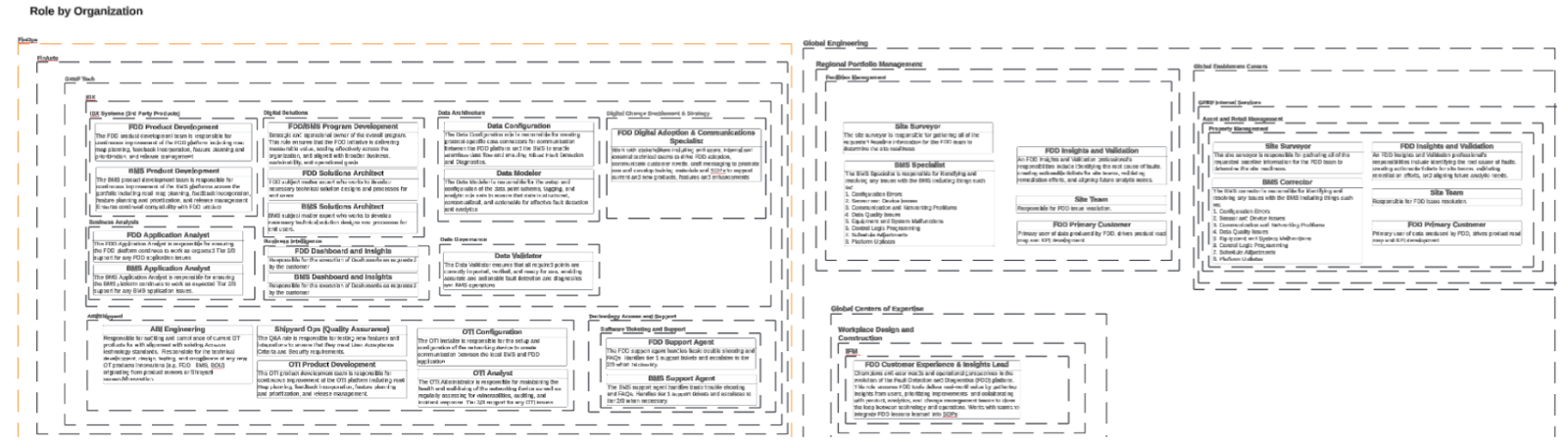
And Kelly, you talk about how you mapped your role ownership and you, you know, show a diagram that you have 26 functional roles that you're trying to map. As you're, um, developing this pilot, kind of describe to the audience like what, what that means. What was that thing that you were building and why were you building it?
Kelly Burke: Yeah, so that was a big lesson learned from the pilot. We had what we needed to do from a resourcing standpoint to. Run. Uh, but when we were thinking of what would it take to support this in scale, utilizing that lessons learned to essentially establish what would've made this easier, had we had someone in this particular role, uh, fulfilling this particular need, and so.
I think [00:23:00] I've heard people initially say 26 roles. That's a lot. Um, it is, it's not necessarily 26 headcount. Uh, some of it, uh, does scale, I would say with your program maturity as well as the square footage that you are working through, but a lot of it can be. Uh, absorbed by a singular headcount, uh, if done correctly based on that particular person's, uh, experience and also their just bandwidth.
So there's a ton of roles that I did end up saying that, uh, are necessary and really where this came from was just. To find where we can make a program, uh, very smooth from, uh, establishing what do we need to, [00:24:00] uh, have from a site inventory standpoint and understand what we have from a. You know, back of house network set up to, uh, the ins and outs of working with some particular, uh, types of BMSs and the controller types, uh, along with the different protocols, as well as being able to take the insights that are being produced and take those to the next level and.
Essentially create that, uh, you know, root cause identification and steps for remediation and take that and resolve 'em, and being generally still operating in that spot of the site. Teams going to do what they do best and, you know, work on their buildings and make them run well and make their occupants happy.
Brad Bonavida: One of the roles that I hear people talk about in condition-based maintenance, like most [00:25:00] often is I, I call it the FDD Super user or the condition-based maintenance super user, where if you just are releasing the platform and you've got these new. You know, work orders coming out that are more condition based rather than like reactive based.
Maybe you assign it to just one person who has the ability to kind of triage those and focus on those so you're not overwhelming the rest of the team who's gotta, you know, focus on what was already in the backlog. Is that one of your roles? Did you have like a, a single person who was kind of focused on these, you know, closing out these tickets to begin with?
Kelly Burke: Yes. So that, I call it something slightly different, but essentially the same thing where I call it the f, d and D insights and validation role. That person, that's essentially managing that fault queue because faults are not a one-to-one situation necessarily with tickets. Uh, not that they can't be, but uh.
With appropriate, uh, you know, roll up in terms of your logic and whatnot to [00:26:00] create those and push those into tickets. But essentially that role is indispensable, and I think it's something that a lot of people think that their site teams are immediately ready to operate in, and. That is not against the question whether or not we have folks that are on site that have the wherewithal to be able to, uh, you know, look at this time series data and interpret trends and, uh, you know, put in the.
Best, uh, root cause as well as remediation and being able to validate those findings against the BMS as well as, uh, against the actual, um. Conditions after resolution and ensure that it was resolved and taking a look and potentially adjusting, uh, down the line, but a lot of them do not have the time to do that.
Right now, we are [00:27:00] in a space that most of these buildings are handing o being handed over post commissioning that are not fully commissioned and are not operating at design. And we don't even have a solidified baseline. We. Are losing folks that have come up in both engineering and the trades with those knowledge sets, uh, that want to be in these positions.
And we're losing a lot of that level of intelligence and these folks are having to do a lot less, or sorry, do a lot more with less. Uh, and so a lot of times it's a time perspective. Um, and this is just someone that. Understands the ability to ingest and analyze data and be that eyes in the sky view versus, um, giving the site teams that ability to continue to be the boots on the ground, do what they do best and resolve issues within their buildings.
Um, and so [00:28:00] that's, that's definitely a focus where I think a lot of people when setting up a fault detection program. They think, oh, we're producing insights. We, the site teams will be able to understand those and action 'em and act upon them, and it's going to be, you know, just easy peasy, uh, lemon squeezy.
But it's, it takes a bit more than that. And this is, this is a new role, this is a new type of engineering and, um, we. To look at it in this lens, uh, as any new technology creates, you know, new roles, um, for any particular industry. So
James Dice: can you talk about specifically how, like a what, what are the roles that existed before?
I feel like sometimes people approach this as kind of like a bolt on. Like there are roles that didn't exist before. You're, you're adding, like, your role and a team, like the, the insights person, you said you're adding those [00:29:00] roles onto the maintenance organization, bolting them on, but there are roles that were there before that are now changing.
Can you talk about like the roles that are changing and how they're changing specifically?
Kelly Burke: And that was something that I wanted to make sure that I was changing for the better and not, um, making these roles, uh, develop any sort of, uh, negative feelings towards the implementation of this. It's. A combination of new roles and then, uh, integrating the tool into the existing roles and their workflows.
So, uh, the site teams and the site engineering part of that, uh, deep integration was sitting down with them and understanding what their current workflow structure is like and what systems they need to interact with on a daily basis, and how they generally go out when they receive a. Uh, we'll say reactive, too hot, too full ticket.
Uh, walk me through how you're [00:30:00] doing that and, uh, what information that you, uh, utilize and how you go about that. What are you doing, uh, generally for your proactive maintenance? How are you attacking issues like that? And so, um. The really important part is to not only think about these new roles and the fact that they need to exist, but also making sure you're not neglecting the old roles because, uh, those folks are going to be the huge drivers of value in the program and the ones that are actually going to be.
Uh, taking ownership of utilizing the insights and creating, um, the value from remediating these, um, particular issues that you're identifying.
Brad Bonavida: You mentioned at the beginning, you know, multiple building automation systems, multiple iot platforms. There's a lot of stuff this comes from. How, how did you think about that kind of satellite role is what I'll call it, of like.
Sometimes it lives in IT [00:31:00] departments or the person who's responsible for like integration and making sure that from all these disparate sources, the correct signals are getting to this centralized platform for people to use. Was that an IT role or who's responsible for getting that all to the the single source of truth?
Kelly Burke: Well, oftentimes we've found that it's a, uh, no one role. A lot of these back of house networks are incredibly neglected, and not only does it not want to touch them, um, they do not know how. Uh, a lot of our scaling effort actually involved me taking on a more technical hat where I've been helping to, uh.
Basically remediate, uh, MSTP trunk communication issues. And not that I do not know how to do that, but definitely not the main focus of my role and where I'm supposed to be, you know, dedicating a lot of my [00:32:00] time, but. You're going to see a lot of those issues and gaps from a long-term perspective. And that's something that we're working on remediating as we scale, um, to be, to have folks that, you know, have some of that more technical communication knowledge.
But, um, I would say even, even on the idea of BMS vendors and folks, uh, who are working in the. Uh, FDD space, uh, from creating those connectors in the BMS product. There is a little bit of that, uh, we'll say gap, uh, between how those folks, uh, communicate and some of the. Communication of resolving those issues.
Um, part of, again, why I had to step in some technical challenges, uh, that, that neither, uh, seemed to know how to overcome because it's just been such a neglected part of our industry. [00:33:00] And so, um. I would say it's, it's a big effort that kind of spans a few roles right now, um, just in the way that it's, that it's occurred.
But definitely, um, having someone that is specifically dedicated to operational technology, in my opinion, um, it's a whole separate. Ballpark, um, and new set of roles. Um, I've heard, uh, people from a network perspective saying that these, uh, seem to sometimes, uh, invalidate, uh. General best practices from, from a network perspective, um, and operate in a way that doesn't seem feasible.
Um, so it's definitely even from a traditional network perspective, throwing some people for a loop in that, that area.
Brad Bonavida: Yeah.
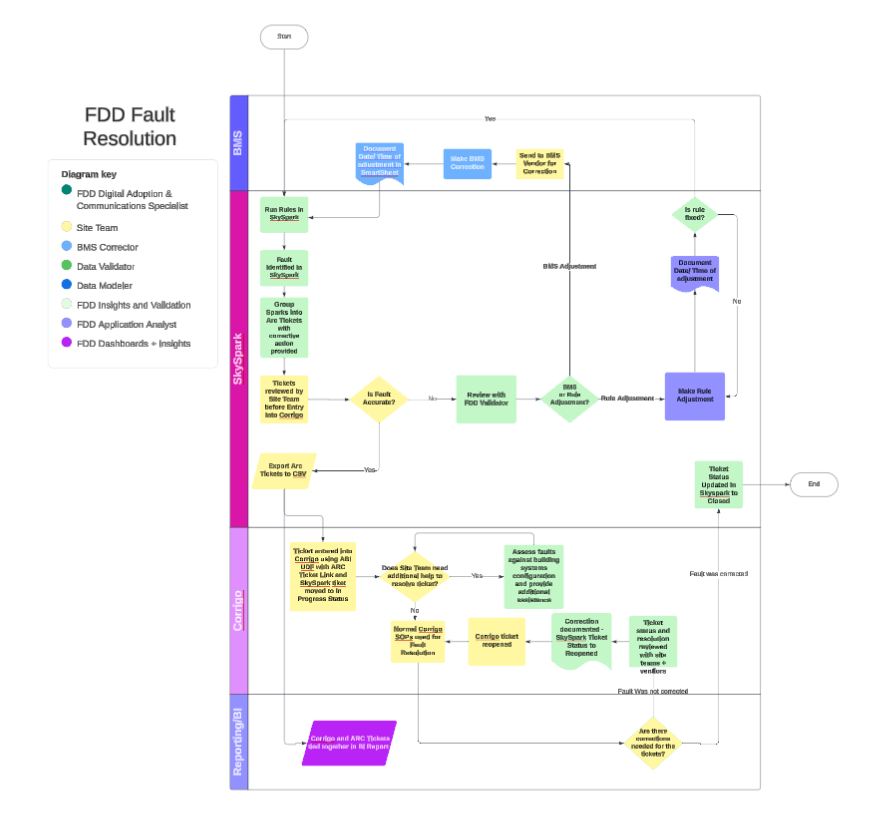
James Dice: I got one more question, Brad. Um, people should check out the [00:34:00] recording for, to look at Kelly's slides specifically around this like. Flow chart. There's like a start in the upper left, I think it says start.
Um, and then it goes into everybody's roles. Uh, it's like a swim lane flow chart. And one of the, um, areas it's really, really well done and it's almost like this is required. So Brad, we write the playbook, like that diagram is 100% required for you to implement. Condition based maintenance. Um, it basically looks at what's the role of the BMS provider, what's the role of the FDD provider?
What's the role of the CMMS in this case? Right? Um, and then what's the role of the, um, there's even a reporting layer that you have in this graphic. Kelly o one of the things I'm wondering is how people don't talk enough about how the role should change of the BMS vendor. So if you guys think about globally, all these different BMS.
Providers, all these different [00:35:00] contractors locally, how do, how do you guys change, or, or how will you, as you roll this out, change their roles and is it contractually changing them or is it simply just changing the, where they get their, their priorities from?
Kelly Burke: I think it's a combination. Um, I think. There will be a lot more work in a good way for BMS vendors to do.
Um, and I think sometimes, especially in the scaling efforts that I've, I've done along with the pilot, uh, there's some initial hesitancy on what's being done here. You know, opening up the, uh, curtain and seeing what's behind can be a little bit scary and. Uh, the great thing about this though, and the best way to work through that with them, is we're actually giving you a bigger piece of the pie.
Because let's face it, we all know that we're not running buildings optimally [00:36:00] right now. Um, if someone shows me something that's operating to design right now, I would love to see it. Um, and this is not a, um, I don't believe you more just, I really wanna see one. Uh, and so that's. They know that there's a lot of work to be done, and until we get it to a baseline, um, we can't really optimize and there's gonna be, you know, um, sequences that need to be rewritten.
I've seen quite a few PI loops that are not in operating in a manner that are, uh, ideal, but a lot of that is client requests and pushback from them. And I think this will also enable them with more information to properly, you know, write these. Sequences of operation in the BMS and do more and get more of the piece of the puzzle.
And being able to utilize some of those lessons learned for some of their other clients too. Um, so I think it changes in the sense that, um, [00:37:00] they're gonna be a little bit hesitant. They're gonna feel like they're potentially at first, you know, going to get scolded because there's information here, but. I would say for most building operators, professors, they understand that.
Um, and I think it's more of a, um, working with a good FDD program manager and program, they're gonna make sure that that is well communicated, um, and that we're giving those BMS operators. Um, of information to be successful at what they do.
Brad Bonavida: One thing I really liked about your presentation was that you actually shared like very concrete results, which we're always trying to get people to do, uh, quick, uh, you know.
Summary for the audience, and correct me if I get anything wrong, but you had three buildings for the pilot, then you got knocked it down to two. The goal was 10% energy savings and 10% operational maintenance. Savings. Uh, you hit 18% energy [00:38:00] savings, so check there. But you hit 1.5% maintenance, savings, and I thought you were really kind of, you had a lot of humility in the way you explained that, so maybe explain why that was low.
And then also I'd like to ask you like, would you recommend that someone who's starting a pilot and condition-based maintenance would even use, uh, operational maintenance, savings as a target metric for it? Why or why wouldn't you recommend that to somebody?
James Dice: Can I add a follow up, which is also how did you calculate operational savings?
Like how does that even, uh, show up as a metric?
Kelly Burke: Yeah, so I will say that was, I think even going into this, a metric that gave, especially the property management and facility management teams, a little bit of pause just because. 10% op uh, operational maintenance savings, uh, oftentimes sounds like a reduction in headcount, and that's not what it should be looking at at all.
It should be, [00:39:00] uh, really looking at how are we empowering our, uh, operators to be able to do their work more efficiently. I would say it's not a metric that I would say. You need to completely abandon, but I don't think it's as critical for the measure of success of a program, especially because, uh, a reduction in force unless absolutely necessary, uh, is not what the intent of a, uh, fault detection program should be.
Um, and. Honestly, I don't think these metrics should be utilized for that in any capacity. Those should be some separate conversations that come down more so to like portfolio management and, you know, overall needs there. But these operators are doing. So much with so little and so really more so when we were [00:40:00] looking at the operational savings, we were, uh, evaluating against similar ticket types in terms of, um, what it would've taken to resolve the particular issue prior, um, without the root cause, uh, and remediation.
I included with that and essentially taking that, um, hourly rate for the engineering team and, uh, reducing that. We did look at, um, also potentially including, uh, some more, um, we'll say theoretical, um, type metrics as well. Included in that where we were like, well. They're able to do things more efficiently.
So maybe now we can pull back some contracts from, we'll say, uh, one of the ones we kept joking about was, uh, the bench painting, uh, budget [00:41:00]for, uh, the campus. 'cause they'll have a little bit more time to, uh, do. Things that we had to sub out versus, um, you know, things that, uh, were more focused on the operational effectiveness of the building.
So overall in that, I think that was a great lessons learned too, um, to really just say this, this isn't the key driver of value. And it was something good to learn, but, um, I think too. People look at that so much with that negative lens of like reduction in force and that that's not what this is intended to be and shouldn't.
And so if you're including it, I think it should be a very, like more fact of the matter like. Situation there. But, um, it's, it's really difficult to calculate. Um, and we wanted to be as rooted in [00:42:00] reality as possible, um, with regards to, uh, like cost savings. Uh, so, uh, even, even with energy savings, we were very, um, fact of the matter and not theoretical in those assumptions that we were doing.
Um, we wanted to make sure that, that, that was clear across. Look bored.
Brad Bonavida: I, I feel like we hear this every time someone deploys FDD, just in terms like my hot take is that you just have to root it in energy savings. 'cause every time someone starts to talk about the, like, operational maintenance, savings or like, um, you know, pushing back capital allocation to, to have to, you know, uh, you know, buy new equipment or something, it gets so abstract that Yep, you just would be getting into an argument in a meeting about what's real and what's not real.
If your condition-based maintenance program isn't heavily rooted in energy savings, which is actually like verifiable, you're gonna struggle to get everybody on the same page. That's [00:43:00] what it seems like.
Kelly Burke: Yeah, that was a great point. That was something that we had looked at too, and we were like, we know if a piece of equipment is now running correctly, of course it will last longer, but it's really difficult to say how long it will actually last.
And so the high, the utility savings from a financial perspective, were, were the huge driver and the more, most concrete thing to, to go forth with and root and reality for that value.
James Dice: I like totally disagree with what you guys are saying right now. Uh, but we don't have time. We don't have time to dig into it.
People are gonna have to come to our event, uh, where I will. Talk more in more detail, or we'll do it in the next podcast, but yeah, I, I just totally disagree with you right now. But that will, yeah. Let's move on.
Brad Bonavida: You're gonna leave us on that? Yeah. You're not gonna give us the,
James Dice: yeah.
Brad Bonavida: Okay. Before we go to carve-outs, th you get 30 seconds.
Kelly, [00:44:00] if you had to give somebody advice who is just about to start their FDD program and go through something similar to you, what would be the 32nd advice for them?
Kelly Burke: My advice would be. Listen, then implement. You are not gonna have a successful program without heavily investing in the teams. Uh, that will be the operational driver of the program.
So those site teams, facilities management, property management, uh, working with your sustainability teams, really figuring out how they work. That is where your true value is going to be driven, and how you're gonna implement this successfully. Uh, a lot of the fault detection programs out there on the market right now, they're all, uh, a lot of them are fantastic and.
Um, generally though the value that you're going to be able to extract from them is going to be similar. Uh, they might not be happy with me saying that, but ultimately, the success of whatever, [00:45:00] um, fall detection, um, program that you are implementing, um, with that is going to be the value in that workforce and how you're aligning it with, um, the resourcing needs and the.
Processes, uh, that exist today. Um, and you'll be able to take whatever platform you choose to, uh, varying levels of success.
Brad Bonavida: Sure. Alright, great. With that, let's close out with some carve outs here. Uh, based on the randomness of the bullet points I put down the sheet, I go first. This week my, my carve out is this fun, silly thing that I do with two of my neighbors who are friends of mine.
We have a local newspaper called the Mountain Mail. John gets the mountain mail, he does the Sudoku, and then he leaves it on my front porch where there's two crosswords, and I do one of the crosswords, and then I leave it on Ashley and Clark's front porch where they get to do the last crossword. So they get to see how everyone did.
John gets to see how no one did. I get to see how John did on the [00:46:00]Sudoku. I realized that now I'm not supporting the Mountain Mail because we're literally recycling their newspaper three times rather than getting three subscriptions. So I am gonna make a small donation this year to make up for the fact that I don't actually subscribe, but get the newspaper.
All right, Kelly, your turn.
James Dice: That's funny.
Kelly Burke: Um, I am just going to be starting, uh, what I call concert season this weekend, so I'm very excited for that. Um, music is my calm, uh, going to see a, uh, smaller indie rock band, uh, called, uh, Alex Sucks on Sunday, so ready for that. Then I think I have a concert for almost every two to three weeks thereafter.
So, uh, damn. Yeah, that's big thing I spend most of my, my, uh, hard-earned money on is, uh, concerts and food.
James Dice: Nice. Great. Great. I don't think I have any shows booked right now. That's, that's a good reminder. [00:47:00] Um, all right, I'm gonna go do two. I'm gonna cheat. Um, the first one is we got an email from someone when we announced that the conference is gonna be in Detroit this year with basically a poo-pooing Detroit.
And I just wanna say I've been twice. This year, and I'm excited to go back again, even before the conference. People should not sleep on Detroit. It's absolutely a really, really, really cool downtown. And there's Shinola watches, which is like really, really cool. They even have their own Shinola hotel down there.
Um, all the sports stadiums are like super close. And then what's cool, what, what I think is cool is the architecture. So, um, people will just wanna walk around downtown. And what's cool about Detroit? For Nexus Con is we have Bedrock Properties that's gonna be doing a downtown walking tour for everyone on Monday.
And so maybe not everyone, we'll have to qualify that, but uh, some of the people will get to go on a downtown walking tour with Bedrock [00:48:00] and they own. 80 something percent of the buildings downtown. And so we're gonna have a little bit of a VIP tour of the coolest parts of Detroit. And so I just wanna say, don't sleep on it.
Also, don't send us mean emails about where we pick our conference location. That's also not,
Brad Bonavida: Hey, I, I couldn't agree more. I fricking love Detroit. I thought it was so fun and I'm super excited to go back. Yeah,
James Dice: yeah.
Brad Bonavida: Everything about it is great. It's fun.
Kelly Burke: That's where my husband's from. So, uh, great spot, uh, and.
Happy to pass along some weird little bars that his dad loves going to.
James Dice: Yeah, we're gonna have a little guide to Detroit as well. Um, the three hotels we're choosing for the, for the conference are also awesome. Um, the Shine, the Hotel, the book Hotel, which is a historic building, national historic register, all that.
Um. My second carve out is that my fiance got me this huge water bottle because she doesn't think I'd drink enough water. So if you're watching it on YouTube, it's like the size of my head, and I'm super behind [00:49:00] today as I have been every day since she got me this on drinking enough water. But it's a good method.
Brad Bonavida: How many ounces, how many ounces is it?
James Dice: It's 64. And so her, her prescription was that I need to drink the 64 while I'm at the office, and then I need to drink another 64 while I'm at home. And
Brad Bonavida: Oh, Jesus. It's too much water.
James Dice: That's a gallon when you live in Boulder, man. It's it's very dry here.
Brad Bonavida: Yep. Yep.
James Dice: She's
Brad Bonavida: trying
James Dice: to take care of.
Brad Bonavida: Kelly, thank you so much. Thank you, Kelly, for joining us. We look forward to hopefully seeing you at the next Nexus Con and uh, have a great rest of your week.
Kelly Burke: Thanks. Thanks guys. This was awesome being on.
Rosy Khalife: Okay, friends, thank you for listening to this episode. As we continue to grow our global community of change makers, we need your help. For the next couple of months, we're challenging our listeners to share a link to their favorite Nexus episode on LinkedIn with a short post about why you listen. It would really, really help us out.
Make sure to tag us in the post so we can see [00:50:00] it. Have a good one.
Welcome to Nexus, a newsletter and podcast for smart people applying smart building technology—hosted by James Dice. If you’re new to Nexus, you might want to start here.
The Nexus podcast (Apple | Spotify | YouTube | Other apps) is our chance to explore and learn with the brightest in our industry—together. The project is directly funded by listeners like you who have joined the Nexus Pro membership community.
You can join Nexus Pro to get a weekly-ish deep dive, access to the Nexus Vendor Landscape, and invites to exclusive events with a community of smart buildings nerds.
Sign-up (or refer a friend!) to the Nexus Newsletter.
Learn more about the Smart Building Strategist Course and the Nexus Courses Platform.
Check out the Nexus Labs Marketplace.
Learn more about Nexus Partnership Opportunities.
Episode 193 is a conversation with James Dice and Brad Bonavida from Nexus Lab, as well as Kelly Burke from JLL.
Summary
Episode 193 is a conversation with James Dice and Brad Bonavida from Nexus Lab, as well as Kelly Burke from JLL. In this episode of the Nexus Podcast, the Nexus Labs team breaks down the top stories relevant to energy managers, facility managers, IT/OT managers, and workplace managers.
Mentions and Links
- JLL (8:25)
- Sign up for NexusCast #2 on Condition-Based Maintenance (1:59)
- Link to Kelly’s presentation (8:20)
Highlights
Introduction (0:34)
At the Nexus (1:29)
Bringing Kelly into the Conversation (7:50)
Sign off (45:30)
Music credits: There Is A Reality by Common Tiger—licensed under an Music Vine Limited Pro Standard License ID: S706971-16073.
Full transcript
Note: transcript was created using an imperfect machine learning tool and lightly edited by a human (so you can get the gist). Please forgive errors!
James Dice: [00:00:00] Hey friends. If you like the Nexus Podcast, the best way to continue the learning is to join our community. You can join the Nexus Pro membership. It's our global community of smart Boeing professionals. We have monthly events, paywall, deep dive content, and a private chat room, and it's just $35 a month.
Finally, our marketplace is how we connect leading vendors with buyers looking for their solutions. The links are below in the show notes, and now let's go onto the podcast.
Brad Bonavida: All right. Welcome back to the Nexus Podcast everybody. I'm Brad Bonavita. I have with me the founder of Nexus Labs. James. James, how you doing?
James Dice: Hey, good morning. I'm good, thank you.
Brad Bonavida: Great. And our guest today is Kelly Burke. Kelly Burke is a business technology consultant at JLL. She focuses on a very specific account.
It's a very large enterprise client, which all of us know, [00:01:00] uh, Kelly, how you doing?
Kelly Burke: I'm doing great. How are you
Brad Bonavida: doing? Fantastic. As always, we wanna remind anyone who's new here that if you are trying to figure out what Nexus Labs is, you're new to listening to the podcast. The best way to figure out everything we've got going on is to subscribe to our newsletter.
It comes out every other Wednesday. It has a ton of information. It's the best way to stay up to date with all the things that we do. With that, uh, we're gonna jump into our at the Nexus section about what's going on at Nexus Labs before we dive into Kelly and all the things that she's working on. Um, just these are just some things that are going on within our community.
James, why don't you kick us off what's going on with you at Nexus?
James Dice: Um, well, we're gonna talk about one of them today, which is we're super focused right now on condition-based maintenance. I believe, Brad, you thought Kelly's presentation on condition-based maintenance was one of the best that you watched so far.
From Nexus Con 2025. So we'll get into that in just a second. But what we're building up to is our April 15th Nexus cast. It's [00:02:00] a three hour event online that people can join. It's the second in the Nexus Cast series, and I'm excited about the, the format we're, we're making tweaks and we talked about in the last few episodes, we don't get into it, but.
If you haven't heard the last few episodes, go register. It's in the links in the show notes. Um, it's free for building owners and pro members and 1 49 for everybody else.
Brad Bonavida: We've kind of been building up on condition-based maintenance for, uh, a couple of podcasts and for like over a month now leading up to Nexus Cast.
And this one's gonna be about condition-based maintenance as well. Um, and then James, you and I have been talking about next week we're gonna record the following podcast. We're gonna try something a little new there, where. We're talking to Kelly about condition-based maintenance. We talked to Chriswell about condition-based maintenance.
We've gone through our 50 plus pieces of content that are condition-based maintenance, and James and I are gonna come into the next podcast with both of our notes and try [00:03:00] to hash this thing out with everything that we've learned about condition-based maintenance, which will hopefully help us distill kind of everything that needs to be in the introduction to that Nexus cast event too.
So look, looking forward to that one.
James Dice: That'd be great.
Brad Bonavida: Uh, yeah. What about Nexus Ka?
James Dice: I think that I've been having a lot of meetings with people around brainstorming. I have a couple this week, um, brainstorming what they're gonna submit for, um, our, an abstract. So we have a request for abstracts out. Anyone that wants to take the stage as Kelly did last year, uh, needs to submit an abstract.
By, um, April 17th and Brad, we have a pretty simple abstract form this year. Um, we've, we've simplified it even more where it's basically just, um, what is an obstacle that a lot of smart buildings programs have. How did you overcome that obstacle? And then how are you going to teach the audience at Nexus Con how to [00:04:00] overcome that obstacle in their smart buildings programs?
And so what we're leaning into pretty heavily this year at Nexus Con is, um. We've always cut the fluff, but now we're gonna kind of cut the context. We don't want someone to tell us about what FDD is or, um, you know, tell us about the, uh, campus at the university of so and so. Right. What we want you to do is teach a very specific thing that someone can take back to their own smart buildings programs.
And so if you sound like, if that sounds like your jam, uh, check out the form on the website.
Brad Bonavida: Yeah, and it's like you said, it's very simple to fill out. Like we're trying to not intimidate people with like, oh, you've gotta have this master plan and write us this like four page abstract of everything that's gonna be about like, get your idea out there.
You learn something, you wanna teach it. We can help you figure out exactly how to frame it if you need. But, uh, we just [00:05:00] wanna see you submit and see what ideas of teachings that people have out there.
James Dice: The other thing that's happening right now is about a quarter of the booths are taken, which means if you're a vendor listening to this and you have not reserved your booth, the first, the the best 25% of the booths are already already grabbed.
Um, and I would say just looking at our, our pipeline. The next 25% is about to be grabbed soon. So, um, it's not like we're not trying to like overhype this, like the booths are gonna sell out, but just like if you're gonna join, if you're gonna sign up for Nexus Con as a vendor in August, you're, you just should know that you're not gonna get the, the, the, the booth that you want to get.
And then when the demo stage schedule gets released, you're also not gonna get the best pick of, of which demo slot you want. And so. Um, we hate hype, but that is a very real thing we do. It's first come, first serve. You get to choose your booth, and then you get to choose your demo slot. [00:06:00] And if you're, if you're late, sorry.
Brad Bonavida: Yeah, and one, one thing about, I can't remember if we've talked about the this on the pod, but I'm really stoked about the layout of the booths this year is that last year you have the marketplace where you can like walk into the marketplace and there's all the booths and like you can go either. Opt in of that or opt out of it this year.
The booths are like the hallway of the whole event. So like you are always in the marketplace. You're walking through it where you get lunches, where the booths are, where you get from one presentation to another is where the booths are. It's like very integrated into the whole experience. So, um, yeah, I'm looking forward to.
Uh, and then the last thing before we get into Kelly is just, I'm really excited about our new website. We just launched it today. It's a lot easier for people to find content that's relevant to them. If you're an energy manager, facility manager, ot, we have different sections that really help curate like what content we have that's specific for you.
So it looks really cool. [00:07:00] Check it out if you have it.
James Dice: Um, just on the new website, it's not a new website, we just have a few new pages. I think we should point people towards the hub pages. So you're, if you're an fm for example, we have an FM hub now, and so everything related to transforming how maintenance and FM are done with technology is gonna end up on that.
So we've tagged all of our archive content. If it's related to fm, it's gonna show up on that FM hub. We'll also be putting, you know, um. More roadmap style materials for fms to think about how smart buildings relate to specifically that, that department. Same thing for ot, same thing for energy, same thing for service providers.
And so it's kind of how we're gonna be building out the website from now on. So. Let us know what you think. Everybody
Brad Bonavida: Alright with that? Let's, let's move on to get Kelly involved here. Kelly, this is a true story. Before you start that, while I was preparing for this, um, I did rewatch your [00:08:00] recording on Nexus Pro.
It's on our website and literally the day I was watching it and like taking notes, I got an email from somebody. Who was like, Hey, I was at Nexus Con and I'm trying to work on this thing. Uh, where do I find Kelly's presentation? 'cause I'm looking for some inspiration, which is crazy and goes to show how well you did.
So, um, thank you for presenting. It was fantastic. So why don't you start by just telling us a little bit about your work at JLL. What do you do? How long have you been there? What's your background? That type of stuff.
Kelly Burke: Yeah. Um, thanks and exciting to hear that, uh, people are following up on the presentation and finding value in it.
So, uh, that's generally what I'm looking for, not only to, you know, drive my clients, but also to help push the industry. And so glad to hear that. Uh, but for JLLI have been here, uh, almost about three years at this point. I have what some might call a untraditional background. Uh, I actually started my career in [00:09:00] FinTech, uh, and then, uh, actually transferred to construction tech and then finally have landed my way here in property tech Smart building, uh, worlds, whatever, uh, you choose to call it at this particular point.
But, uh, I do think that that's actually created a. Very interesting lens for me to look at the industry with. Uh, I tend to find that because I have navigated through these very different, uh, industries, that it has really led me to find the people who are the actual experts, uh, and listen to those folks and help to sort of establish.
If I can't necessarily out engineer our engineers, they have decades more experience. But what I'm great at helping them to do is figuring out, uh, where they need assistance and [00:10:00] how I can make them, uh, better at what they do by empowering them with the right tools.
Brad Bonavida: Nice. And you work for JLL, you work on a specific client's account.
How long have you been assigned to that one client and what portfolio of buildings are you, are, are you kind of responsible for of theirs?
Kelly Burke: Yeah, so I have been on the account as long as I have been at JLL, uh, so. Pretty much, again, three years at this point with the particular portfolio of buildings that we are, uh, looking at, it is office buildings, uh, comprised of, uh, owned and lease sites, uh, campus sites, uh, as well as individual owned sites.
Uh, then generally about. 500 plus buildings changes, um, on that particular number depending on, uh, who you're asking, uh, at that particular point in time. But, uh, also from. [00:11:00] A difference in the types of, uh, work that they support. Uh, some areas being lab settings, some being, uh, television studios, um, recording studios.
So there's a lot of variety in, in what's, uh, an office building there. Sure.
Brad Bonavida: And are those all located in one place or are they dispersed throughout the country?
Kelly Burke: Uh, not only dispersed throughout the country, but also global.
Brad Bonavida: Okay, great. And then I, I always think it's interesting with like specifically JLL employees to kind of understand the lay of the land a little bit.
So can you describe in terms of like you're working with employees who are part of this enterprise company as well as JLL employees, and then you also have outsourced contractors, I imagine too. So like, and we'll get a little bit more into the roles, but like how do those relationships kind of mesh together?
Like what does the team look like across those orgs?
Kelly Burke: Yeah, it's pretty interesting. [00:12:00] And where I sit has been an additional layer of, uh, complexity there, just because I was not intended to be on this account in full-time for three years. But, uh, has just worked out that way that we've been able to make good progress on what I've been working on.
Uh, the. General setup of the team that I sit on is entirely, uh, actual, uh, client folks, uh, whereas I am the only contractor. But, uh, in, in that particular team, uh, I do actually utilize, uh, our internal JLL intelligent, uh, operation center, uh, short is IOC, and they're the ones that are currently, uh, working on the FDD program from a technical and service standpoint.
Uh, prior to [00:13:00] that it was, uh, a mix of vendors that we had been working with, just ended up being the. Strike cost. Um, and for the scaling needs that we had, uh, from a partnership perspective, uh, on the level that we were going there. But, uh, it's very mixed in how the, the teams operate. There are, uh, your leads on the real estate side that are generally all client based, and then mostly the site teams, which are a variety of.
Uh, JLL operators as well as, uh, we have, uh, some folks that, uh, in different regions based on some, uh, differences in how the. Set up is there and, uh, some changing client accounts that we have other, uh, folks that are also commercial, uh, real estate [00:14:00] operators that we have to work with, um, in addition, uh, but generally the client likes to keep out as many, uh, third party operations as possible.
Uh, so definitely very interesting that they try and pull a lot of what they can in house, um, even from the tech perspective. So. Very, very unique setup. Um, I think from that particular lens.
Brad Bonavida: So let's dive into the, the meat of what your nex com presentation was about, which is this nexus or this, excuse me, this FDD pilot that you, that you kind of led.
Um, you kind of started out, you got the great meme, I've seen it before, of like where the, the, the customer asked for the swing on the tree and like what the designer thought, what the engineer thought, and what the VP thought. I love that. Uh, look, but basically it sounds like you have a lot of experience or you've seen the pitfalls of a failed FDD pilot.
You mentioned specifically like too many dashboards and using AI to like plug and play rules. What was your [00:15:00] experience prior, like how did you know about these pitfalls of FDD gone bad before you started this pilot?
Kelly Burke: So, interestingly enough, uh, this was my. First pilot that I had run for F, d, and D, but where I had experience with identifying those pitfalls had been from my par prior lives, working at general contractors, uh, and doing.
Uh, construction technology where I was seeing the implementation of this technology not being done in a way that properly supported, uh, those on site to get their, uh, jobs done efficiently, uh, as well as supply them with the right information and tools to get that job done. And so while this had been my personal first, uh, foray into FDD, not that it was a new concept by any means, um, it was something that I, it's a [00:16:00] tale as old as time in any industry.
I think we've seen. If you're not looking at the, the people in the process, uh, then you're left with a hammer that nobody knows how to use.
Brad Bonavida: Mm-hmm. Yeah. And then you, you had pretty specific, uh, metrics that you were kind of being held to as you started this pilot. Like I think they were more specific than we typically see with someone going into the pilot.
Can you talk about those and like what, what you guys had defined as success before you started? Before
Kelly Burke: started? Yeah. So I actually had been brought on a little bit, um, mid. We'll say stream in terms of the, uh, startup of the program. So some of these things had been, uh, already agreed to upon prior to me joining the project with the particular metrics.
But, uh, the client really wanted hard numbers of. Is [00:17:00] this something that will actually make us successful? Does it bring value? And they wanted to be able to not only show it in. Um, a very nice, neat package, but also across diverse conditions, different building types. Um, essentially introducing as much diversity as we could into the actual results to say, um, that not only is this something that we can replicate at one site, but something that we can replicate at other sites.
Most of these, uh, general parameters that we ended up, uh, coming up with from a metrics standpoint for success evaluation came from, uh, the Lawrence Berkeley study that was done, I think back in 2020, uh, if I remember correctly. And so those were our, um, general drivers to see. We had the hypothesis of, you know, if [00:18:00] we deploy this at buildings, are we able to achieve the, uh, industry agreed upon, um, results seen there?
Uh, to show that this drives enough value for the customer to scale.
James Dice: People don't talk very much. At least I haven't heard JLL talk very much about their FTD group and FDD offering. Can you talk about like what is their, how, how do they come into this? It sounds like they're using skypark and then there's a team that has developed their own sort of JLL product.
Is that something we can talk about publicly here?
Kelly Burke: Yeah. Um, so the. FDD sort of offering, uh, that is actually something as a result of this, uh, pilot, we, uh, pilot and scaling effort with this particular client. We are actively working on, uh, refining. My team specifically is, uh, [00:19:00] software agnostic. So we have that, uh.
I'll say fortunate, uh, ability to be able to look at, uh, all of the tools available to us, uh, on the market from my particular team and recommend what is the right fit, uh, for the pilot at the time, uh, we didn't go with anything JLL related. Uh, we did end up establishing that SKYPARK was going to be our.
Uh, method of choice just because from a, uh, cost perspective as well as, uh, some other parameters that the client had set, like being able to own their data, um, being able to, uh, create customizations, potentially utilizing the Hackel framework, uh, to, uh, establish their own version, um, and had the most ownership over.
Uh, analytic rule sets as well as, uh, [00:20:00] easy integration, uh, with other platforms. So that had been why we initially went with that, uh, and to try and eliminate a lot of, uh, we'll say. Conflict of interest, uh, with going with an internal team, uh, to utilize skypark because the JLL, uh, developed platform is developed on, uh, the skypark Hackel framework.
Um, and so it's called Inte Build, but uh, we went completely third party otherwise, and it was just me acting in as that sort of. Uh, technical program manager perspective, and, uh, we hired someone to, uh, come in as the vendor of the software, uh, to get everything set up. Uh, and then also to run, uh, the, what I call experience and insights, uh, portion.
So basically [00:21:00] taking a look at the tickets generated, making sure that. Uh, they were able to validate those conditions against the BMS, um, and so forth. But, um, based on the results of that, that's why we ended up, uh, taking a broader look at who the, uh, market from skypark perspective, uh, to see what the other offerings were out there from a cost and service perspective, and ended up going internal just because, uh, from that analysis, uh, the.
Client thought that it made the most sense to move forward in that capacity.
Brad Bonavida: I want to fast forward to, you did a great job throughout your whole Nexus con presentation of kind of going through your entire condition-based maintenance playbook. James and I are writing the Nexus Labs version of the Condition-based Maintenance Playbook right now.
I was actually mapping them together. You obviously have a bunch of the same steps. What I thought was the most interesting part of your presentation is what we call step seven James. We [00:22:00] had 10 steps and then, then we went down to eight, and now I think we have nine steps. But step seven in our process is establishing role ownership.
And Kelly, you talk about how you mapped your role ownership and you, you know, show a diagram that you have 26 functional roles that you're trying to map. As you're, um, developing this pilot, kind of describe to the audience like what, what that means. What was that thing that you were building and why were you building it?
Kelly Burke: Yeah, so that was a big lesson learned from the pilot. We had what we needed to do from a resourcing standpoint to. Run. Uh, but when we were thinking of what would it take to support this in scale, utilizing that lessons learned to essentially establish what would've made this easier, had we had someone in this particular role, uh, fulfilling this particular need, and so.
I think [00:23:00] I've heard people initially say 26 roles. That's a lot. Um, it is, it's not necessarily 26 headcount. Uh, some of it, uh, does scale, I would say with your program maturity as well as the square footage that you are working through, but a lot of it can be. Uh, absorbed by a singular headcount, uh, if done correctly based on that particular person's, uh, experience and also their just bandwidth.
So there's a ton of roles that I did end up saying that, uh, are necessary and really where this came from was just. To find where we can make a program, uh, very smooth from, uh, establishing what do we need to, [00:24:00] uh, have from a site inventory standpoint and understand what we have from a. You know, back of house network set up to, uh, the ins and outs of working with some particular, uh, types of BMSs and the controller types, uh, along with the different protocols, as well as being able to take the insights that are being produced and take those to the next level and.
Essentially create that, uh, you know, root cause identification and steps for remediation and take that and resolve 'em, and being generally still operating in that spot of the site. Teams going to do what they do best and, you know, work on their buildings and make them run well and make their occupants happy.
Brad Bonavida: One of the roles that I hear people talk about in condition-based maintenance, like most [00:25:00] often is I, I call it the FDD Super user or the condition-based maintenance super user, where if you just are releasing the platform and you've got these new. You know, work orders coming out that are more condition based rather than like reactive based.
Maybe you assign it to just one person who has the ability to kind of triage those and focus on those so you're not overwhelming the rest of the team who's gotta, you know, focus on what was already in the backlog. Is that one of your roles? Did you have like a, a single person who was kind of focused on these, you know, closing out these tickets to begin with?
Kelly Burke: Yes. So that, I call it something slightly different, but essentially the same thing where I call it the f, d and D insights and validation role. That person, that's essentially managing that fault queue because faults are not a one-to-one situation necessarily with tickets. Uh, not that they can't be, but uh.
With appropriate, uh, you know, roll up in terms of your logic and whatnot to [00:26:00] create those and push those into tickets. But essentially that role is indispensable, and I think it's something that a lot of people think that their site teams are immediately ready to operate in, and. That is not against the question whether or not we have folks that are on site that have the wherewithal to be able to, uh, you know, look at this time series data and interpret trends and, uh, you know, put in the.
Best, uh, root cause as well as remediation and being able to validate those findings against the BMS as well as, uh, against the actual, um. Conditions after resolution and ensure that it was resolved and taking a look and potentially adjusting, uh, down the line, but a lot of them do not have the time to do that.
Right now, we are [00:27:00] in a space that most of these buildings are handing o being handed over post commissioning that are not fully commissioned and are not operating at design. And we don't even have a solidified baseline. We. Are losing folks that have come up in both engineering and the trades with those knowledge sets, uh, that want to be in these positions.
And we're losing a lot of that level of intelligence and these folks are having to do a lot less, or sorry, do a lot more with less. Uh, and so a lot of times it's a time perspective. Um, and this is just someone that. Understands the ability to ingest and analyze data and be that eyes in the sky view versus, um, giving the site teams that ability to continue to be the boots on the ground, do what they do best and resolve issues within their buildings.
Um, and so [00:28:00] that's, that's definitely a focus where I think a lot of people when setting up a fault detection program. They think, oh, we're producing insights. We, the site teams will be able to understand those and action 'em and act upon them, and it's going to be, you know, just easy peasy, uh, lemon squeezy.
But it's, it takes a bit more than that. And this is, this is a new role, this is a new type of engineering and, um, we. To look at it in this lens, uh, as any new technology creates, you know, new roles, um, for any particular industry. So
James Dice: can you talk about specifically how, like a what, what are the roles that existed before?
I feel like sometimes people approach this as kind of like a bolt on. Like there are roles that didn't exist before. You're, you're adding, like, your role and a team, like the, the insights person, you said you're adding those [00:29:00] roles onto the maintenance organization, bolting them on, but there are roles that were there before that are now changing.
Can you talk about like the roles that are changing and how they're changing specifically?
Kelly Burke: And that was something that I wanted to make sure that I was changing for the better and not, um, making these roles, uh, develop any sort of, uh, negative feelings towards the implementation of this. It's. A combination of new roles and then, uh, integrating the tool into the existing roles and their workflows.
So, uh, the site teams and the site engineering part of that, uh, deep integration was sitting down with them and understanding what their current workflow structure is like and what systems they need to interact with on a daily basis, and how they generally go out when they receive a. Uh, we'll say reactive, too hot, too full ticket.
Uh, walk me through how you're [00:30:00] doing that and, uh, what information that you, uh, utilize and how you go about that. What are you doing, uh, generally for your proactive maintenance? How are you attacking issues like that? And so, um. The really important part is to not only think about these new roles and the fact that they need to exist, but also making sure you're not neglecting the old roles because, uh, those folks are going to be the huge drivers of value in the program and the ones that are actually going to be.
Uh, taking ownership of utilizing the insights and creating, um, the value from remediating these, um, particular issues that you're identifying.
Brad Bonavida: You mentioned at the beginning, you know, multiple building automation systems, multiple iot platforms. There's a lot of stuff this comes from. How, how did you think about that kind of satellite role is what I'll call it, of like.
Sometimes it lives in IT [00:31:00] departments or the person who's responsible for like integration and making sure that from all these disparate sources, the correct signals are getting to this centralized platform for people to use. Was that an IT role or who's responsible for getting that all to the the single source of truth?
Kelly Burke: Well, oftentimes we've found that it's a, uh, no one role. A lot of these back of house networks are incredibly neglected, and not only does it not want to touch them, um, they do not know how. Uh, a lot of our scaling effort actually involved me taking on a more technical hat where I've been helping to, uh.
Basically remediate, uh, MSTP trunk communication issues. And not that I do not know how to do that, but definitely not the main focus of my role and where I'm supposed to be, you know, dedicating a lot of my [00:32:00] time, but. You're going to see a lot of those issues and gaps from a long-term perspective. And that's something that we're working on remediating as we scale, um, to be, to have folks that, you know, have some of that more technical communication knowledge.
But, um, I would say even, even on the idea of BMS vendors and folks, uh, who are working in the. Uh, FDD space, uh, from creating those connectors in the BMS product. There is a little bit of that, uh, we'll say gap, uh, between how those folks, uh, communicate and some of the. Communication of resolving those issues.
Um, part of, again, why I had to step in some technical challenges, uh, that, that neither, uh, seemed to know how to overcome because it's just been such a neglected part of our industry. [00:33:00] And so, um. I would say it's, it's a big effort that kind of spans a few roles right now, um, just in the way that it's, that it's occurred.
But definitely, um, having someone that is specifically dedicated to operational technology, in my opinion, um, it's a whole separate. Ballpark, um, and new set of roles. Um, I've heard, uh, people from a network perspective saying that these, uh, seem to sometimes, uh, invalidate, uh. General best practices from, from a network perspective, um, and operate in a way that doesn't seem feasible.
Um, so it's definitely even from a traditional network perspective, throwing some people for a loop in that, that area.
Brad Bonavida: Yeah.
James Dice: I got one more question, Brad. Um, people should check out the [00:34:00] recording for, to look at Kelly's slides specifically around this like. Flow chart. There's like a start in the upper left, I think it says start.
Um, and then it goes into everybody's roles. Uh, it's like a swim lane flow chart. And one of the, um, areas it's really, really well done and it's almost like this is required. So Brad, we write the playbook, like that diagram is 100% required for you to implement. Condition based maintenance. Um, it basically looks at what's the role of the BMS provider, what's the role of the FDD provider?
What's the role of the CMMS in this case? Right? Um, and then what's the role of the, um, there's even a reporting layer that you have in this graphic. Kelly o one of the things I'm wondering is how people don't talk enough about how the role should change of the BMS vendor. So if you guys think about globally, all these different BMS.
Providers, all these different [00:35:00] contractors locally, how do, how do you guys change, or, or how will you, as you roll this out, change their roles and is it contractually changing them or is it simply just changing the, where they get their, their priorities from?
Kelly Burke: I think it's a combination. Um, I think. There will be a lot more work in a good way for BMS vendors to do.
Um, and I think sometimes, especially in the scaling efforts that I've, I've done along with the pilot, uh, there's some initial hesitancy on what's being done here. You know, opening up the, uh, curtain and seeing what's behind can be a little bit scary and. Uh, the great thing about this though, and the best way to work through that with them, is we're actually giving you a bigger piece of the pie.
Because let's face it, we all know that we're not running buildings optimally [00:36:00] right now. Um, if someone shows me something that's operating to design right now, I would love to see it. Um, and this is not a, um, I don't believe you more just, I really wanna see one. Uh, and so that's. They know that there's a lot of work to be done, and until we get it to a baseline, um, we can't really optimize and there's gonna be, you know, um, sequences that need to be rewritten.
I've seen quite a few PI loops that are not in operating in a manner that are, uh, ideal, but a lot of that is client requests and pushback from them. And I think this will also enable them with more information to properly, you know, write these. Sequences of operation in the BMS and do more and get more of the piece of the puzzle.
And being able to utilize some of those lessons learned for some of their other clients too. Um, so I think it changes in the sense that, um, [00:37:00] they're gonna be a little bit hesitant. They're gonna feel like they're potentially at first, you know, going to get scolded because there's information here, but. I would say for most building operators, professors, they understand that.
Um, and I think it's more of a, um, working with a good FDD program manager and program, they're gonna make sure that that is well communicated, um, and that we're giving those BMS operators. Um, of information to be successful at what they do.
Brad Bonavida: One thing I really liked about your presentation was that you actually shared like very concrete results, which we're always trying to get people to do, uh, quick, uh, you know.
Summary for the audience, and correct me if I get anything wrong, but you had three buildings for the pilot, then you got knocked it down to two. The goal was 10% energy savings and 10% operational maintenance. Savings. Uh, you hit 18% energy [00:38:00] savings, so check there. But you hit 1.5% maintenance, savings, and I thought you were really kind of, you had a lot of humility in the way you explained that, so maybe explain why that was low.
And then also I'd like to ask you like, would you recommend that someone who's starting a pilot and condition-based maintenance would even use, uh, operational maintenance, savings as a target metric for it? Why or why wouldn't you recommend that to somebody?
James Dice: Can I add a follow up, which is also how did you calculate operational savings?
Like how does that even, uh, show up as a metric?
Kelly Burke: Yeah, so I will say that was, I think even going into this, a metric that gave, especially the property management and facility management teams, a little bit of pause just because. 10% op uh, operational maintenance savings, uh, oftentimes sounds like a reduction in headcount, and that's not what it should be looking at at all.
It should be, [00:39:00] uh, really looking at how are we empowering our, uh, operators to be able to do their work more efficiently. I would say it's not a metric that I would say. You need to completely abandon, but I don't think it's as critical for the measure of success of a program, especially because, uh, a reduction in force unless absolutely necessary, uh, is not what the intent of a, uh, fault detection program should be.
Um, and. Honestly, I don't think these metrics should be utilized for that in any capacity. Those should be some separate conversations that come down more so to like portfolio management and, you know, overall needs there. But these operators are doing. So much with so little and so really more so when we were [00:40:00] looking at the operational savings, we were, uh, evaluating against similar ticket types in terms of, um, what it would've taken to resolve the particular issue prior, um, without the root cause, uh, and remediation.
I included with that and essentially taking that, um, hourly rate for the engineering team and, uh, reducing that. We did look at, um, also potentially including, uh, some more, um, we'll say theoretical, um, type metrics as well. Included in that where we were like, well. They're able to do things more efficiently.
So maybe now we can pull back some contracts from, we'll say, uh, one of the ones we kept joking about was, uh, the bench painting, uh, budget [00:41:00]for, uh, the campus. 'cause they'll have a little bit more time to, uh, do. Things that we had to sub out versus, um, you know, things that, uh, were more focused on the operational effectiveness of the building.
So overall in that, I think that was a great lessons learned too, um, to really just say this, this isn't the key driver of value. And it was something good to learn, but, um, I think too. People look at that so much with that negative lens of like reduction in force and that that's not what this is intended to be and shouldn't.
And so if you're including it, I think it should be a very, like more fact of the matter like. Situation there. But, um, it's, it's really difficult to calculate. Um, and we wanted to be as rooted in [00:42:00] reality as possible, um, with regards to, uh, like cost savings. Uh, so, uh, even, even with energy savings, we were very, um, fact of the matter and not theoretical in those assumptions that we were doing.
Um, we wanted to make sure that, that, that was clear across. Look bored.
Brad Bonavida: I, I feel like we hear this every time someone deploys FDD, just in terms like my hot take is that you just have to root it in energy savings. 'cause every time someone starts to talk about the, like, operational maintenance, savings or like, um, you know, pushing back capital allocation to, to have to, you know, uh, you know, buy new equipment or something, it gets so abstract that Yep, you just would be getting into an argument in a meeting about what's real and what's not real.
If your condition-based maintenance program isn't heavily rooted in energy savings, which is actually like verifiable, you're gonna struggle to get everybody on the same page. That's [00:43:00] what it seems like.
Kelly Burke: Yeah, that was a great point. That was something that we had looked at too, and we were like, we know if a piece of equipment is now running correctly, of course it will last longer, but it's really difficult to say how long it will actually last.
And so the high, the utility savings from a financial perspective, were, were the huge driver and the more, most concrete thing to, to go forth with and root and reality for that value.
James Dice: I like totally disagree with what you guys are saying right now. Uh, but we don't have time. We don't have time to dig into it.
People are gonna have to come to our event, uh, where I will. Talk more in more detail, or we'll do it in the next podcast, but yeah, I, I just totally disagree with you right now. But that will, yeah. Let's move on.
Brad Bonavida: You're gonna leave us on that? Yeah. You're not gonna give us the,
James Dice: yeah.
Brad Bonavida: Okay. Before we go to carve-outs, th you get 30 seconds.
Kelly, [00:44:00] if you had to give somebody advice who is just about to start their FDD program and go through something similar to you, what would be the 32nd advice for them?
Kelly Burke: My advice would be. Listen, then implement. You are not gonna have a successful program without heavily investing in the teams. Uh, that will be the operational driver of the program.
So those site teams, facilities management, property management, uh, working with your sustainability teams, really figuring out how they work. That is where your true value is going to be driven, and how you're gonna implement this successfully. Uh, a lot of the fault detection programs out there on the market right now, they're all, uh, a lot of them are fantastic and.
Um, generally though the value that you're going to be able to extract from them is going to be similar. Uh, they might not be happy with me saying that, but ultimately, the success of whatever, [00:45:00] um, fall detection, um, program that you are implementing, um, with that is going to be the value in that workforce and how you're aligning it with, um, the resourcing needs and the.
Processes, uh, that exist today. Um, and you'll be able to take whatever platform you choose to, uh, varying levels of success.
Brad Bonavida: Sure. Alright, great. With that, let's close out with some carve outs here. Uh, based on the randomness of the bullet points I put down the sheet, I go first. This week my, my carve out is this fun, silly thing that I do with two of my neighbors who are friends of mine.
We have a local newspaper called the Mountain Mail. John gets the mountain mail, he does the Sudoku, and then he leaves it on my front porch where there's two crosswords, and I do one of the crosswords, and then I leave it on Ashley and Clark's front porch where they get to do the last crossword. So they get to see how everyone did.
John gets to see how no one did. I get to see how John did on the [00:46:00]Sudoku. I realized that now I'm not supporting the Mountain Mail because we're literally recycling their newspaper three times rather than getting three subscriptions. So I am gonna make a small donation this year to make up for the fact that I don't actually subscribe, but get the newspaper.
All right, Kelly, your turn.
James Dice: That's funny.
Kelly Burke: Um, I am just going to be starting, uh, what I call concert season this weekend, so I'm very excited for that. Um, music is my calm, uh, going to see a, uh, smaller indie rock band, uh, called, uh, Alex Sucks on Sunday, so ready for that. Then I think I have a concert for almost every two to three weeks thereafter.
So, uh, damn. Yeah, that's big thing I spend most of my, my, uh, hard-earned money on is, uh, concerts and food.
James Dice: Nice. Great. Great. I don't think I have any shows booked right now. That's, that's a good reminder. [00:47:00] Um, all right, I'm gonna go do two. I'm gonna cheat. Um, the first one is we got an email from someone when we announced that the conference is gonna be in Detroit this year with basically a poo-pooing Detroit.
And I just wanna say I've been twice. This year, and I'm excited to go back again, even before the conference. People should not sleep on Detroit. It's absolutely a really, really, really cool downtown. And there's Shinola watches, which is like really, really cool. They even have their own Shinola hotel down there.
Um, all the sports stadiums are like super close. And then what's cool, what, what I think is cool is the architecture. So, um, people will just wanna walk around downtown. And what's cool about Detroit? For Nexus Con is we have Bedrock Properties that's gonna be doing a downtown walking tour for everyone on Monday.
And so maybe not everyone, we'll have to qualify that, but uh, some of the people will get to go on a downtown walking tour with Bedrock [00:48:00] and they own. 80 something percent of the buildings downtown. And so we're gonna have a little bit of a VIP tour of the coolest parts of Detroit. And so I just wanna say, don't sleep on it.
Also, don't send us mean emails about where we pick our conference location. That's also not,
Brad Bonavida: Hey, I, I couldn't agree more. I fricking love Detroit. I thought it was so fun and I'm super excited to go back. Yeah,
James Dice: yeah.
Brad Bonavida: Everything about it is great. It's fun.
Kelly Burke: That's where my husband's from. So, uh, great spot, uh, and.
Happy to pass along some weird little bars that his dad loves going to.
James Dice: Yeah, we're gonna have a little guide to Detroit as well. Um, the three hotels we're choosing for the, for the conference are also awesome. Um, the Shine, the Hotel, the book Hotel, which is a historic building, national historic register, all that.
Um. My second carve out is that my fiance got me this huge water bottle because she doesn't think I'd drink enough water. So if you're watching it on YouTube, it's like the size of my head, and I'm super behind [00:49:00] today as I have been every day since she got me this on drinking enough water. But it's a good method.
Brad Bonavida: How many ounces, how many ounces is it?
James Dice: It's 64. And so her, her prescription was that I need to drink the 64 while I'm at the office, and then I need to drink another 64 while I'm at home. And
Brad Bonavida: Oh, Jesus. It's too much water.
James Dice: That's a gallon when you live in Boulder, man. It's it's very dry here.
Brad Bonavida: Yep. Yep.
James Dice: She's
Brad Bonavida: trying
James Dice: to take care of.
Brad Bonavida: Kelly, thank you so much. Thank you, Kelly, for joining us. We look forward to hopefully seeing you at the next Nexus Con and uh, have a great rest of your week.
Kelly Burke: Thanks. Thanks guys. This was awesome being on.
Rosy Khalife: Okay, friends, thank you for listening to this episode. As we continue to grow our global community of change makers, we need your help. For the next couple of months, we're challenging our listeners to share a link to their favorite Nexus episode on LinkedIn with a short post about why you listen. It would really, really help us out.
Make sure to tag us in the post so we can see [00:50:00] it. Have a good one.


This is a great piece!
I agree.