
The Proof Tax Every Energy Manager Pays
A tenured New York City facility manager told me about an energy consultant who was hired and advised the team to update the chilled water discharge setpoint from 42 to 46 degrees.
Sounds like a clear-cut way to save energy, right?
The only problem is that as the chilled water temperature rose, VAV boxes across the building swung open to compensate, and fan VFDs were driven to max speed. The energy saved at the chiller was wiped out by even greater energy spent on ventilation.
When he brought his concerns to senior leadership and suggested they validate the energy savings, he was told to stay in his lane.
On the other side of the coin, many energy managers face analysis paralysis: a never-ending request for more and more data to prove their work is worth the squeeze. When every change requires a mountain of evidence, the safest move becomes changing nothing.
On The Nexus Podcast, Patrick Testoni, Director of Energy at UC Santa Cruz, put this struggle plainly: "The default setting is, 'If I do what they've always told me to do, then I won't get in trouble or be critiqued,' even though that could be making the equipment more vulnerable [to energy overconsumption]."
This is the Proof Tax every energy manager battles. Too much measurement and verification (M&V), and you're wasting time and money proving the work rather than doing it. Not enough M&V, and everyone is questioning your work. How do you find the balance?
Most energy managers (EMs) we talk to are over-taxed, not under-taxed. Skeptics fighting for a limited budget will always poke holes in the latest energy conservation measure (ECM), and an EM can spend all their time paying the proof tax.
Brandon McCoy of Texas Tech identified $977k in energy savings in his program's first year but only had the capacity and permission to capture $97k of it.
Another EM in life sciences told us that although they are aware of major energy waste, they "lack the metering to be able to perform full building analysis," and "most of our buildings are 24/7 and are difficult to interrupt to add meters." He can't get permission to perform the energy updates because "the issues don't seem to 'impact' anyone, so they don't get prioritized."
No one has blind trust in his intuition, yet he's hamstrung from proving himself.
But the proof tax isn't always the villain. Look back at the opening story: the whole chiller setpoint mess happened because nobody validated the consultant's recommendation. Proof is how you hold your service providers accountable for the value they claim.
A senior director at a major commercial real estate organization explained to us that their energy performance contracts require them to M&V anything the ESCO wasn't touching. That way, if they complete a project that had nothing to do with the ESCO, or their occupancy drops with nothing to do with the ESCO, they're not paying for energy savings the ESCO wasn't responsible for delivering.
The proof tax also isn't going away for utility incentives, which can require meticulous M&V and provide major financial justification for the project. Stanford Children's Health shared at NexusCon 2026 how they recouped 100% of their occupancy-based ventilation project costs, in part because the M&V write-up already existed and its exact figures fed the incentive application.
So what's an energy manager to do? When we look at the successful energy management programs in our community, their proof tax balance comes down to some combination of three techniques:
Scrappy ways to prove savings without meters
This is where nearly everyone starts, because it requires nothing you don't already own.
Chris Lelle of Lincoln Property, who spoke in the Wrangle the Utility Bill session at NexusCon 2026, told us how he uses air handler run time multiplied by known drive behavior to calculate energy savings to an acceptable level "without having to put any effort into it." Many technology vendors now offer a calculated version of energy savings, similar to what Lelle describes, under the term "virtual metering."
Aaron Hastings of Apex Consulting Services shared in our Continuous Validation session how he compares trend data from when chiller optimization was on vs. off to prove what it's done for CSUCI's energy bill over the past year.
Continuous buildout of M&V infrastructure
While you can get away with scrappy calculations for many use cases, the smart energy manager still recognizes the importance of developing meter infrastructure.
Justin Owen of Weber State told us about his 300 utility submeters and how he watches the campus substation like a dashboard. This lets him calculate energy savings and match them to the reduction in the utility bill. There's no ambiguity left to argue about.
A full metering overhaul isn't realistic for most owners. But as Testoni pointed out on that same podcast episode, you own more meters than you think: a VFD is a meter, and a chiller with a BACnet card in it is a meter too. Capture what's already installed, then add a submeter every time a project opens a wall.
And after enough years of calculated numbers matching the utility bill, the meters start buying you something better than data.
A magical level of trust and accountability
The NYC facility manager from our introduction eventually landed at a building where his supervisor let him operate differently. That building's Energy Star score went from 42 to 80, and the utility bills dropped by roughly half, almost entirely on no-cost measures.
When we asked how, he immediately credited the trust: "I used to create a summary and analysis and ROI on no-cost ECMs. I would present it to [my supervisor], and he would say, 'You know what you're doing. I trust you.' So I started making updates faster, and I was just shocked at the results."
He'd also learned where to stop: "I used to struggle from analysis paralysis. I would analyze, analyze, analyze. It's a no-cost ECM. You don't need to do that much analyzing." While the trust he gained didn't entirely eliminate the requirement for proof, it allowed for proof to come after the ECM was completed.
At our NexusCon building owner kickoff, Thano Lambrinos of QuadReal argued that building operators are held to a higher standard of justification than other departments, and EMs should feel comfortable fighting for budget with major assumptions. Does the organization ask for a detailed ROI when the IT group recommends a new ERP system? No. Marketing, Operations, IT: they all advocate for the work they need done with major assumptions baked in, and building operators should feel no different.
The proof tax isn't going away, but the best programs in our community know the perfect balance so they aren't paying too much or too little. Energy managers compared exactly how they set theirs on the Energy Track at NexusCon 2026, and those recordings are now available to Nexus Pro members.
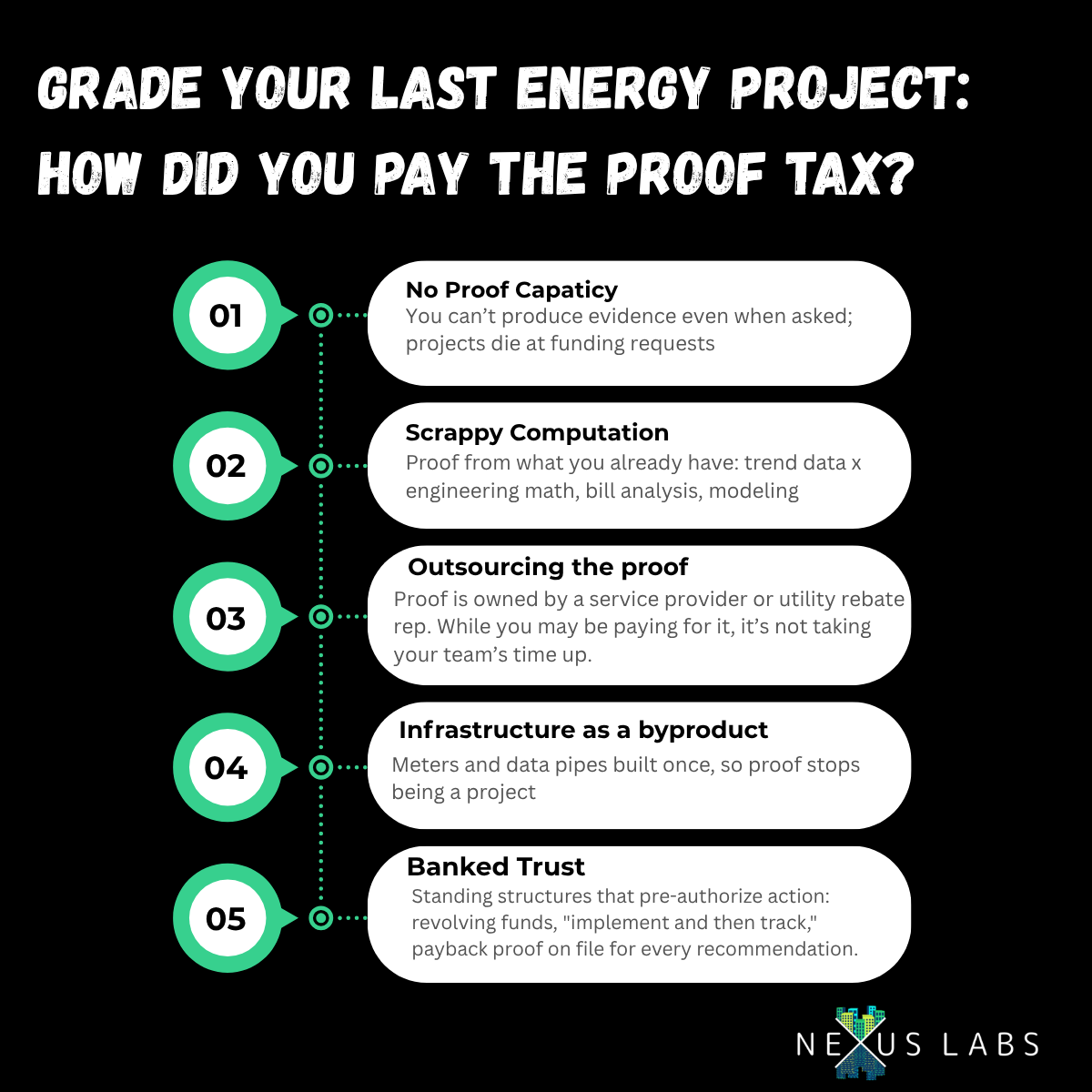
Benchmark your Proof Tax
Where does your program land?
Sign up for the newsletter to get 5 stories like this per week:
A tenured New York City facility manager told me about an energy consultant who was hired and advised the team to update the chilled water discharge setpoint from 42 to 46 degrees.
Sounds like a clear-cut way to save energy, right?
The only problem is that as the chilled water temperature rose, VAV boxes across the building swung open to compensate, and fan VFDs were driven to max speed. The energy saved at the chiller was wiped out by even greater energy spent on ventilation.
When he brought his concerns to senior leadership and suggested they validate the energy savings, he was told to stay in his lane.
On the other side of the coin, many energy managers face analysis paralysis: a never-ending request for more and more data to prove their work is worth the squeeze. When every change requires a mountain of evidence, the safest move becomes changing nothing.
On The Nexus Podcast, Patrick Testoni, Director of Energy at UC Santa Cruz, put this struggle plainly: "The default setting is, 'If I do what they've always told me to do, then I won't get in trouble or be critiqued,' even though that could be making the equipment more vulnerable [to energy overconsumption]."
This is the Proof Tax every energy manager battles. Too much measurement and verification (M&V), and you're wasting time and money proving the work rather than doing it. Not enough M&V, and everyone is questioning your work. How do you find the balance?
Most energy managers (EMs) we talk to are over-taxed, not under-taxed. Skeptics fighting for a limited budget will always poke holes in the latest energy conservation measure (ECM), and an EM can spend all their time paying the proof tax.
Brandon McCoy of Texas Tech identified $977k in energy savings in his program's first year but only had the capacity and permission to capture $97k of it.
Another EM in life sciences told us that although they are aware of major energy waste, they "lack the metering to be able to perform full building analysis," and "most of our buildings are 24/7 and are difficult to interrupt to add meters." He can't get permission to perform the energy updates because "the issues don't seem to 'impact' anyone, so they don't get prioritized."
No one has blind trust in his intuition, yet he's hamstrung from proving himself.
But the proof tax isn't always the villain. Look back at the opening story: the whole chiller setpoint mess happened because nobody validated the consultant's recommendation. Proof is how you hold your service providers accountable for the value they claim.
A senior director at a major commercial real estate organization explained to us that their energy performance contracts require them to M&V anything the ESCO wasn't touching. That way, if they complete a project that had nothing to do with the ESCO, or their occupancy drops with nothing to do with the ESCO, they're not paying for energy savings the ESCO wasn't responsible for delivering.
The proof tax also isn't going away for utility incentives, which can require meticulous M&V and provide major financial justification for the project. Stanford Children's Health shared at NexusCon 2026 how they recouped 100% of their occupancy-based ventilation project costs, in part because the M&V write-up already existed and its exact figures fed the incentive application.
So what's an energy manager to do? When we look at the successful energy management programs in our community, their proof tax balance comes down to some combination of three techniques:
Scrappy ways to prove savings without meters
This is where nearly everyone starts, because it requires nothing you don't already own.
Chris Lelle of Lincoln Property, who spoke in the Wrangle the Utility Bill session at NexusCon 2026, told us how he uses air handler run time multiplied by known drive behavior to calculate energy savings to an acceptable level "without having to put any effort into it." Many technology vendors now offer a calculated version of energy savings, similar to what Lelle describes, under the term "virtual metering."
Aaron Hastings of Apex Consulting Services shared in our Continuous Validation session how he compares trend data from when chiller optimization was on vs. off to prove what it's done for CSUCI's energy bill over the past year.
Continuous buildout of M&V infrastructure
While you can get away with scrappy calculations for many use cases, the smart energy manager still recognizes the importance of developing meter infrastructure.
Justin Owen of Weber State told us about his 300 utility submeters and how he watches the campus substation like a dashboard. This lets him calculate energy savings and match them to the reduction in the utility bill. There's no ambiguity left to argue about.
A full metering overhaul isn't realistic for most owners. But as Testoni pointed out on that same podcast episode, you own more meters than you think: a VFD is a meter, and a chiller with a BACnet card in it is a meter too. Capture what's already installed, then add a submeter every time a project opens a wall.
And after enough years of calculated numbers matching the utility bill, the meters start buying you something better than data.
A magical level of trust and accountability
The NYC facility manager from our introduction eventually landed at a building where his supervisor let him operate differently. That building's Energy Star score went from 42 to 80, and the utility bills dropped by roughly half, almost entirely on no-cost measures.
When we asked how, he immediately credited the trust: "I used to create a summary and analysis and ROI on no-cost ECMs. I would present it to [my supervisor], and he would say, 'You know what you're doing. I trust you.' So I started making updates faster, and I was just shocked at the results."
He'd also learned where to stop: "I used to struggle from analysis paralysis. I would analyze, analyze, analyze. It's a no-cost ECM. You don't need to do that much analyzing." While the trust he gained didn't entirely eliminate the requirement for proof, it allowed for proof to come after the ECM was completed.
At our NexusCon building owner kickoff, Thano Lambrinos of QuadReal argued that building operators are held to a higher standard of justification than other departments, and EMs should feel comfortable fighting for budget with major assumptions. Does the organization ask for a detailed ROI when the IT group recommends a new ERP system? No. Marketing, Operations, IT: they all advocate for the work they need done with major assumptions baked in, and building operators should feel no different.
The proof tax isn't going away, but the best programs in our community know the perfect balance so they aren't paying too much or too little. Energy managers compared exactly how they set theirs on the Energy Track at NexusCon 2026, and those recordings are now available to Nexus Pro members.
Benchmark your Proof Tax
Where does your program land?
Sign up for the newsletter to get 5 stories like this per week:


This is a great piece!
I agree.