
When Epic Investment Services Replaced Their CMMS, The Hardest Part Wasn't the Tech
Epic Investment Services—a Canadian property management firm with 26.6 million square feet under management—hit a wall. Their teams weren't using their existing maintenance platform. Tenants were bypassing official channels to report issues. Leadership couldn't see what was happening across properties, let alone measure performance or prioritize work.
Nada Sutic, Head of Sustainability, Innovation and National Programs at Epic Investment Services, summed up the problem when her CEO suggested more training: "I don't think it's that great, and I don't want to invest the time to get people good at something that still isn't very good."
This story came out of a recent NexusCon presentation where Epic and their replacement software vendor Visitt walked through what it actually takes to unify operations across a multi-region portfolio. They saw dramatic improvements in tenant engagement, response times cut from hours to minutes, and AI-assisted workflows that actually help teams work faster.
But Epic's leadership was refreshingly honest about the hard parts and the cultural work required to shift how building operators document and execute their daily work.
What follows covers both the implementation wins and the unsexy operational work that determines whether digital tools transform how buildings run or just gather dust. Epic's experience shows what happens when you get the basics right—and what happens when you don't.
The Before State: A System No One Wanted to Use
Epic's existing maintenance management system checked basic boxes on paper. But in practice, it had become a liability. The interface was clunky. Reporting capabilities were limited. The vendor wasn't innovating or responding to feedback. And critically, operators simply weren't using it consistently.
When leadership suggested more training to boost adoption, Sutic pushed back. The problem wasn't user competency—the tool wasn't worth their time. Forcing teams to get proficient at something fundamentally inadequate would only deepen the problem.
This is a common pattern in facility management. As research from IFMA shows, nearly 40% of facility management teams report that their existing software doesn't meet their needs, yet organizations continue investing in training and workarounds rather than addressing the core issue.
Epic's operators were finding their own solutions—hallway conversations, phone calls, text messages. Work was getting done, but it wasn't being documented. That meant no visibility, no data, no way to measure performance or prove service levels to tenants.
"If I can get visibility into the data, we can deliver on a whole lot of other things," Sutic said. "But where we were before, we didn't really have great visibility into the data."
Requirements First, Tools Second
Epic spent four to five months defining what they actually needed before looking at any platforms. This included non-negotiables versus nice-to-haves, interviews with operators and property managers, and input from a committee of about 10 core stakeholders plus another 15 actively engaged team members.
The goal wasn't to find "a CMMS." It was to create operational visibility across a 200-person organization managing office, industrial, and retail properties across multiple regions. That meant different team cultures, different operational maturity levels, and different tenant expectations.
Their requirements broke down into three categories:
Core functionality: Mobile-first work order management, preventive maintenance scheduling, equipment tracking, property inspections, omnichannel tenant requests, robust analytics and reporting.
Technology infrastructure: SAML single sign-on integration, reasonable cybersecurity protections, open APIs for future integrations, AI and machine learning capabilities, strong access controls.
Optional features: Certificate of insurance tracking, amenity booking, tenant communications, SOC compliance, implementation of frameworks like ISO27001 or NIST.
Sutic emphasized that taking time up front to define these requirements made everything easier later. "The takeaway is spend the time to do this, because then the rest gets a lot easier."
This approach aligns with what Gartner calls "requirements-led procurement"—where organizations define business outcomes and operational needs before evaluating specific products. In facility management software selection, this is rare. Most organizations start with vendor demos and try to figure out requirements on the fly.
The Decision: Simplicity as a Dealbreaker
Epic evaluated multiple platforms over about six months. What emerged as the decisive factor wasn't features—it was user experience.
"I know our building operators. I know a lot of our property managers," Sutic explained. "Some of them are super tech savvy and they're going to spend time and figure things out. And some of them, you just need to give them something that works."
She compared it to getting her first iPhone, which didn't come with a user manual. "I was really irritated for about a day, and then I figured it out, because it's not that hard, because it was fairly intuitive."
Building operations teams have wildly different levels of technical comfort. Younger operators might be comfortable with mobile-first interfaces and cloud platforms. Veterans with 20+ years in the field often prefer established workflows and may resist anything that feels like unnecessary complexity.
If a platform feels like "work" rather than a natural extension of how teams already operate, adoption collapses. As McKinsey research on digital transformation shows, 70% of digital transformations fail—and the biggest reason isn't technology, it's people not changing their behavior.
Epic also prioritized partnership over pure vendor relationship. Itay Oren, Co-Founder and CEO of Visitt, described their approach to building for onsite teams: "We noticed that the onsite teams are not tech savvy, and it should be easy enough for them to do the job with the new solution."
The platform Epic selected offered mobile-first workflows, AI-assisted communication, open APIs, real-time operational visibility, and a vendor willing to co-develop features based on client feedback. That last piece mattered more than Epic initially realized.
The Fast Rollout That Broke All the Rules
Epic's implementation moved fast—arguably too fast by conventional change management standards. After platform selection, they spent two months on data migration, three weeks on team training, two weeks on tenant communication, and went live in September 2024.
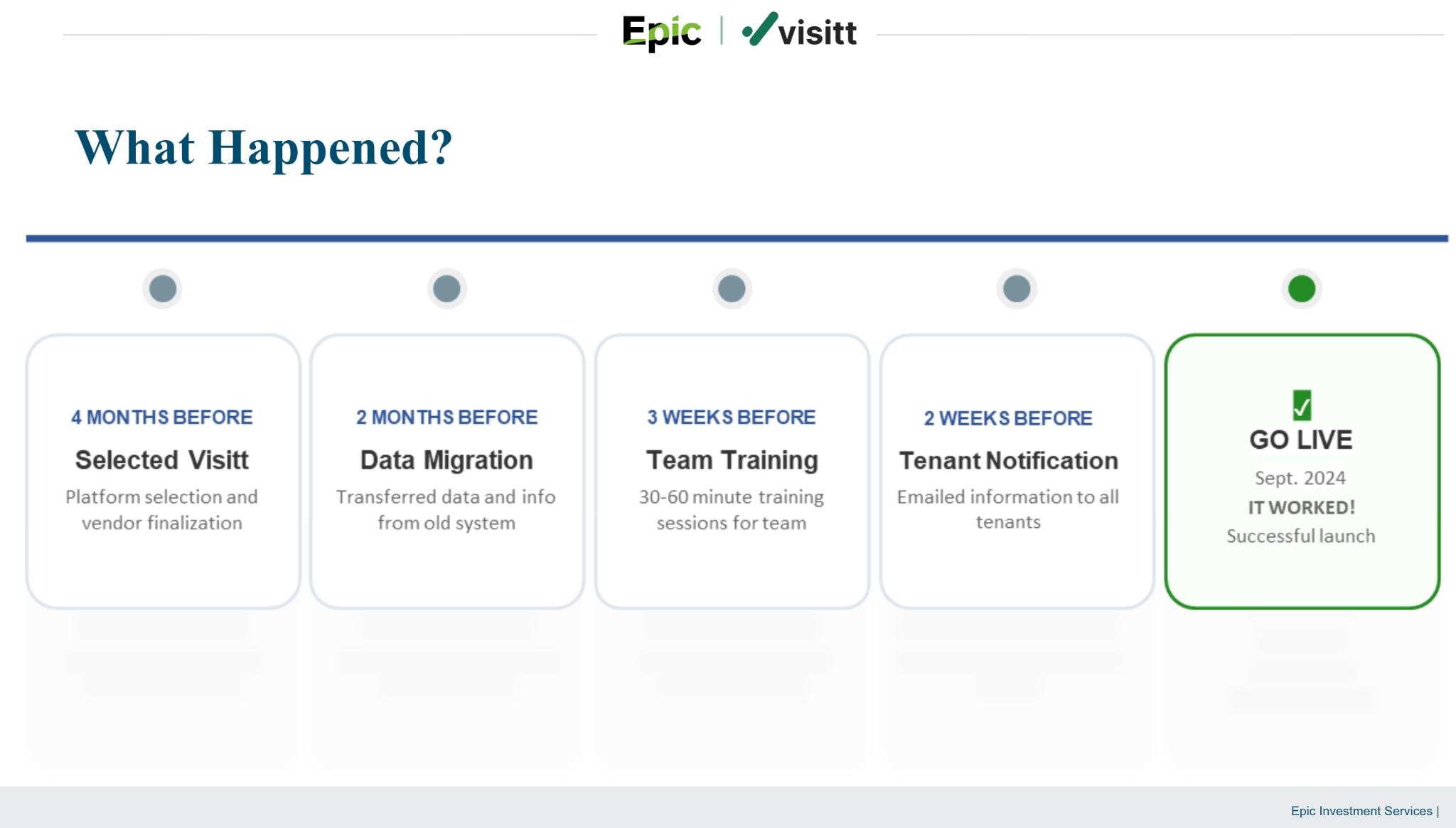
Training was deliberately minimal: 30 minutes for most operators, 60 minutes for property managers who wanted deeper exposure. Tenants got an email with the new link and instructions. That was it.
"All the things I know about change management, I ignored them, and was like, 'Okay, we're just going to go,'" Sutic admitted. "And it was really that belief in—if the user interface is easy, it's going to work."
It did work. Business carried on. Operators started using the mobile app. Tenants started logging requests through the new portal instead of calling the front desk.
This contradicts conventional wisdom about enterprise software implementation, which typically emphasizes months of change management, extensive training programs, and phased rollouts. But Epic's experience shows what happens when tools align with how people already work—friction drops dramatically.
The Visitt team handled heavy lifting on the data migration side, bringing over historical work orders and equipment records from Epic's previous system. That meant operators didn't lose context or continuity even as they shifted to new workflows.
Tenant Operations Took Off Immediately
The results on tenant-facing operations were striking and immediate.
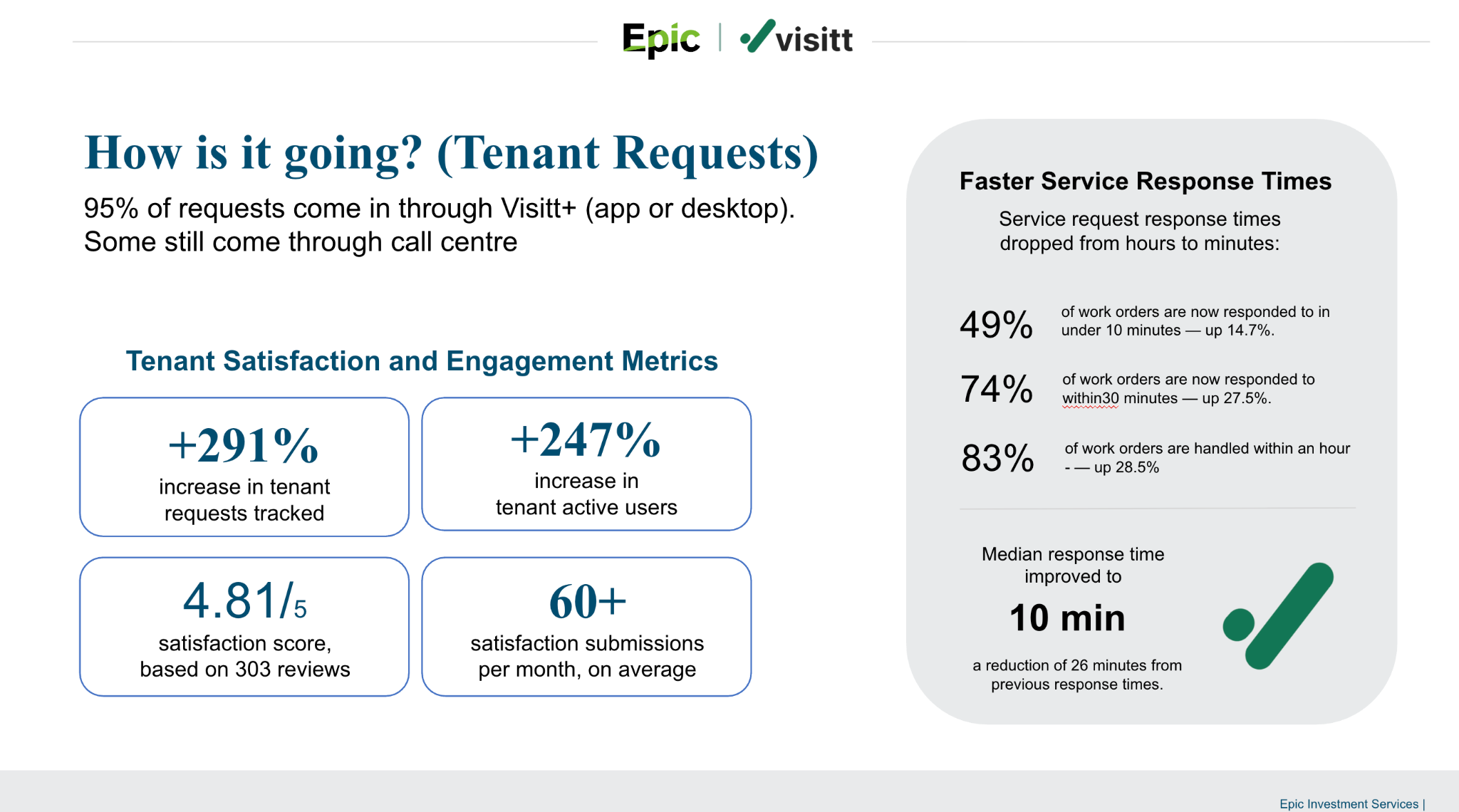
Tracked tenant requests increased 291%. Active tenant users grew 247%. Tenant satisfaction hit 4.81 out of 5 based on 303 reviews, with an average of 60+ satisfaction submissions per month.
But the most meaningful metric was response time. Under the previous system, median response time hovered around 36 minutes. After implementation, it dropped to 10 minutes.
Even more impressive: 49% of work orders now get an initial response within 10 minutes (up 14.7%), 74% within 30 minutes (up 27.5%), and 83% within an hour (up 28.5%).
These numbers reflect more than speed—they reflect visibility. Prior to implementation, a significant portion of tenant requests never entered any system. An operator would run into a tenant in the hallway, hear about a problem, fix it, and move on. The work happened, but there was no record.
Now 95% of requests come through the platform, either via mobile app or desktop. Only 5% still go through the call center, typically from tenants who prefer talking to a human.
This shift creates accountability. When every request is logged, teams can track response patterns, identify recurring issues, prioritize work based on impact, and prove service levels to ownership and tenants.
As JLL's research on tenant experience notes, responsiveness is one of the top three factors in tenant satisfaction—and the gap between perceived responsiveness and actual responsiveness is often massive. Tenants don't know if their request is being addressed unless they're kept informed. When requests vanish into informal channels, that communication breaks down.
Epic's tenants now have transparency. They can see when their request was received, when someone responded, when work is scheduled, and when it's complete. That alone justifies the investment for many building owners.
The Hard Part: Preventive Maintenance Lags Behind
Sutic was blunt about the other side of operations: "This change is harder."
While tenant requests took off immediately, preventive maintenance and inspections are moving much more slowly. Epic is "certainly not where we want to be" in terms of getting teams to document and execute PM work consistently through the platform.
The problems are familiar to anyone who's tried to implement structured PM programs:
Dirty legacy data: Equipment records migrated from the previous system were incomplete or inaccurate. Serial numbers missing. Installation dates wrong. Maintenance schedules inconsistent.
Missing information: Equipment details still need to be filled in. PM schedules still need to be standardized. Inspection protocols aren't consistently defined across properties.
Cultural resistance: There's still "a lot of maintenance that happens outside of the system," Sutic said. Operators revert to familiar habits—doing the work but not documenting it.
Sheer grunt work: Getting all equipment details into any platform requires time and effort. It's tedious, unglamorous work that competes with daily fire-drills.
"Most of our problems are people and process," Sutic acknowledged.
This pattern shows up across the industry. Research from Ramco Systems found that only 30% of facility teams achieve consistent preventive maintenance execution despite having CMMS platforms in place. The software exists, but the discipline, data hygiene, and cultural buy-in required to use it effectively often don't.
PM data takes longer because it requires changing entrenched behaviors. Operators have been doing certain tasks "the same way for 20 years." They know the equipment. They know the schedule. They don't necessarily see value in logging it all digitally—especially if no one has clearly explained why it matters or given them time to do it properly.
The Regional and Cultural Challenge
Epic's multi-region portfolio adds another layer of complexity. Different regions have different definitions of "done," different comfort levels with technology, and different standards for what gets documented versus what stays informal.
Standardizing service level agreements across regions takes work. So does setting clear expectations for how teams document work, keeping tenant contact information current, and ensuring equipment data is accurate and complete.
Epic's current focus reflects this reality. They're working on:
- Standardizing SLAs and response expectations
- Defining how and when teams update tenants on work progress
- Keeping tenant and equipment information current
- Filling gaps in PM records and inspection data
- Building out reporting and analytics capabilities
- Setting small, achievable goals for property teams that roll up to larger objectives
"I haven't necessarily given our teams all of the expectations about how you should use this," Sutic said. "And importantly, here's the resourcing that's going to help you get there."
That last part is critical. You can't mandate cultural change without resourcing it. If operators are already stretched thin, asking them to "just log everything" without additional support or time simply creates frustration and non-compliance.
Unified operations becomes a leadership problem here, not a technology problem. Software can enable visibility—but only if teams have clarity on what's expected, why it matters, and the resources to make it happen.
AI: Useful Only When Embedded in Daily Work
Epic's platform includes AI-assisted workflows, but the implementation is deliberately practical rather than futuristic.
AI currently helps operators by refining tenant responses, making communication clearer and friendlier, and offering faster access to KPIs and operational insights. The goal is helping teams shift from reactive to proactive work—not adding complexity.
Oren emphasized this point: "The way we see AI is how we can help property teams and how we can empower them to do a better job. So I'm not wasting their time, but practical case study and use cases where they can use as part of doing something on the day to day basis."
The product roadmap includes "AI Views," which would allow property managers and operators to ask natural language questions and receive instant insights—essentially querying operational data without building custom reports.
This aligns with where AI in facility management is actually useful. As Deloitte's research on AI in real estate operations notes, the highest-value applications are narrow, task-specific tools that reduce friction in existing workflows—not broad, autonomous systems that attempt to replace human judgment.
AI that rewrites a terse operator response into friendly tenant communication saves time and improves experience. AI that surfaces patterns in work order data helps managers identify recurring issues. AI that automates report generation eliminates tedious manual work.
But AI only works when built on good data. Which brings the story back to the core challenge: getting consistent, quality information into the system in the first place.
What This Means for Building Owners
Epic didn't "implement a CMMS." They took the first step toward unified operations—one that requires ongoing cleanup, cultural shifts, and sustained leadership attention.
And they're honest about how far they still have to go.
That honesty is what makes this story valuable. Most case studies highlight wins and hide challenges. Epic laid both on the table.
Building Owner Takeaways:
You can't train your way out of a bad tool. If your teams aren't using existing platforms, ask whether the problem is user competency or whether the tool simply doesn't fit how work actually gets done. More training on inadequate software wastes time and deepens frustration.
User experience matters more than feature lists. The most powerful platform in the world is useless if your teams won't use it. Prioritize simplicity, mobile-first design, and interfaces that feel natural to operators with varying technical skill levels.
Tenant operations improve fast; PM takes time. Reactive work orders are easier to digitize because they're event-driven and visible. Preventive maintenance requires discipline, data hygiene, and cultural change. Expect tenant-facing results quickly, but plan for longer timelines on PM execution.
Legacy data is always worse than you think. Equipment records, maintenance histories, and inspection schedules migrated from old systems will be incomplete, inaccurate, or both. Budget time and resources for data cleanup—it's unglamorous but essential.
Culture and process make or break your investment. Technology enables visibility, but people and processes determine whether that visibility translates into better execution. Define clear expectations, resource your teams appropriately, and set achievable goals that build toward larger objectives.
AI should support daily work, not complicate it. The highest-value AI applications are narrow, task-specific tools that reduce friction in existing workflows. AI that generates reports, refines communication, or surfaces insights from operational data is useful. AI that adds complexity or requires new workflows often gets ignored.
Choose a partner who evolves with you. No platform fits perfectly on day one. Evaluate vendors not just on current features but on their responsiveness, roadmap transparency, and willingness to incorporate client feedback. A vendor who listens during implementation and adapts their product over time is worth more than one with a longer feature list today.
Epic's story isn't finished. They're still working through data cleanup, standardizing processes across regions, and building the cultural habits that turn a platform into a true operational backbone.
But they've created something most building owners lack: visibility. They can see what work is happening, how fast teams respond, where bottlenecks exist, and what needs attention.
That visibility is the foundation for everything else—better tenant experience, more proactive maintenance, data-driven decision-making, and AI-enabled insights.
The hard work isn't behind them. But they're no longer operating blind.
And that, ultimately, is what unified operations looks like—a continuous process of making the invisible visible, aligning teams around shared standards, and using data to actually run buildings instead of just documenting them.
Epic Investment Services—a Canadian property management firm with 26.6 million square feet under management—hit a wall. Their teams weren't using their existing maintenance platform. Tenants were bypassing official channels to report issues. Leadership couldn't see what was happening across properties, let alone measure performance or prioritize work.
Nada Sutic, Head of Sustainability, Innovation and National Programs at Epic Investment Services, summed up the problem when her CEO suggested more training: "I don't think it's that great, and I don't want to invest the time to get people good at something that still isn't very good."
This story came out of a recent NexusCon presentation where Epic and their replacement software vendor Visitt walked through what it actually takes to unify operations across a multi-region portfolio. They saw dramatic improvements in tenant engagement, response times cut from hours to minutes, and AI-assisted workflows that actually help teams work faster.
But Epic's leadership was refreshingly honest about the hard parts and the cultural work required to shift how building operators document and execute their daily work.
What follows covers both the implementation wins and the unsexy operational work that determines whether digital tools transform how buildings run or just gather dust. Epic's experience shows what happens when you get the basics right—and what happens when you don't.
The Before State: A System No One Wanted to Use
Epic's existing maintenance management system checked basic boxes on paper. But in practice, it had become a liability. The interface was clunky. Reporting capabilities were limited. The vendor wasn't innovating or responding to feedback. And critically, operators simply weren't using it consistently.
When leadership suggested more training to boost adoption, Sutic pushed back. The problem wasn't user competency—the tool wasn't worth their time. Forcing teams to get proficient at something fundamentally inadequate would only deepen the problem.
This is a common pattern in facility management. As research from IFMA shows, nearly 40% of facility management teams report that their existing software doesn't meet their needs, yet organizations continue investing in training and workarounds rather than addressing the core issue.
Epic's operators were finding their own solutions—hallway conversations, phone calls, text messages. Work was getting done, but it wasn't being documented. That meant no visibility, no data, no way to measure performance or prove service levels to tenants.
"If I can get visibility into the data, we can deliver on a whole lot of other things," Sutic said. "But where we were before, we didn't really have great visibility into the data."
Requirements First, Tools Second
Epic spent four to five months defining what they actually needed before looking at any platforms. This included non-negotiables versus nice-to-haves, interviews with operators and property managers, and input from a committee of about 10 core stakeholders plus another 15 actively engaged team members.
The goal wasn't to find "a CMMS." It was to create operational visibility across a 200-person organization managing office, industrial, and retail properties across multiple regions. That meant different team cultures, different operational maturity levels, and different tenant expectations.
Their requirements broke down into three categories:
Core functionality: Mobile-first work order management, preventive maintenance scheduling, equipment tracking, property inspections, omnichannel tenant requests, robust analytics and reporting.
Technology infrastructure: SAML single sign-on integration, reasonable cybersecurity protections, open APIs for future integrations, AI and machine learning capabilities, strong access controls.
Optional features: Certificate of insurance tracking, amenity booking, tenant communications, SOC compliance, implementation of frameworks like ISO27001 or NIST.
Sutic emphasized that taking time up front to define these requirements made everything easier later. "The takeaway is spend the time to do this, because then the rest gets a lot easier."
This approach aligns with what Gartner calls "requirements-led procurement"—where organizations define business outcomes and operational needs before evaluating specific products. In facility management software selection, this is rare. Most organizations start with vendor demos and try to figure out requirements on the fly.
The Decision: Simplicity as a Dealbreaker
Epic evaluated multiple platforms over about six months. What emerged as the decisive factor wasn't features—it was user experience.
"I know our building operators. I know a lot of our property managers," Sutic explained. "Some of them are super tech savvy and they're going to spend time and figure things out. And some of them, you just need to give them something that works."
She compared it to getting her first iPhone, which didn't come with a user manual. "I was really irritated for about a day, and then I figured it out, because it's not that hard, because it was fairly intuitive."
Building operations teams have wildly different levels of technical comfort. Younger operators might be comfortable with mobile-first interfaces and cloud platforms. Veterans with 20+ years in the field often prefer established workflows and may resist anything that feels like unnecessary complexity.
If a platform feels like "work" rather than a natural extension of how teams already operate, adoption collapses. As McKinsey research on digital transformation shows, 70% of digital transformations fail—and the biggest reason isn't technology, it's people not changing their behavior.
Epic also prioritized partnership over pure vendor relationship. Itay Oren, Co-Founder and CEO of Visitt, described their approach to building for onsite teams: "We noticed that the onsite teams are not tech savvy, and it should be easy enough for them to do the job with the new solution."
The platform Epic selected offered mobile-first workflows, AI-assisted communication, open APIs, real-time operational visibility, and a vendor willing to co-develop features based on client feedback. That last piece mattered more than Epic initially realized.
The Fast Rollout That Broke All the Rules
Epic's implementation moved fast—arguably too fast by conventional change management standards. After platform selection, they spent two months on data migration, three weeks on team training, two weeks on tenant communication, and went live in September 2024.
Training was deliberately minimal: 30 minutes for most operators, 60 minutes for property managers who wanted deeper exposure. Tenants got an email with the new link and instructions. That was it.
"All the things I know about change management, I ignored them, and was like, 'Okay, we're just going to go,'" Sutic admitted. "And it was really that belief in—if the user interface is easy, it's going to work."
It did work. Business carried on. Operators started using the mobile app. Tenants started logging requests through the new portal instead of calling the front desk.
This contradicts conventional wisdom about enterprise software implementation, which typically emphasizes months of change management, extensive training programs, and phased rollouts. But Epic's experience shows what happens when tools align with how people already work—friction drops dramatically.
The Visitt team handled heavy lifting on the data migration side, bringing over historical work orders and equipment records from Epic's previous system. That meant operators didn't lose context or continuity even as they shifted to new workflows.
Tenant Operations Took Off Immediately
The results on tenant-facing operations were striking and immediate.
Tracked tenant requests increased 291%. Active tenant users grew 247%. Tenant satisfaction hit 4.81 out of 5 based on 303 reviews, with an average of 60+ satisfaction submissions per month.
But the most meaningful metric was response time. Under the previous system, median response time hovered around 36 minutes. After implementation, it dropped to 10 minutes.
Even more impressive: 49% of work orders now get an initial response within 10 minutes (up 14.7%), 74% within 30 minutes (up 27.5%), and 83% within an hour (up 28.5%).
These numbers reflect more than speed—they reflect visibility. Prior to implementation, a significant portion of tenant requests never entered any system. An operator would run into a tenant in the hallway, hear about a problem, fix it, and move on. The work happened, but there was no record.
Now 95% of requests come through the platform, either via mobile app or desktop. Only 5% still go through the call center, typically from tenants who prefer talking to a human.
This shift creates accountability. When every request is logged, teams can track response patterns, identify recurring issues, prioritize work based on impact, and prove service levels to ownership and tenants.
As JLL's research on tenant experience notes, responsiveness is one of the top three factors in tenant satisfaction—and the gap between perceived responsiveness and actual responsiveness is often massive. Tenants don't know if their request is being addressed unless they're kept informed. When requests vanish into informal channels, that communication breaks down.
Epic's tenants now have transparency. They can see when their request was received, when someone responded, when work is scheduled, and when it's complete. That alone justifies the investment for many building owners.
The Hard Part: Preventive Maintenance Lags Behind
Sutic was blunt about the other side of operations: "This change is harder."
While tenant requests took off immediately, preventive maintenance and inspections are moving much more slowly. Epic is "certainly not where we want to be" in terms of getting teams to document and execute PM work consistently through the platform.
The problems are familiar to anyone who's tried to implement structured PM programs:
Dirty legacy data: Equipment records migrated from the previous system were incomplete or inaccurate. Serial numbers missing. Installation dates wrong. Maintenance schedules inconsistent.
Missing information: Equipment details still need to be filled in. PM schedules still need to be standardized. Inspection protocols aren't consistently defined across properties.
Cultural resistance: There's still "a lot of maintenance that happens outside of the system," Sutic said. Operators revert to familiar habits—doing the work but not documenting it.
Sheer grunt work: Getting all equipment details into any platform requires time and effort. It's tedious, unglamorous work that competes with daily fire-drills.
"Most of our problems are people and process," Sutic acknowledged.
This pattern shows up across the industry. Research from Ramco Systems found that only 30% of facility teams achieve consistent preventive maintenance execution despite having CMMS platforms in place. The software exists, but the discipline, data hygiene, and cultural buy-in required to use it effectively often don't.
PM data takes longer because it requires changing entrenched behaviors. Operators have been doing certain tasks "the same way for 20 years." They know the equipment. They know the schedule. They don't necessarily see value in logging it all digitally—especially if no one has clearly explained why it matters or given them time to do it properly.
The Regional and Cultural Challenge
Epic's multi-region portfolio adds another layer of complexity. Different regions have different definitions of "done," different comfort levels with technology, and different standards for what gets documented versus what stays informal.
Standardizing service level agreements across regions takes work. So does setting clear expectations for how teams document work, keeping tenant contact information current, and ensuring equipment data is accurate and complete.
Epic's current focus reflects this reality. They're working on:
- Standardizing SLAs and response expectations
- Defining how and when teams update tenants on work progress
- Keeping tenant and equipment information current
- Filling gaps in PM records and inspection data
- Building out reporting and analytics capabilities
- Setting small, achievable goals for property teams that roll up to larger objectives
"I haven't necessarily given our teams all of the expectations about how you should use this," Sutic said. "And importantly, here's the resourcing that's going to help you get there."
That last part is critical. You can't mandate cultural change without resourcing it. If operators are already stretched thin, asking them to "just log everything" without additional support or time simply creates frustration and non-compliance.
Unified operations becomes a leadership problem here, not a technology problem. Software can enable visibility—but only if teams have clarity on what's expected, why it matters, and the resources to make it happen.
AI: Useful Only When Embedded in Daily Work
Epic's platform includes AI-assisted workflows, but the implementation is deliberately practical rather than futuristic.
AI currently helps operators by refining tenant responses, making communication clearer and friendlier, and offering faster access to KPIs and operational insights. The goal is helping teams shift from reactive to proactive work—not adding complexity.
Oren emphasized this point: "The way we see AI is how we can help property teams and how we can empower them to do a better job. So I'm not wasting their time, but practical case study and use cases where they can use as part of doing something on the day to day basis."
The product roadmap includes "AI Views," which would allow property managers and operators to ask natural language questions and receive instant insights—essentially querying operational data without building custom reports.
This aligns with where AI in facility management is actually useful. As Deloitte's research on AI in real estate operations notes, the highest-value applications are narrow, task-specific tools that reduce friction in existing workflows—not broad, autonomous systems that attempt to replace human judgment.
AI that rewrites a terse operator response into friendly tenant communication saves time and improves experience. AI that surfaces patterns in work order data helps managers identify recurring issues. AI that automates report generation eliminates tedious manual work.
But AI only works when built on good data. Which brings the story back to the core challenge: getting consistent, quality information into the system in the first place.
What This Means for Building Owners
Epic didn't "implement a CMMS." They took the first step toward unified operations—one that requires ongoing cleanup, cultural shifts, and sustained leadership attention.
And they're honest about how far they still have to go.
That honesty is what makes this story valuable. Most case studies highlight wins and hide challenges. Epic laid both on the table.
Building Owner Takeaways:
You can't train your way out of a bad tool. If your teams aren't using existing platforms, ask whether the problem is user competency or whether the tool simply doesn't fit how work actually gets done. More training on inadequate software wastes time and deepens frustration.
User experience matters more than feature lists. The most powerful platform in the world is useless if your teams won't use it. Prioritize simplicity, mobile-first design, and interfaces that feel natural to operators with varying technical skill levels.
Tenant operations improve fast; PM takes time. Reactive work orders are easier to digitize because they're event-driven and visible. Preventive maintenance requires discipline, data hygiene, and cultural change. Expect tenant-facing results quickly, but plan for longer timelines on PM execution.
Legacy data is always worse than you think. Equipment records, maintenance histories, and inspection schedules migrated from old systems will be incomplete, inaccurate, or both. Budget time and resources for data cleanup—it's unglamorous but essential.
Culture and process make or break your investment. Technology enables visibility, but people and processes determine whether that visibility translates into better execution. Define clear expectations, resource your teams appropriately, and set achievable goals that build toward larger objectives.
AI should support daily work, not complicate it. The highest-value AI applications are narrow, task-specific tools that reduce friction in existing workflows. AI that generates reports, refines communication, or surfaces insights from operational data is useful. AI that adds complexity or requires new workflows often gets ignored.
Choose a partner who evolves with you. No platform fits perfectly on day one. Evaluate vendors not just on current features but on their responsiveness, roadmap transparency, and willingness to incorporate client feedback. A vendor who listens during implementation and adapts their product over time is worth more than one with a longer feature list today.
Epic's story isn't finished. They're still working through data cleanup, standardizing processes across regions, and building the cultural habits that turn a platform into a true operational backbone.
But they've created something most building owners lack: visibility. They can see what work is happening, how fast teams respond, where bottlenecks exist, and what needs attention.
That visibility is the foundation for everything else—better tenant experience, more proactive maintenance, data-driven decision-making, and AI-enabled insights.
The hard work isn't behind them. But they're no longer operating blind.
And that, ultimately, is what unified operations looks like—a continuous process of making the invisible visible, aligning teams around shared standards, and using data to actually run buildings instead of just documenting them.


This is a great piece!
I agree.