
🎧 #190: The Mythological Single Pane of Glass with Kate Stelzel
Welcome to Nexus, a newsletter and podcast for smart people applying smart building technology—hosted by James Dice. If you’re new to Nexus, you might want to start here.
The Nexus podcast (Apple | Spotify | YouTube | Other apps) is our chance to explore and learn with the brightest in our industry—together. The project is directly funded by listeners like you who have joined the Nexus Pro membership community.
You can join Nexus Pro to get a weekly-ish deep dive, access to the Nexus Vendor Landscape, and invites to exclusive events with a community of smart buildings nerds.
Sign-up (or refer a friend!) to the Nexus Newsletter.
Learn more about the Smart Building Strategist Course and the Nexus Courses Platform.
Check out the Nexus Labs Marketplace.
Learn more about Nexus Partnership Opportunities.
Episode 190 is a conversation with Brad Bonavida from Nexus Labs and Kate Stelzel from JLL.
Summary
Episode 190 is a conversation with Brad Bonavida from Nexus Labs and Kate Stelzel from JLL. In this episode of the Nexus Podcast, the Nexus Labs team breaks down the top stories relevant to energy managers, facility managers, IT/OT managers, and workplace managers.
Mentions and Links
- Kate’s NexusCon recording
- JLL (1:23)
- NexusCon 2026 (1:55)
- Mitsubishi Electric Iconics Digital Solutions
Highlights
Introduction (0:50)
At the Nexus (1:34)
Sign off (29:57)
Music credits: There Is A Reality by Common Tiger—licensed under an Music Vine Limited Pro Standard License ID: S706971-16073.
Full transcript
Note: transcript was created using an imperfect machine learning tool and lightly edited by a human (so you can get the gist). Please forgive errors!
James Dice: [00:00:00] Hey friends, if you like the Nexus Podcast, the best way to continue the learning is to join our community. There are three ways to do that. First, you can join the Nexus Pro membership. It's our global community of smart Boeing professionals. We have monthly events, paywall, deep dive content, and a private chat room, and it's just $35 a month.
Second, you can upgrade from the pro membership to our courses offering. It's headlined by our flagship course, the Smart Building Strategist, and we're building a catalog of courses taught by world leading experts on each topic under the smart buildings umbrella. Third, and finally, our marketplace is how we connect leading vendors with buyers looking for their solutions.
The links are below in the show notes, and now let's go on the podcast.
Brad Bonavida: All right. Hello and welcome everybody back to the Nexus podcast. I'm your interim host, Brad Bonavita. I'm the head of product at Nexus Labs. Um, [00:01:00] hopefully you've missed us. We've unfortunately been out for a while, getting all set up for January, so thanks for being patient. But we have a. Great docket and schedule of, you know, new guests coming in the new year, starting today.
Uh, so today I have with me Kate Zel. Hi Kate. How you doing?
Kate Stelzel: Hey, doing good. How are you?
Brad Bonavida: Good, good. Kate is the technology operations manager at JLL. Um, we are going to dive into all things about what Kate does and her presentation at Nexus Con. But first, uh, just to. Settle some, some nexus at the nexus things, what's going on in our community today.
Um, first off, if you don't listen often for the full experience, make sure that you subscribe to our newsletter. That's the best way to stay up to date with everything that's going on. Um, and then a couple of other important things that have been happening at Nexus Labs quickly. James and I just got back from Detroit where Nexus Con 2026 is gonna be, uh, the venue is called the Department at Hudson's and it is [00:02:00] spectacular.
We are super excited, stoked. It's so nice. We're gonna have a blast. Um, windows everywhere. Brand new venue, huge ceilings. It's gonna be amazing right in the heart of Detroit. Um, it really got us excited for this. And, uh, abstracts for speaking at Nexus Con 2026 are gonna be open on Wednesday, February 11th.
So that's coming up. People have a lot of time to apply to speak, but keep in mind that's coming. And then, um, otherwise we also have. This week, uh, we have our first Nexus Cast Virtual conference. By the time that this podcast comes out, that event is already gonna ha have happened, so hopefully you were there, but if you weren't there, uh, the on-demand version will be available on our website as well.
We're very excited about this as well. We've got speakers from JP Morgan Chase, Morgan Stanley, BXP, Heinz, Dartmouth College, Inova Health Systems, and more. Um, it's all gonna be about their OT device management. We also have tons [00:03:00] of breakout rooms and demo stages and virtual booths. It's gonna be pretty cool.
Um, and then we're repeating this Nexus Cast Virtual Conference on a new topic. It's the, the second topic for Nexus Cast number two is gonna be. Work orders, digital asset registers, and condition-based maintenance. So kind of up your alley, Kate. Um, and that one is gonna be on Wednesday, April 15th, so plenty of time to sign up.
Um, by the time this podcast is live, you'll be able to register for that event and we'll also be looking for, uh, speakers for that. So, um, please do submit your applications when that comes out. I think that's it on the Nexus update side. So, um, let me introduce Kate a little further. So, Kate, the reason that, uh, we wanted to have you on this podcast is that you were a speaker at Nexus Con last year.
You spoke with Arup, um, and your guys'. Presentation was called the mythological, single pane of glass. And um, I think I told you this, but you guys got second place for most amount of VO votes, so you almost won best presentation. Um, it [00:04:00] was a really solid one. So close. Um, why don't you tell me a little bit more about your role, your position, what you do.
Kate Stelzel: Yeah, so I, you did a quick introduction. I worked for JLL as a technology operations manager. You know, our client is Delta, so I am at LaGuardia Airport. We are working for Delta and for LaGuardia all the time, uh, specifically focusing on their tech. Um, they've made themselves at LaGuardia, one of the very focused on technology areas.
So almost everything you see when you walk into LaGuardia. Specifically terminal CI won't comment on the other terminals, but um, is gonna be very tech based. So we're monitoring everything using the internet of things, everything from the small things of like the bathrooms to the trash cans. And then we're going all the way to our, like, power monitoring equipment, our escalators, our elevators.
So basically anything you think that we could track, we're tracking it there and it's all being monitored, um, through my team, um, over at LaGuardia.
Brad Bonavida: Nice. Um, and maybe you can explain that relationship with Delta a [00:05:00] little better. So you work for JLL, obviously, and your client is Delta and LaGuardia, or how does, how does that work between Delta and LaGuardia for the title?
Kate Stelzel: Yeah, so my client is Delta will fully respond to everything that Delta says, but. It's kind of an interesting situation 'cause airports are a very new space that operations management is kind of very new area in it. Um, but what Delta did specifically for Terminal Sea is they're leasing that property from the Port Authority of New York and New Jersey.
So technically the Port Authority would be our, um. Overall like Delta's client, but we don't really report into them. Obviously they have certain rules and regulations that we have to follow as being their tenant. Um, but everything we're doing is reporting to Delta and then there are just some more high level things that the Port Authority would control.
But really Delta is
Rosy Khalife: the one we're going back to.
Brad Bonavida: Awesome. And how long have you been on that account for JLL?
Kate Stelzel: So I started in October of 2022, so it's been a little over three years now.
Brad Bonavida: Nice. [00:06:00] Okay. So let's dig into what you guys were talking about a little bit at Nexus Con. Um. The, the information broker, that's the, the term you guys were using.
Why don't we start there? What is the information broker?
Kate Stelzel: Yeah, so we kind of coined this term along with Iconix, basically to mean all of the information, right? It's this one stop shop where you can get all of that information together. So normally at a lot of sites you'd have like one main BMS, uh, business monitoring system, where really you would mostly have like HVAC equipment and sometimes there's a few other things, but it's very simplistic and it's very dependent on the vendor.
But here we're pulling all these separate systems from a bunch of different vendors, going back to our power monitoring equipment, our escalators, our elevators, our janitorial partners. Some people that wouldn't have a whole BMS system, but they might have endpoints that we can just specifically connect to.
And then iconix the information brokers. Pulling all of those endpoints into one, not only getting the data from them, but also creating [00:07:00] graphics and workflows, something that you wouldn't normally get on your basic level. BMS.
Brad Bonavida: Yep. Okay. I, I love the, the term for the title two, the mythological single pane of glass, because single pane of glass is something that we talk about a lot at Nexus Labs is like a buzzword.
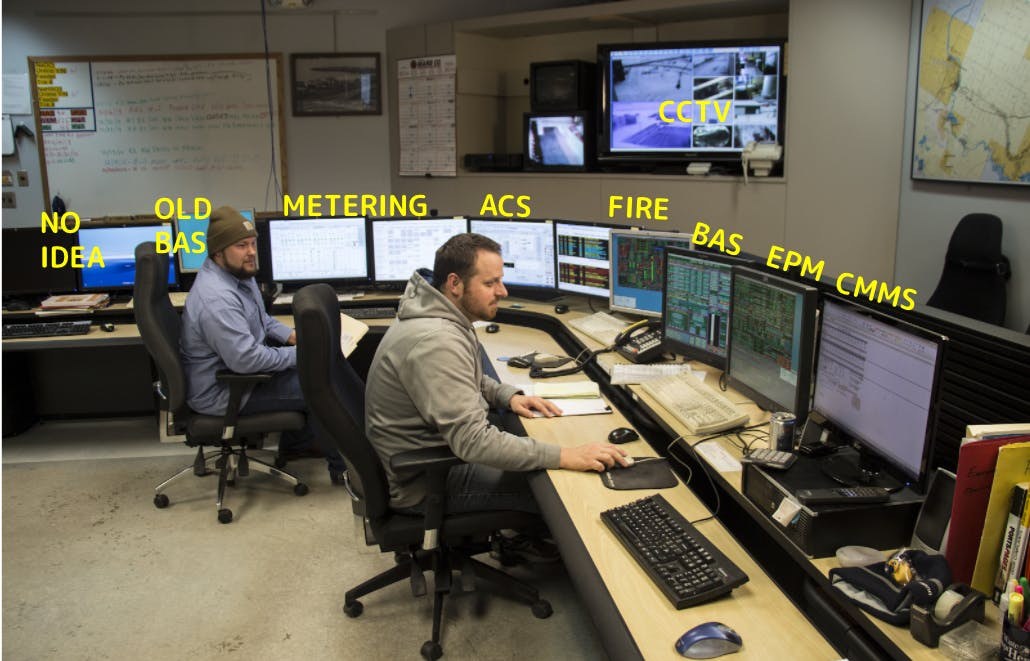
Uh, we have a really great meme that we used to produce a lot off to dig it up and like put it in the show notes here, but it's like, it's a, for lack of better term, facility management basement. And there's these two gentlemen sitting in this room and there's like. Nine screens around them, right? There's the BMS, there's the old BMS, there's the elevator control, there's security, there's CCTV, and the concept of the single pane of glass is that there's no longer this room with nine different screens and you're able to like have that on one platform.
So. Have you actually physically seen a difference where you, you, you know, walk by one of your colleagues and there's not, you know, four monitors necessary, but you've got this, this information broker that's kind of the main thing that they need to look [00:08:00] at.
Kate Stelzel: Yeah,
Rosy Khalife: so that meme is actually
Kate Stelzel: exactly what you would've seen at the airport is.
Not a joke at all. And we used to walk in, we had what we called the TOCC, that was our command center, our 24 7 operations area, and when you would walk in, there was basically like a whole wall of computers that would just kind of have different screens depending on if it was the baggage handling system.
The CCTV, like you said. And now when you walk in, there's probably like two or three, 'cause there are a few that have to be separate, specifically the baggage handling system as an example. But it's just that system and then Iconix, and that's all you have up. So instead of having 20 different logins, 20 different screens that you have to look at, and trying to specifically focus certain people in certain areas, now everyone has access to the same information and everyone can see it all in one place.
Brad Bonavida: Nice and how so? I have to imagine like that has driven it to have a ton of users. 'cause it has so many different. Use cases. Do you know like how many, you know, estimated users you have?
Kate Stelzel: Yeah, so I was actually looking back at one of our sheets 'cause I was like, I [00:09:00] know it's above 100. Um, and we actually have a Excel sheet.
So every time we wanna add a user, we kinda list out who it is and the specific group. 'cause there are different types of groups with different permissions, more or less for like higher ups versus very specific engineers. And we have about 200 users, I'd say probably about a hundred are actually in the system using it a lot more often.
There are some people who've had access and don't really use it anymore. But yeah, about 200. Um, and it has made it easier 'cause only probably 20 people tops could fit in that old TOCC room where you could see all those monitors. Right now you can do it from anywhere. You could look at it from home, as long as you have your laptop.
It gives everyone the access to look at it at any point in time.
Brad Bonavida: Nice. And those users are not GIST JLL employees, I imagine. But I mean, are there contractors in there as well?
Kate Stelzel: Yeah, there's a range. So our vendors specifically can also look at it, which is nice for them 'cause they can see how their VMS looks and then they can see it in Iconix and generally see that it's a little bit nicer, but it helps them kind of look at their data differently.
Um, Delta users [00:10:00] also have it. Arup has access the design team, all the JLL users. Um, a big one was port Authority, actually, like how we said earlier. Um, they manage the property and so we've given them access to a few things on there that they've honestly been asking Delta for access to for the longest time.
Um, specifically like their flight information, but Delta wouldn't give it to them 'cause it is proprietary. But through Iconix they have all these specific permissions and levels. Um, so they actually do fit the security preferences, so we were able to share that information with them.
Brad Bonavida: Cool. So, yeah, and that example, people are.
Have the people have already understood how valuable it is. They're like asking for access, but what, when did you first like deploy this and how was that first user adoption? Like, did it take quite a bit of work to, of change management to really get people to buy into this? Or was it pretty easy because people just saw the value right away?
Kate Stelzel: It, it definitely took some adoption to the Getty. It's nice now to act and everyone's like, oh, can I get access to Iconics? Can I look at that? [00:11:00] Um. But about three years ago, it was definitely not there. Um, when I first got the job, it was very specifically asking me to try to get people involved and get that user adoption.
Um, so the main thing I did was kind of. Picked out which groups were gonna be the most important. Um, and for me it was the engineering team that was the one who was gonna be able to get the most value out of it. Um, do more hands-on stuff. So I would sit with them every single day, just ask them, you know, what do they wanna see?
What is interesting to them? I'd kind of just show them the tool. I didn't really force them at first, kind of just showed it to 'em, almost like a new tool they can play with, but they're not like, you don't have to use it yet. And then I would just say, you know what would make this better? And kind of started asking things like that.
I'd even walk around on their rounds with them when they were on the floor, so then I could be like, oh, you know, doing that right there, you could actually do that in Iconics instead, and then not have to do your rounds that way. Kinda just slowly seeding the way for things that they could use it for.
And honestly, once I got them adopted, I'd say it probably took a solid three months of me doing that and working with them [00:12:00] to get them using the system a lot more. Um, but once they started adopting it, it was much easier to get everyone else on board.
Brad Bonavida: Yep. I, we hear all the time that when you know. Any sort of large portfolio adopts a new software platform.
You have like this, this clock that basically starts to get some quick wins to help with your user adoption. Like getting right as it's deployed, some sort of a quick win where people see the value of it quickly and then, and then that really can spark the user adoption.
Kate Stelzel: Yeah. Something that directly affects them is usually the way to get it.
They're like, oh, that will actually save me time. Absolutely.
Brad Bonavida: Let's
Kate Stelzel: do it.
Brad Bonavida: Right. Yeah. So on that, when, when we're thinking about saving people time. Is there like A-C-M-M-S, like a maintenance management work order style system that's separate from this? Or does this handle giving like a facility maintenance personnel, like the job that they need to do at that moment?
Kate Stelzel: So we do have a separate system. We use corrigo. Um, that's our work order system. There is one cool benefit of Iconix that we actually roped into it. [00:13:00] It's still very new, um, but we did actually do a connection with Corrigo. So as long as our assets and Iconics are tagged correctly, they now link. To the assets that we have tagged in Crego.
So we actually can create a work order from this system and it does send a crego. Again, that's not an initial thing that was set up. We had to go through contracts and layers to get this connection, but it was possible. And now we do have that ability. Of course, that will depend on your ability to tag all of the assets and make sure they align, which was quite a task.
But we do have that ability now. Yeah.
Brad Bonavida: Yeah. That's like. From, that's pretty cutting edge. I mean, I talked to a lot of building owners and that, that gap from your, uh, you know, FDD data analytics to the CMMS, to the work orders, it's usually still manual, so that's pretty cool that you've got a integration there.
How much, how much of your work orders are actually coming from the information broker versus coming from something else? [00:14:00]
Kate Stelzel: Not a lot. And that's where the adoption kind of has to grow a little bit. So we have connected a certain amount of assets and the ones that are connected, we can usually create like a few in there.
But generally most of the work orders are still coming through that CMMS system. So that's definitely one that we need to get more user adoption on. 'cause it's a much newer idea and a lot of the team is very used to creating them in the other work order system. So it kind of goes back to that, all right, let's try again.
Let's train you on a, a new one. Help them see the value of it a little more. But that value is the harder part to kinda get in there for them. Sure.
Brad Bonavida: Yeah. Yeah, that'll be, I'll be interested to see how that adoption continues to go for you. 'cause again, like that's just something that we've seen our audience, our community, struggle with to get those two connected.
And the value of it is not only like just, um, more efficient operations, but also if you're. With your maintenance management systems or your IWMS, you have the ability to like link your work a lot more to your capital planning and [00:15:00] budgeting. And you know, in a perfect world, you're starting to potentially choose what maintenance occurs based on what the true value is to, you know, the building portfolio.
Like what, where, what's the depreciation of that item, what that asset like, when is it gonna get, um. You know, maintained next or when is it gonna get replaced and start to actually like, connect dollars and cents of your assets to how you, um, how you prioritize. So that's really cool.
Kate Stelzel: It definitely allows you to see trends that that's kind of the goal to get that adoption.
So you can see over time, like when things start to break and when there are issues. I think the biggest issue we have for our site is that. A lot of the people that are creating work orders, our techs and our mechanics are very boots on the ground. Um, yeah,
Rosy Khalife: they're not very computer savvy. They're not very tech savvy.
They do have
Kate Stelzel: their phones, um, but Iconix is not as much of a phone interface. You can definitely open it on your phone, but it is more of a computer interface. So I would say it might be one of our issues with trying to get them to use it a little more. 'cause they're very against. Going on a computer
Rosy Khalife: and sitting
Kate Stelzel: down and, and I get [00:16:00] it.
'cause a lot of them are out in the field and that's, that's how they work. Um, but that's the big thing we're trying to jump over right now or figure out a caveat around that one.
Brad Bonavida: Sure makes sense. Uh, I, I feel as though I, I've gone too far without giving Eric some credit because, uh, Leo Gabri, uh, presented with you as well and I think, you know, one of the.
Most important points that you guys got across in your presentation was not only about this information broker and you know how much it does for you and how helpful it is to have everything on one screen, but how the mentality was really to build this thing, not just like you, you don't, you don't just go purchase this single pane of glass.
Can you talk a little bit more about that and the mentality of this being like a build your own single pane of glass instead of a buy one and just install it?
Kate Stelzel: Definitely. So I gotta give a lot of credit to Leo and Aup for that too. Obviously we've definitely taken over that idea. Um, but they really came in with this like, Hey, we have the system that we wanna use, um, and here are all the ideas, like [00:17:00] how we can make it better and how we can actually use it.
Um. Honestly, seeing the way that they looked at it very much made me change my mind about how I wanna implement it. And I think it's actually why it got implemented better. 'cause I very much focused on what are the objectives we can actually get out of it? What data can we pull out of this system and how can we make that actionable?
The biggest thing was actionable for the client. If we're not giving something back to them, they're spending tons of money on this and it's worth it if you can show that they're getting value out of it. So the biggest thing too is we would sit down. We have weekly meetings with Arup and the client and we just go through the graphics and create new workflows, try to think of new ways that it can create value, and looking at all the different data feeds and trying to just see how can we use this data?
'cause there is a lot of data that we're getting. So the biggest thing was how can we actually use this data to create something actionable? Um, and that was what the client really wanted to see too.
Brad Bonavida: Yep. Connecting it to the jobs to be done. That's what we're always hearing. Um, so let's kind of, [00:18:00] I wanna make this more practical for the audience and bring it to life.
How many different systems are connected to this? I think there's is is it 30? Is that, is that
Kate Stelzel: what you said? Yeah, so the short answer is like about 30. Um, the long answer is really, it's probably about like a hundred data feeds. Um, 'cause when you think of systems, I'd say bigger systems like your BMS system, your UPS is, our PMCS is, which is all the power monitoring equipment, our V-H-T-M-S, which is our, um, elevators, um, escalators.
Those I'd kind of call like our big bucket systems, but within each system, sometimes just 'cause the way the airport was set up, we have four concourses and a headhouse, so we have a separate contract for each specific area. And so for some of 'em we end up using the same vendor for all four concourses and the Headhouse.
But for a few of 'em we had different vendors for every single concourse or two vendors for one concourse and one for another. Um, so in terms of like the people that Iconix had to do. Specific data feeds for was definitely a pushing maybe a hundred, but in terms of systems, [00:19:00] it's about 30, which is a much easier way to kind of look at it.
When you open up Iconix, there's like about a list of 30 systems on the side and those are the ones you can click and do and then go by concourse. The thing that makes a little harder about the different vendors is sometimes when there are issues in the data feed or something's broken, you kind of gotta go back and figure out which vendor it was, um, and who you have to reach out to.
Brad Bonavida: Yeah, sure. I, I can imagine like. I don't know. I mean, always HVAC is the simple example, but let's just say someone replaces a, a terminal unit, uh, you know, a HVAC terminal unit that a contractor had to go in. The controller was broken. Who is responsible? How do you make sure that that information gets back into the information broker that, hey, we have a new piece of equipment here, it's been changed out.
Like what is kind of the workflow to get that back into the system?
Kate Stelzel: It depends on the vendor. Um, like for Schneider and a lot of our bigger ones for BMS, like we have a really close partnership where we're constantly talking about, Hey, this need to be replaced, this is where we're gonna replace it. And then I communicate that with [00:20:00] Iconix.
For most of the systems, it's a plug and play where when you put a new one in, it's already. Routed the right way, and there's not a lot of
Rosy Khalife: configuration changes that need to be made. So generally there aren't any issues in
Kate Stelzel: that
Rosy Khalife: sense.
Kate Stelzel: There are a few times where it just happens probably for some of the smaller vendors where there wasn't that line of communication and the data will just go out.
And so then normally the question is, okay, how did that happen? And normally it's a pretty quick thing to go back to Iconix and they'll just say, oh, well, we're no longer, longer pinging the device. We reach out to the vendor.
Rosy Khalife: They're like, oh, yeah, we, we switched out, we forgot to tell you.
Kate Stelzel: Um, and then it's a quick fix from there.
So generally with the line of communication, it's pretty easy. Sometimes if there's no oversight to it, you might lose communication for a little bit. Um, but generally it's a pretty quick fix to just switch it back.
Brad Bonavida: Okay. And then to, to go to some of the kind of cooler examples, you had two particular examples in your presentation.
I, I wanted to talk about the. Fuel tank alarming one. I think that's pretty unique. I, I just love talking about airports, BBMS and single pane of glass and all their systems because there's so much at an airport that you [00:21:00] can get data on. It's like such a unique building with so many different sources. So why don't you walk us through the fuel tank alarming, uh, you know, example that you brought and how the, um, information broker helped you out with that.
Kate Stelzel: Absolutely. I also
think
Rosy Khalife: when
Kate Stelzel: you talk about the real life examples, it's just so much more interesting 'cause it, it really is
Rosy Khalife: happening. These really did happen at the airport. Um, so yeah,
Kate Stelzel: for
Rosy Khalife: us,
Kate Stelzel: for the fuel tank monitoring, um. The problem we realized here was once we missed a critical fuel delivery, because the physical check tank levels were overlooked, um, they must have checked it.
And then it was fine when they did, but then there was a big drop and before the next round that was happened, no one had seen it. Um, so what we kind of decided was, well, there's a miss there. Um, although we still were doing our rounds, the rounds weren't missed. The tank dropped a lot of fuel between the two rounds, and so no one had noticed that.
Um, and so what we wanted to do was set up these custom alarms within Iconix that would. Based on one of the raw data fields, kind of like what I mentioned earlier with [00:22:00] certain vendors, Iconix is just directly connecting to those data fields and pulling these points. Some of these points aren't points that you would get an alarm on.
Normally it is just a raw data point that says, in this case, percent full. So I would let you know how at what level the fuel's at. So we pulled back
Brad Bonavida: and real quick, sorry, Kate, the fuel, are we talking like jet fuel or, uh, tarmac vehicles? The, we,
Rosy Khalife: it's actually a range. So we have.
Kate Stelzel: Two, we have like glycol, which is more for like the winter months when we then we have actual like underground storage tank fuel that is directly going into planes to mm-hmm.
Help or fly. Mm-hmm.
Brad Bonavida: Okay.
Kate Stelzel: Sorry if I don't know the exact term for the fuel there, but
Brad Bonavida: No, no, you're good.
Kate Stelzel: Um,
Brad Bonavida: so, but you were mentioning, yeah, go ahead. You were, I interrupted you. You were talking about how you can get kind of this raw data from the fuel tank, but it wasn't actually very, um, usable, I would say.
Right.
Kate Stelzel: Yeah, so if you're like our vendor for our underground storage tanks, um, they. They have a simple BMS, right? That would tell you certain points. [00:23:00] Percent full was not a point. It was not a point where you could just check and say, oh, you know, this is where it's at. It did have a raw data point that said percent full, but that's not something that it showed on their BMS.
It's something that unless you are like the technician all the way in there, you're not gonna be able to see it. But since Iconix has access to that raw data point, they pulled it out and we created an alarm in Iconix that would say you were at. 70 or 80% full would send an alarm to our team that says, Hey, you're at this percent full.
You need to refill your tank. Um, and this kind of enabled that detection of fuel levels that the standard BMS would not have allowed you to do.
Brad Bonavida: Gotcha. And is another part of that as well, that. You have multiple building management systems on this terminal, right? So like if you were to try to do it via the BMS, you would've had to create alarms in multiple different BMS and Iconix kind of sits above all of them.
Kate Stelzel: Right. So like earlier when I mentioned, because we have the four concourses and the Headhouse, there could be different vendors for each of 'em. And [00:24:00] for these tanks you'd have to set them up separately for each concourse, which you could do. You could go through and you could get them, but then it wouldn't be standardized.
You would be getting one email when concourse F goes off and one email when Headhouse goes off and maybe one win concourse E goes off and they would all look different. So the way of bringing it in together was. It's the exact same message, you're gonna see it the same way. There's no confusion then of like one versus the other.
Um, it just makes it a much more consolidated view.
Brad Bonavida: Nice. That's awesome. Uh, just take a step back. So this was, you didn't, you weren't at Nexus Con 2024 first one, but you were at this one. What would you tell the audiences, let's start with what was your favorite part of Nexus Con?
Kate Stelzel: I think it'd have to be the demos.
Okay. It was just the most similar to like being in person and then seeing things like, it just, it feels more real actually getting to see some of these newer technologies that, you know, I, I deal with like the internet of things and some of these things, but what they were doing there was very cool, is very different than some of the things that you would see, especially like in the airport space.[00:25:00]
Brad Bonavida: Somebody who is responsible for a portfolio of buildings, why would, why would you recommend that they'd come to Nexus Con? Like what value did you get out of it for your particular job?
Kate Stelzel: For me, it was actually seeing how much more was out there. You know, I, I. I've focused only on Iconics for the longest time, obviously it was great they were at Nexus Con two and was able to chat with them.
Um, but that, I kind of was a little single-minded in the sense that I was like, this is, this is the system. It's a great system and I will still stand by it. But I kind of didn't think there was much else out there dealing with all this internet of things and different ways to track and monitor and tag things.
But I. Spent so much time actually talking to the vendors and seeing all the different tech that's out there. Um, and it actually kind of got me excited about some of the different things that, maybe not specifically at LaGuardia, 'cause we do really focus on Iconics. But again, we have tons of different airports, tons of different spaces, um, and maybe different systems that might be better depending on the airport or depending on the space.
'cause some of our spaces aren't as big. They were a lot more like smaller. [00:26:00] Simpler systems that mm-hmm. I have a few different clients actually at JLL that have reached out and been like, wow, Iconix is great. I'd love to use it. And then I give this whole presentation. They're like, wow, it's great. But I don't think it's, for us, like, I think it's too big, it's like too much of a cost.
But then you can see some smaller ones, especially ATUs Con, that I was like, oh, that's super useful too. And maybe that's something that I could use in a different account and it's more relevant.
Brad Bonavida: Yep. Simple buildings. It's uh, it's very interesting how this industry has been. So capable of figuring it out for the most complex buildings, but it's like we skipped past all the simple ones.
You know, we've got a, a white paper called the Untapped 87% that talks about this. Um, and that's, uh, it seems to be the most difficult one to figure out software platforms that, um, they work out for. So, yeah, I completely agree. Um, so let's, what about your job? I mean, we've talked about the information broker.
Tell us a little bit about your job today. Like what, what are you focusing on now? What's, what's keeping Kate up at night and keeping you working on [00:27:00] the uh, Delta terminal?
Kate Stelzel: Well, right now definitely is, uh, just making sure that we get through all the snow and ice storm that's coming through New York City.
Yeah, so we've definitely been focusing on that. Um, but I'd honestly say the next is. Thinking of the new workflows. So I kind of already put this out to my team the other day. Um, one of the biggest workflows that we got known for at Delta was one that dealt with the Jet Bridge area. Um, and so we recently kind of connected with that team to say, Hey, we realize that you have all of this power that you're keeping on throughout the night.
Like, 'cause Iconix is tracking and seeing that all the jet bridges were just staying on throughout the night. Um, and then they realized no one was being used. There were no planes there, and. We started a workflow that checked for the planes, and so as long as the plane was not physically at one of the gates, it would actually turn off, uh, the jet equipment by itself.
And so I think the number was 25%, might be 35%, somewhere in there, but essentially saved delta and [00:28:00] terminal C that much percent in power because we worked through this workflow to note. Two different systems that wouldn't have normally been connected. And so that's kind of what I'm challenging my team to do now.
I said, Hey, like let's go back. Let's look at this data. And let's see what different systems. 'cause it comes by connecting systems that you wouldn't normally see. Because we have always had the shepherd data and we always had the flight data, but the workflow wouldn't have worked unless we realized you had to put them together to notice when a plane's not there, that's when we turn off the, uh, electricity for those areas.
So nothing yet, but very specifically looking at ways that we can kind of generally power is where we go Focusing on more, um. But looking for workflows and ways to connect data that hasn't been seen before.
Brad Bonavida: Nice. That's awesome. What, what kind of power is a jet bridge using when it's not? When there's not a plane there, is this like heating the jet bridge or the lighting or, yes.
Kate Stelzel: Yep.
Rosy Khalife: Both.
Kate Stelzel: So they have like um, A GPU, which is a ground power unit, which is the [00:29:00] main one that's actually the specific one that we're turning on and off. Um, and it does that exactly, it powers the jet bridge area and it keeps it warm. And so a lot of the jet bridges will still be extended when there's not a plane there.
Um, which is one an issue. We wanna be able to just retract them unless a plane's coming within like 20 minutes. That's also something that checks for if there's a plane coming within like 30 minutes. They won't turn it off, but if it's, there hasn't been one there for like an hour, and we have the flight schedules too, so there's not one scheduled to come, then it will turn it off.
But yeah, it's really the heating and the lighting in those areas.
Brad Bonavida: Gotcha. Very cool. Well, uh, if anyone listening wants to hear more about the story, you can watch the recording of Kate and Leo's presentation on our website. Uh, it's available for Nexus Pro members, uh, really stoked to hopefully have you again at Nexus Con.
It's gonna be great in 2026. We'll wanna get an update on how you guys are doing. Um, so let's, let's wrap here. So we always do carve outs to wrap things up. Um. It's just something fun [00:30:00] that's going on in your life. I'll, I'll, uh, I'll let you go first. Kate, do you have a, a carve out for us?
Kate Stelzel: Yeah, so like I mentioned earlier, it, it was be done at the big snowstorm or start of the snowstorm here.
Uh, so I did actually get to venture out to Central Park this weekend. Um, get to do a little, you know, I wouldn't say snowboarding, but some, some sledding, borrowed someone snowboard for a little bit. Got to try it, uh, do some new snow sports. Uh, me being from Georgia, it was. Uh, mesmerizing to see the snow, 'cause I don't see much snow ever.
Um, so I really enjoyed that.
Brad Bonavida: Nice. That's awesome. Snowboarding in Central Park, that's a, that's a new one. Pretty fun. Um, I, I also actually went snowboarding this weekend. I'm in Colorado, so it's a more normal, uh, occurrence here, but our snow has actually been, um, quite poor. Uh, so I, I can't say much about, I've
Kate Stelzel: actually
Brad Bonavida: heard
Kate Stelzel: that my sister's out there and so they
Brad Bonavida: haven't been so.
No, it's been, it's been pretty bad. Um, but hopefully it'll, it'll, uh, ramp back up. And we always do, um, our, a lot of our prizes at Nexus Con are ski [00:31:00]trips to Colorado, right? So, um, we're, we've the ski trip for the prize winners of last year's. Nexus Con is gonna be, I think, April 1st or something like that.
So hopefully things turn around for us. This
Kate Stelzel: should be good by then.
Brad Bonavida: Yeah, my, my carve out was just gonna be, uh, so I, I mentioned I was in Detroit, which is where our next con's gonna be next year. Um, I had not spent much time in Detroit. The venue is like right downtown and one of the restaurants there is called Buddy's Pizza, which apparently is like the original Detroit style pizza.
I was aware of Detroit style pizza. I had never had it before. I thought it was spectacular. So if anyone's going to Nexus Khan, it's right. It's within walking distance. If you haven't tried Cho style pizza, um, highly recommended from a uh, Colorado guy. So there's that. Um, awesome. Thank you so much, Kate.
For being a part of this. Um, your story's really cool. Uh, if anybody wants to learn more, like I said, you can watch the recording on our website and, uh, thanks a lot. Have a good one.[00:32:00]
Rosy Khalife: Okay, friends, thank you for listening to this episode. As we continue to grow our global community of change makers, we need your help. For the next couple of months, we're challenging our listeners to share a link to their favorite Nexus episode on LinkedIn with a short post about why you listen. It would really, really help us out.
Make sure to tag us in the post so we can see it. Have a good one.
Welcome to Nexus, a newsletter and podcast for smart people applying smart building technology—hosted by James Dice. If you’re new to Nexus, you might want to start here.
The Nexus podcast (Apple | Spotify | YouTube | Other apps) is our chance to explore and learn with the brightest in our industry—together. The project is directly funded by listeners like you who have joined the Nexus Pro membership community.
You can join Nexus Pro to get a weekly-ish deep dive, access to the Nexus Vendor Landscape, and invites to exclusive events with a community of smart buildings nerds.
Sign-up (or refer a friend!) to the Nexus Newsletter.
Learn more about the Smart Building Strategist Course and the Nexus Courses Platform.
Check out the Nexus Labs Marketplace.
Learn more about Nexus Partnership Opportunities.
Episode 190 is a conversation with Brad Bonavida from Nexus Labs and Kate Stelzel from JLL.
Summary
Episode 190 is a conversation with Brad Bonavida from Nexus Labs and Kate Stelzel from JLL. In this episode of the Nexus Podcast, the Nexus Labs team breaks down the top stories relevant to energy managers, facility managers, IT/OT managers, and workplace managers.
Mentions and Links
- Kate’s NexusCon recording
- JLL (1:23)
- NexusCon 2026 (1:55)
- Mitsubishi Electric Iconics Digital Solutions
Highlights
Introduction (0:50)
At the Nexus (1:34)
Sign off (29:57)
Music credits: There Is A Reality by Common Tiger—licensed under an Music Vine Limited Pro Standard License ID: S706971-16073.
Full transcript
Note: transcript was created using an imperfect machine learning tool and lightly edited by a human (so you can get the gist). Please forgive errors!
James Dice: [00:00:00] Hey friends, if you like the Nexus Podcast, the best way to continue the learning is to join our community. There are three ways to do that. First, you can join the Nexus Pro membership. It's our global community of smart Boeing professionals. We have monthly events, paywall, deep dive content, and a private chat room, and it's just $35 a month.
Second, you can upgrade from the pro membership to our courses offering. It's headlined by our flagship course, the Smart Building Strategist, and we're building a catalog of courses taught by world leading experts on each topic under the smart buildings umbrella. Third, and finally, our marketplace is how we connect leading vendors with buyers looking for their solutions.
The links are below in the show notes, and now let's go on the podcast.
Brad Bonavida: All right. Hello and welcome everybody back to the Nexus podcast. I'm your interim host, Brad Bonavita. I'm the head of product at Nexus Labs. Um, [00:01:00] hopefully you've missed us. We've unfortunately been out for a while, getting all set up for January, so thanks for being patient. But we have a. Great docket and schedule of, you know, new guests coming in the new year, starting today.
Uh, so today I have with me Kate Zel. Hi Kate. How you doing?
Kate Stelzel: Hey, doing good. How are you?
Brad Bonavida: Good, good. Kate is the technology operations manager at JLL. Um, we are going to dive into all things about what Kate does and her presentation at Nexus Con. But first, uh, just to. Settle some, some nexus at the nexus things, what's going on in our community today.
Um, first off, if you don't listen often for the full experience, make sure that you subscribe to our newsletter. That's the best way to stay up to date with everything that's going on. Um, and then a couple of other important things that have been happening at Nexus Labs quickly. James and I just got back from Detroit where Nexus Con 2026 is gonna be, uh, the venue is called the Department at Hudson's and it is [00:02:00] spectacular.
We are super excited, stoked. It's so nice. We're gonna have a blast. Um, windows everywhere. Brand new venue, huge ceilings. It's gonna be amazing right in the heart of Detroit. Um, it really got us excited for this. And, uh, abstracts for speaking at Nexus Con 2026 are gonna be open on Wednesday, February 11th.
So that's coming up. People have a lot of time to apply to speak, but keep in mind that's coming. And then, um, otherwise we also have. This week, uh, we have our first Nexus Cast Virtual conference. By the time that this podcast comes out, that event is already gonna ha have happened, so hopefully you were there, but if you weren't there, uh, the on-demand version will be available on our website as well.
We're very excited about this as well. We've got speakers from JP Morgan Chase, Morgan Stanley, BXP, Heinz, Dartmouth College, Inova Health Systems, and more. Um, it's all gonna be about their OT device management. We also have tons [00:03:00] of breakout rooms and demo stages and virtual booths. It's gonna be pretty cool.
Um, and then we're repeating this Nexus Cast Virtual Conference on a new topic. It's the, the second topic for Nexus Cast number two is gonna be. Work orders, digital asset registers, and condition-based maintenance. So kind of up your alley, Kate. Um, and that one is gonna be on Wednesday, April 15th, so plenty of time to sign up.
Um, by the time this podcast is live, you'll be able to register for that event and we'll also be looking for, uh, speakers for that. So, um, please do submit your applications when that comes out. I think that's it on the Nexus update side. So, um, let me introduce Kate a little further. So, Kate, the reason that, uh, we wanted to have you on this podcast is that you were a speaker at Nexus Con last year.
You spoke with Arup, um, and your guys'. Presentation was called the mythological, single pane of glass. And um, I think I told you this, but you guys got second place for most amount of VO votes, so you almost won best presentation. Um, it [00:04:00] was a really solid one. So close. Um, why don't you tell me a little bit more about your role, your position, what you do.
Kate Stelzel: Yeah, so I, you did a quick introduction. I worked for JLL as a technology operations manager. You know, our client is Delta, so I am at LaGuardia Airport. We are working for Delta and for LaGuardia all the time, uh, specifically focusing on their tech. Um, they've made themselves at LaGuardia, one of the very focused on technology areas.
So almost everything you see when you walk into LaGuardia. Specifically terminal CI won't comment on the other terminals, but um, is gonna be very tech based. So we're monitoring everything using the internet of things, everything from the small things of like the bathrooms to the trash cans. And then we're going all the way to our, like, power monitoring equipment, our escalators, our elevators.
So basically anything you think that we could track, we're tracking it there and it's all being monitored, um, through my team, um, over at LaGuardia.
Brad Bonavida: Nice. Um, and maybe you can explain that relationship with Delta a [00:05:00] little better. So you work for JLL, obviously, and your client is Delta and LaGuardia, or how does, how does that work between Delta and LaGuardia for the title?
Kate Stelzel: Yeah, so my client is Delta will fully respond to everything that Delta says, but. It's kind of an interesting situation 'cause airports are a very new space that operations management is kind of very new area in it. Um, but what Delta did specifically for Terminal Sea is they're leasing that property from the Port Authority of New York and New Jersey.
So technically the Port Authority would be our, um. Overall like Delta's client, but we don't really report into them. Obviously they have certain rules and regulations that we have to follow as being their tenant. Um, but everything we're doing is reporting to Delta and then there are just some more high level things that the Port Authority would control.
But really Delta is
Rosy Khalife: the one we're going back to.
Brad Bonavida: Awesome. And how long have you been on that account for JLL?
Kate Stelzel: So I started in October of 2022, so it's been a little over three years now.
Brad Bonavida: Nice. [00:06:00] Okay. So let's dig into what you guys were talking about a little bit at Nexus Con. Um. The, the information broker, that's the, the term you guys were using.
Why don't we start there? What is the information broker?
Kate Stelzel: Yeah, so we kind of coined this term along with Iconix, basically to mean all of the information, right? It's this one stop shop where you can get all of that information together. So normally at a lot of sites you'd have like one main BMS, uh, business monitoring system, where really you would mostly have like HVAC equipment and sometimes there's a few other things, but it's very simplistic and it's very dependent on the vendor.
But here we're pulling all these separate systems from a bunch of different vendors, going back to our power monitoring equipment, our escalators, our elevators, our janitorial partners. Some people that wouldn't have a whole BMS system, but they might have endpoints that we can just specifically connect to.
And then iconix the information brokers. Pulling all of those endpoints into one, not only getting the data from them, but also creating [00:07:00] graphics and workflows, something that you wouldn't normally get on your basic level. BMS.
Brad Bonavida: Yep. Okay. I, I love the, the term for the title two, the mythological single pane of glass, because single pane of glass is something that we talk about a lot at Nexus Labs is like a buzzword.
Uh, we have a really great meme that we used to produce a lot off to dig it up and like put it in the show notes here, but it's like, it's a, for lack of better term, facility management basement. And there's these two gentlemen sitting in this room and there's like. Nine screens around them, right? There's the BMS, there's the old BMS, there's the elevator control, there's security, there's CCTV, and the concept of the single pane of glass is that there's no longer this room with nine different screens and you're able to like have that on one platform.
So. Have you actually physically seen a difference where you, you, you know, walk by one of your colleagues and there's not, you know, four monitors necessary, but you've got this, this information broker that's kind of the main thing that they need to look [00:08:00] at.
Kate Stelzel: Yeah,
Rosy Khalife: so that meme is actually
Kate Stelzel: exactly what you would've seen at the airport is.
Not a joke at all. And we used to walk in, we had what we called the TOCC, that was our command center, our 24 7 operations area, and when you would walk in, there was basically like a whole wall of computers that would just kind of have different screens depending on if it was the baggage handling system.
The CCTV, like you said. And now when you walk in, there's probably like two or three, 'cause there are a few that have to be separate, specifically the baggage handling system as an example. But it's just that system and then Iconix, and that's all you have up. So instead of having 20 different logins, 20 different screens that you have to look at, and trying to specifically focus certain people in certain areas, now everyone has access to the same information and everyone can see it all in one place.
Brad Bonavida: Nice and how so? I have to imagine like that has driven it to have a ton of users. 'cause it has so many different. Use cases. Do you know like how many, you know, estimated users you have?
Kate Stelzel: Yeah, so I was actually looking back at one of our sheets 'cause I was like, I [00:09:00] know it's above 100. Um, and we actually have a Excel sheet.
So every time we wanna add a user, we kinda list out who it is and the specific group. 'cause there are different types of groups with different permissions, more or less for like higher ups versus very specific engineers. And we have about 200 users, I'd say probably about a hundred are actually in the system using it a lot more often.
There are some people who've had access and don't really use it anymore. But yeah, about 200. Um, and it has made it easier 'cause only probably 20 people tops could fit in that old TOCC room where you could see all those monitors. Right now you can do it from anywhere. You could look at it from home, as long as you have your laptop.
It gives everyone the access to look at it at any point in time.
Brad Bonavida: Nice. And those users are not GIST JLL employees, I imagine. But I mean, are there contractors in there as well?
Kate Stelzel: Yeah, there's a range. So our vendors specifically can also look at it, which is nice for them 'cause they can see how their VMS looks and then they can see it in Iconix and generally see that it's a little bit nicer, but it helps them kind of look at their data differently.
Um, Delta users [00:10:00] also have it. Arup has access the design team, all the JLL users. Um, a big one was port Authority, actually, like how we said earlier. Um, they manage the property and so we've given them access to a few things on there that they've honestly been asking Delta for access to for the longest time.
Um, specifically like their flight information, but Delta wouldn't give it to them 'cause it is proprietary. But through Iconix they have all these specific permissions and levels. Um, so they actually do fit the security preferences, so we were able to share that information with them.
Brad Bonavida: Cool. So, yeah, and that example, people are.
Have the people have already understood how valuable it is. They're like asking for access, but what, when did you first like deploy this and how was that first user adoption? Like, did it take quite a bit of work to, of change management to really get people to buy into this? Or was it pretty easy because people just saw the value right away?
Kate Stelzel: It, it definitely took some adoption to the Getty. It's nice now to act and everyone's like, oh, can I get access to Iconics? Can I look at that? [00:11:00] Um. But about three years ago, it was definitely not there. Um, when I first got the job, it was very specifically asking me to try to get people involved and get that user adoption.
Um, so the main thing I did was kind of. Picked out which groups were gonna be the most important. Um, and for me it was the engineering team that was the one who was gonna be able to get the most value out of it. Um, do more hands-on stuff. So I would sit with them every single day, just ask them, you know, what do they wanna see?
What is interesting to them? I'd kind of just show them the tool. I didn't really force them at first, kind of just showed it to 'em, almost like a new tool they can play with, but they're not like, you don't have to use it yet. And then I would just say, you know what would make this better? And kind of started asking things like that.
I'd even walk around on their rounds with them when they were on the floor, so then I could be like, oh, you know, doing that right there, you could actually do that in Iconics instead, and then not have to do your rounds that way. Kinda just slowly seeding the way for things that they could use it for.
And honestly, once I got them adopted, I'd say it probably took a solid three months of me doing that and working with them [00:12:00] to get them using the system a lot more. Um, but once they started adopting it, it was much easier to get everyone else on board.
Brad Bonavida: Yep. I, we hear all the time that when you know. Any sort of large portfolio adopts a new software platform.
You have like this, this clock that basically starts to get some quick wins to help with your user adoption. Like getting right as it's deployed, some sort of a quick win where people see the value of it quickly and then, and then that really can spark the user adoption.
Kate Stelzel: Yeah. Something that directly affects them is usually the way to get it.
They're like, oh, that will actually save me time. Absolutely.
Brad Bonavida: Let's
Kate Stelzel: do it.
Brad Bonavida: Right. Yeah. So on that, when, when we're thinking about saving people time. Is there like A-C-M-M-S, like a maintenance management work order style system that's separate from this? Or does this handle giving like a facility maintenance personnel, like the job that they need to do at that moment?
Kate Stelzel: So we do have a separate system. We use corrigo. Um, that's our work order system. There is one cool benefit of Iconix that we actually roped into it. [00:13:00] It's still very new, um, but we did actually do a connection with Corrigo. So as long as our assets and Iconics are tagged correctly, they now link. To the assets that we have tagged in Crego.
So we actually can create a work order from this system and it does send a crego. Again, that's not an initial thing that was set up. We had to go through contracts and layers to get this connection, but it was possible. And now we do have that ability. Of course, that will depend on your ability to tag all of the assets and make sure they align, which was quite a task.
But we do have that ability now. Yeah.
Brad Bonavida: Yeah. That's like. From, that's pretty cutting edge. I mean, I talked to a lot of building owners and that, that gap from your, uh, you know, FDD data analytics to the CMMS, to the work orders, it's usually still manual, so that's pretty cool that you've got a integration there.
How much, how much of your work orders are actually coming from the information broker versus coming from something else? [00:14:00]
Kate Stelzel: Not a lot. And that's where the adoption kind of has to grow a little bit. So we have connected a certain amount of assets and the ones that are connected, we can usually create like a few in there.
But generally most of the work orders are still coming through that CMMS system. So that's definitely one that we need to get more user adoption on. 'cause it's a much newer idea and a lot of the team is very used to creating them in the other work order system. So it kind of goes back to that, all right, let's try again.
Let's train you on a, a new one. Help them see the value of it a little more. But that value is the harder part to kinda get in there for them. Sure.
Brad Bonavida: Yeah. Yeah, that'll be, I'll be interested to see how that adoption continues to go for you. 'cause again, like that's just something that we've seen our audience, our community, struggle with to get those two connected.
And the value of it is not only like just, um, more efficient operations, but also if you're. With your maintenance management systems or your IWMS, you have the ability to like link your work a lot more to your capital planning and [00:15:00] budgeting. And you know, in a perfect world, you're starting to potentially choose what maintenance occurs based on what the true value is to, you know, the building portfolio.
Like what, where, what's the depreciation of that item, what that asset like, when is it gonna get, um. You know, maintained next or when is it gonna get replaced and start to actually like, connect dollars and cents of your assets to how you, um, how you prioritize. So that's really cool.
Kate Stelzel: It definitely allows you to see trends that that's kind of the goal to get that adoption.
So you can see over time, like when things start to break and when there are issues. I think the biggest issue we have for our site is that. A lot of the people that are creating work orders, our techs and our mechanics are very boots on the ground. Um, yeah,
Rosy Khalife: they're not very computer savvy. They're not very tech savvy.
They do have
Kate Stelzel: their phones, um, but Iconix is not as much of a phone interface. You can definitely open it on your phone, but it is more of a computer interface. So I would say it might be one of our issues with trying to get them to use it a little more. 'cause they're very against. Going on a computer
Rosy Khalife: and sitting
Kate Stelzel: down and, and I get [00:16:00] it.
'cause a lot of them are out in the field and that's, that's how they work. Um, but that's the big thing we're trying to jump over right now or figure out a caveat around that one.
Brad Bonavida: Sure makes sense. Uh, I, I feel as though I, I've gone too far without giving Eric some credit because, uh, Leo Gabri, uh, presented with you as well and I think, you know, one of the.
Most important points that you guys got across in your presentation was not only about this information broker and you know how much it does for you and how helpful it is to have everything on one screen, but how the mentality was really to build this thing, not just like you, you don't, you don't just go purchase this single pane of glass.
Can you talk a little bit more about that and the mentality of this being like a build your own single pane of glass instead of a buy one and just install it?
Kate Stelzel: Definitely. So I gotta give a lot of credit to Leo and Aup for that too. Obviously we've definitely taken over that idea. Um, but they really came in with this like, Hey, we have the system that we wanna use, um, and here are all the ideas, like [00:17:00] how we can make it better and how we can actually use it.
Um. Honestly, seeing the way that they looked at it very much made me change my mind about how I wanna implement it. And I think it's actually why it got implemented better. 'cause I very much focused on what are the objectives we can actually get out of it? What data can we pull out of this system and how can we make that actionable?
The biggest thing was actionable for the client. If we're not giving something back to them, they're spending tons of money on this and it's worth it if you can show that they're getting value out of it. So the biggest thing too is we would sit down. We have weekly meetings with Arup and the client and we just go through the graphics and create new workflows, try to think of new ways that it can create value, and looking at all the different data feeds and trying to just see how can we use this data?
'cause there is a lot of data that we're getting. So the biggest thing was how can we actually use this data to create something actionable? Um, and that was what the client really wanted to see too.
Brad Bonavida: Yep. Connecting it to the jobs to be done. That's what we're always hearing. Um, so let's kind of, [00:18:00] I wanna make this more practical for the audience and bring it to life.
How many different systems are connected to this? I think there's is is it 30? Is that, is that
Kate Stelzel: what you said? Yeah, so the short answer is like about 30. Um, the long answer is really, it's probably about like a hundred data feeds. Um, 'cause when you think of systems, I'd say bigger systems like your BMS system, your UPS is, our PMCS is, which is all the power monitoring equipment, our V-H-T-M-S, which is our, um, elevators, um, escalators.
Those I'd kind of call like our big bucket systems, but within each system, sometimes just 'cause the way the airport was set up, we have four concourses and a headhouse, so we have a separate contract for each specific area. And so for some of 'em we end up using the same vendor for all four concourses and the Headhouse.
But for a few of 'em we had different vendors for every single concourse or two vendors for one concourse and one for another. Um, so in terms of like the people that Iconix had to do. Specific data feeds for was definitely a pushing maybe a hundred, but in terms of systems, [00:19:00] it's about 30, which is a much easier way to kind of look at it.
When you open up Iconix, there's like about a list of 30 systems on the side and those are the ones you can click and do and then go by concourse. The thing that makes a little harder about the different vendors is sometimes when there are issues in the data feed or something's broken, you kind of gotta go back and figure out which vendor it was, um, and who you have to reach out to.
Brad Bonavida: Yeah, sure. I, I can imagine like. I don't know. I mean, always HVAC is the simple example, but let's just say someone replaces a, a terminal unit, uh, you know, a HVAC terminal unit that a contractor had to go in. The controller was broken. Who is responsible? How do you make sure that that information gets back into the information broker that, hey, we have a new piece of equipment here, it's been changed out.
Like what is kind of the workflow to get that back into the system?
Kate Stelzel: It depends on the vendor. Um, like for Schneider and a lot of our bigger ones for BMS, like we have a really close partnership where we're constantly talking about, Hey, this need to be replaced, this is where we're gonna replace it. And then I communicate that with [00:20:00] Iconix.
For most of the systems, it's a plug and play where when you put a new one in, it's already. Routed the right way, and there's not a lot of
Rosy Khalife: configuration changes that need to be made. So generally there aren't any issues in
Kate Stelzel: that
Rosy Khalife: sense.
Kate Stelzel: There are a few times where it just happens probably for some of the smaller vendors where there wasn't that line of communication and the data will just go out.
And so then normally the question is, okay, how did that happen? And normally it's a pretty quick thing to go back to Iconix and they'll just say, oh, well, we're no longer, longer pinging the device. We reach out to the vendor.
Rosy Khalife: They're like, oh, yeah, we, we switched out, we forgot to tell you.
Kate Stelzel: Um, and then it's a quick fix from there.
So generally with the line of communication, it's pretty easy. Sometimes if there's no oversight to it, you might lose communication for a little bit. Um, but generally it's a pretty quick fix to just switch it back.
Brad Bonavida: Okay. And then to, to go to some of the kind of cooler examples, you had two particular examples in your presentation.
I, I wanted to talk about the. Fuel tank alarming one. I think that's pretty unique. I, I just love talking about airports, BBMS and single pane of glass and all their systems because there's so much at an airport that you [00:21:00] can get data on. It's like such a unique building with so many different sources. So why don't you walk us through the fuel tank alarming, uh, you know, example that you brought and how the, um, information broker helped you out with that.
Kate Stelzel: Absolutely. I also
think
Rosy Khalife: when
Kate Stelzel: you talk about the real life examples, it's just so much more interesting 'cause it, it really is
Rosy Khalife: happening. These really did happen at the airport. Um, so yeah,
Kate Stelzel: for
Rosy Khalife: us,
Kate Stelzel: for the fuel tank monitoring, um. The problem we realized here was once we missed a critical fuel delivery, because the physical check tank levels were overlooked, um, they must have checked it.
And then it was fine when they did, but then there was a big drop and before the next round that was happened, no one had seen it. Um, so what we kind of decided was, well, there's a miss there. Um, although we still were doing our rounds, the rounds weren't missed. The tank dropped a lot of fuel between the two rounds, and so no one had noticed that.
Um, and so what we wanted to do was set up these custom alarms within Iconix that would. Based on one of the raw data fields, kind of like what I mentioned earlier with [00:22:00] certain vendors, Iconix is just directly connecting to those data fields and pulling these points. Some of these points aren't points that you would get an alarm on.
Normally it is just a raw data point that says, in this case, percent full. So I would let you know how at what level the fuel's at. So we pulled back
Brad Bonavida: and real quick, sorry, Kate, the fuel, are we talking like jet fuel or, uh, tarmac vehicles? The, we,
Rosy Khalife: it's actually a range. So we have.
Kate Stelzel: Two, we have like glycol, which is more for like the winter months when we then we have actual like underground storage tank fuel that is directly going into planes to mm-hmm.
Help or fly. Mm-hmm.
Brad Bonavida: Okay.
Kate Stelzel: Sorry if I don't know the exact term for the fuel there, but
Brad Bonavida: No, no, you're good.
Kate Stelzel: Um,
Brad Bonavida: so, but you were mentioning, yeah, go ahead. You were, I interrupted you. You were talking about how you can get kind of this raw data from the fuel tank, but it wasn't actually very, um, usable, I would say.
Right.
Kate Stelzel: Yeah, so if you're like our vendor for our underground storage tanks, um, they. They have a simple BMS, right? That would tell you certain points. [00:23:00] Percent full was not a point. It was not a point where you could just check and say, oh, you know, this is where it's at. It did have a raw data point that said percent full, but that's not something that it showed on their BMS.
It's something that unless you are like the technician all the way in there, you're not gonna be able to see it. But since Iconix has access to that raw data point, they pulled it out and we created an alarm in Iconix that would say you were at. 70 or 80% full would send an alarm to our team that says, Hey, you're at this percent full.
You need to refill your tank. Um, and this kind of enabled that detection of fuel levels that the standard BMS would not have allowed you to do.
Brad Bonavida: Gotcha. And is another part of that as well, that. You have multiple building management systems on this terminal, right? So like if you were to try to do it via the BMS, you would've had to create alarms in multiple different BMS and Iconix kind of sits above all of them.
Kate Stelzel: Right. So like earlier when I mentioned, because we have the four concourses and the Headhouse, there could be different vendors for each of 'em. And [00:24:00] for these tanks you'd have to set them up separately for each concourse, which you could do. You could go through and you could get them, but then it wouldn't be standardized.
You would be getting one email when concourse F goes off and one email when Headhouse goes off and maybe one win concourse E goes off and they would all look different. So the way of bringing it in together was. It's the exact same message, you're gonna see it the same way. There's no confusion then of like one versus the other.
Um, it just makes it a much more consolidated view.
Brad Bonavida: Nice. That's awesome. Uh, just take a step back. So this was, you didn't, you weren't at Nexus Con 2024 first one, but you were at this one. What would you tell the audiences, let's start with what was your favorite part of Nexus Con?
Kate Stelzel: I think it'd have to be the demos.
Okay. It was just the most similar to like being in person and then seeing things like, it just, it feels more real actually getting to see some of these newer technologies that, you know, I, I deal with like the internet of things and some of these things, but what they were doing there was very cool, is very different than some of the things that you would see, especially like in the airport space.[00:25:00]
Brad Bonavida: Somebody who is responsible for a portfolio of buildings, why would, why would you recommend that they'd come to Nexus Con? Like what value did you get out of it for your particular job?
Kate Stelzel: For me, it was actually seeing how much more was out there. You know, I, I. I've focused only on Iconics for the longest time, obviously it was great they were at Nexus Con two and was able to chat with them.
Um, but that, I kind of was a little single-minded in the sense that I was like, this is, this is the system. It's a great system and I will still stand by it. But I kind of didn't think there was much else out there dealing with all this internet of things and different ways to track and monitor and tag things.
But I. Spent so much time actually talking to the vendors and seeing all the different tech that's out there. Um, and it actually kind of got me excited about some of the different things that, maybe not specifically at LaGuardia, 'cause we do really focus on Iconics. But again, we have tons of different airports, tons of different spaces, um, and maybe different systems that might be better depending on the airport or depending on the space.
'cause some of our spaces aren't as big. They were a lot more like smaller. [00:26:00] Simpler systems that mm-hmm. I have a few different clients actually at JLL that have reached out and been like, wow, Iconix is great. I'd love to use it. And then I give this whole presentation. They're like, wow, it's great. But I don't think it's, for us, like, I think it's too big, it's like too much of a cost.
But then you can see some smaller ones, especially ATUs Con, that I was like, oh, that's super useful too. And maybe that's something that I could use in a different account and it's more relevant.
Brad Bonavida: Yep. Simple buildings. It's uh, it's very interesting how this industry has been. So capable of figuring it out for the most complex buildings, but it's like we skipped past all the simple ones.
You know, we've got a, a white paper called the Untapped 87% that talks about this. Um, and that's, uh, it seems to be the most difficult one to figure out software platforms that, um, they work out for. So, yeah, I completely agree. Um, so let's, what about your job? I mean, we've talked about the information broker.
Tell us a little bit about your job today. Like what, what are you focusing on now? What's, what's keeping Kate up at night and keeping you working on [00:27:00] the uh, Delta terminal?
Kate Stelzel: Well, right now definitely is, uh, just making sure that we get through all the snow and ice storm that's coming through New York City.
Yeah, so we've definitely been focusing on that. Um, but I'd honestly say the next is. Thinking of the new workflows. So I kind of already put this out to my team the other day. Um, one of the biggest workflows that we got known for at Delta was one that dealt with the Jet Bridge area. Um, and so we recently kind of connected with that team to say, Hey, we realize that you have all of this power that you're keeping on throughout the night.
Like, 'cause Iconix is tracking and seeing that all the jet bridges were just staying on throughout the night. Um, and then they realized no one was being used. There were no planes there, and. We started a workflow that checked for the planes, and so as long as the plane was not physically at one of the gates, it would actually turn off, uh, the jet equipment by itself.
And so I think the number was 25%, might be 35%, somewhere in there, but essentially saved delta and [00:28:00] terminal C that much percent in power because we worked through this workflow to note. Two different systems that wouldn't have normally been connected. And so that's kind of what I'm challenging my team to do now.
I said, Hey, like let's go back. Let's look at this data. And let's see what different systems. 'cause it comes by connecting systems that you wouldn't normally see. Because we have always had the shepherd data and we always had the flight data, but the workflow wouldn't have worked unless we realized you had to put them together to notice when a plane's not there, that's when we turn off the, uh, electricity for those areas.
So nothing yet, but very specifically looking at ways that we can kind of generally power is where we go Focusing on more, um. But looking for workflows and ways to connect data that hasn't been seen before.
Brad Bonavida: Nice. That's awesome. What, what kind of power is a jet bridge using when it's not? When there's not a plane there, is this like heating the jet bridge or the lighting or, yes.
Kate Stelzel: Yep.
Rosy Khalife: Both.
Kate Stelzel: So they have like um, A GPU, which is a ground power unit, which is the [00:29:00] main one that's actually the specific one that we're turning on and off. Um, and it does that exactly, it powers the jet bridge area and it keeps it warm. And so a lot of the jet bridges will still be extended when there's not a plane there.
Um, which is one an issue. We wanna be able to just retract them unless a plane's coming within like 20 minutes. That's also something that checks for if there's a plane coming within like 30 minutes. They won't turn it off, but if it's, there hasn't been one there for like an hour, and we have the flight schedules too, so there's not one scheduled to come, then it will turn it off.
But yeah, it's really the heating and the lighting in those areas.
Brad Bonavida: Gotcha. Very cool. Well, uh, if anyone listening wants to hear more about the story, you can watch the recording of Kate and Leo's presentation on our website. Uh, it's available for Nexus Pro members, uh, really stoked to hopefully have you again at Nexus Con.
It's gonna be great in 2026. We'll wanna get an update on how you guys are doing. Um, so let's, let's wrap here. So we always do carve outs to wrap things up. Um. It's just something fun [00:30:00] that's going on in your life. I'll, I'll, uh, I'll let you go first. Kate, do you have a, a carve out for us?
Kate Stelzel: Yeah, so like I mentioned earlier, it, it was be done at the big snowstorm or start of the snowstorm here.
Uh, so I did actually get to venture out to Central Park this weekend. Um, get to do a little, you know, I wouldn't say snowboarding, but some, some sledding, borrowed someone snowboard for a little bit. Got to try it, uh, do some new snow sports. Uh, me being from Georgia, it was. Uh, mesmerizing to see the snow, 'cause I don't see much snow ever.
Um, so I really enjoyed that.
Brad Bonavida: Nice. That's awesome. Snowboarding in Central Park, that's a, that's a new one. Pretty fun. Um, I, I also actually went snowboarding this weekend. I'm in Colorado, so it's a more normal, uh, occurrence here, but our snow has actually been, um, quite poor. Uh, so I, I can't say much about, I've
Kate Stelzel: actually
Brad Bonavida: heard
Kate Stelzel: that my sister's out there and so they
Brad Bonavida: haven't been so.
No, it's been, it's been pretty bad. Um, but hopefully it'll, it'll, uh, ramp back up. And we always do, um, our, a lot of our prizes at Nexus Con are ski [00:31:00]trips to Colorado, right? So, um, we're, we've the ski trip for the prize winners of last year's. Nexus Con is gonna be, I think, April 1st or something like that.
So hopefully things turn around for us. This
Kate Stelzel: should be good by then.
Brad Bonavida: Yeah, my, my carve out was just gonna be, uh, so I, I mentioned I was in Detroit, which is where our next con's gonna be next year. Um, I had not spent much time in Detroit. The venue is like right downtown and one of the restaurants there is called Buddy's Pizza, which apparently is like the original Detroit style pizza.
I was aware of Detroit style pizza. I had never had it before. I thought it was spectacular. So if anyone's going to Nexus Khan, it's right. It's within walking distance. If you haven't tried Cho style pizza, um, highly recommended from a uh, Colorado guy. So there's that. Um, awesome. Thank you so much, Kate.
For being a part of this. Um, your story's really cool. Uh, if anybody wants to learn more, like I said, you can watch the recording on our website and, uh, thanks a lot. Have a good one.[00:32:00]
Rosy Khalife: Okay, friends, thank you for listening to this episode. As we continue to grow our global community of change makers, we need your help. For the next couple of months, we're challenging our listeners to share a link to their favorite Nexus episode on LinkedIn with a short post about why you listen. It would really, really help us out.
Make sure to tag us in the post so we can see it. Have a good one.


This is a great piece!
I agree.